
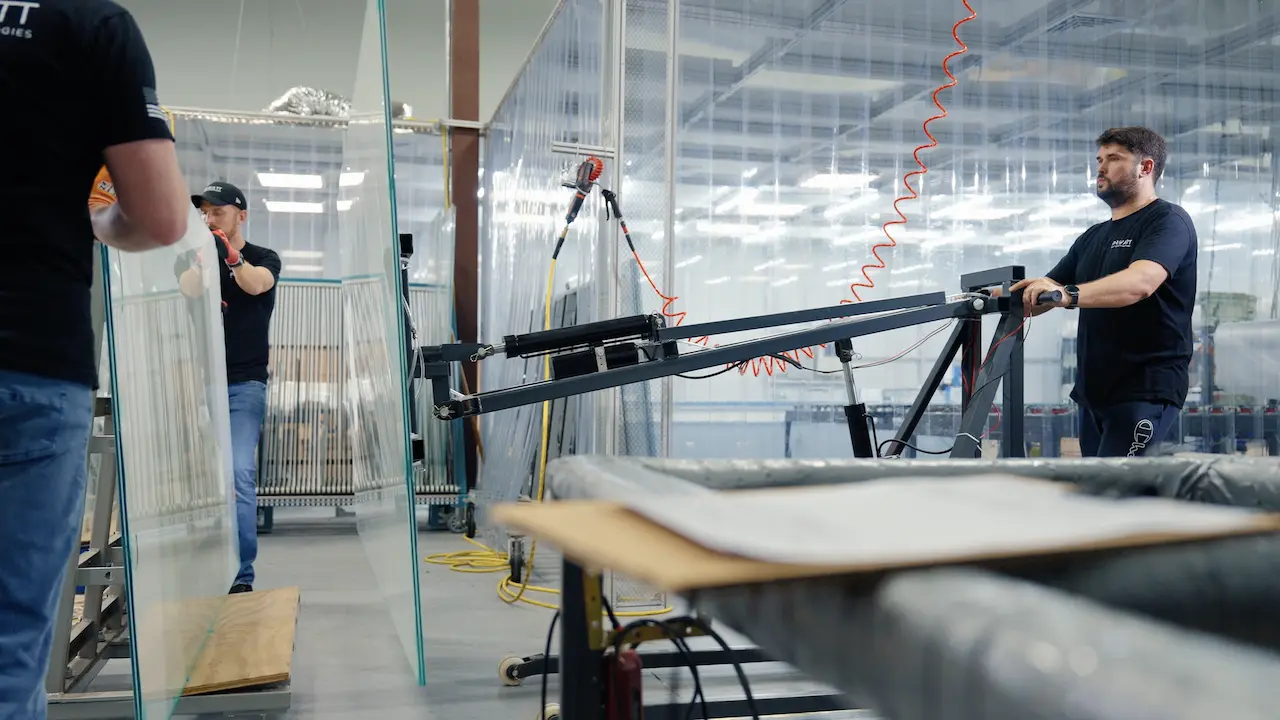
Where it is made
Manufactured in Pompano Beach, Florida
The panels are laminated, wired, assembled and tested in Florida. Lead times are a schedule, not an estimate, because the plant is here; a unit that has to be adjusted or replaced is remade here; and the person who answers a technical question is in the same building as the line.
The components come from where the best ones are made. The glass is American, and so are the busbars: the part PriWatt holds the patents on, and the connection the whole panel depends on. The isolation transformers are German. The liquid-crystal film and dozens of smaller components are imported. So the accurate claim is the qualified one: made in the USA from domestic and imported components. On a federal job that sentence is worth more than a badge, because it is the sentence that survives being checked.
The submittal and the website have to agree
Switchable glass is bought by hospitals, universities, transit authorities and federal agencies. Every one of them eventually sends a form asking where the product is made, and the answer goes into a contract. A supplier whose website says one thing and whose certificate of origin says another has a problem that no amount of marketing fixes.
PriWatt would rather publish the position than defend it later. Below is what the three procurement frameworks actually ask. None of it is answered by a flag on a homepage.
What each rule turns on
| Framework | Where it applies | What it actually asks |
|---|---|---|
| Buy American Act (FAR) | Direct federal purchases and federal construction | Was the end product manufactured in the US, and does the cost of its domestic components clear the current threshold — a calculation, per product |
| Trade Agreements Act | Federal buys above the TAA threshold, GSA schedules | Is the end product from the US or a designated country, or substantially transformed in one — a determination against the actual product and the actual clause |
| Build America, Buy America | Federally funded infrastructure | For glass as a construction material, whether all manufacturing processes occurred in the United States |
| FTC Made in USA Labeling Rule | What may be claimed in advertising | An unqualified claim requires all or virtually all components to be domestic; a qualified claim states the imported content, as this page does |
These are four different questions with four different answers, and the answer to each depends on the panel schedule, the clause in the contract and the project. That is why this page does not carry a compliance badge. A badge is not evidence, and a contracting officer knows it.
A written answer about your project
A statement for the panel schedule
Send the clause (the FAR reference is enough) with the panel schedule. The answer comes back in writing against that specific product and that specific contract, not as a general assurance.
The certificates, in full
UL file E514182, SGCC 9894, the three Intertek fire reports, the acoustic measurement and the CSI three-part specification, as documents, into the submittal.
A manufacturer, not a reseller
The questions a submittal raises are answered by the people who laminate the panel. A distributor reading a datasheet cannot tell you what a component cost breakdown contains.
A straight no, where that is the answer
If a project needs something PriWatt cannot document, you get told at enquiry stage, not at submittal stage. That is worth more than a badge on both sides.
The part that is not about paperwork
The commercial case for a US plant was never the origin of every screw. It is what happens when a project needs something:
- Lead times set by a schedule here, not by a container ship and a customs queue
- A panel that has to be remade to a corrected size is remade here, in days instead of months
- Shop drawings and a technical review before fabrication, with the plant in the conversation
- Sizes, shapes, cut-outs and hardware made to the opening instead of chosen from a catalogue
- A warranty administered by the company that made the panel, in the same country as the building
That is the difference between a manufacturer and an importer, and it holds whatever the bill of materials says. It is also why finished panels shipped in from overseas are a different proposition from panels laminated in Florida, a distinction the partner programme is built on.
The plant, and how it got here since 2016, is on about PriWatt; where the work has been covered is under news. The warranty referred to above is published in full.
Common questions
The panels are laminated, wired, assembled and tested in Pompano Beach, Florida, from domestic and imported components. The glass and the busbars are American, the isolation transformers are German, and the liquid-crystal film is imported.
That depends on the contract and the product. It gets answered in writing for a specific project, never claimed in general. The Trade Agreements Act asks whether the end product comes from the US or a designated country, or was substantially transformed in one, and the panel is manufactured in Florida. Send the clause and the panel schedule and you get the position for your project, in writing, against that contract.
The Buy American Act asks two things: whether the end product was manufactured in the United States, and whether the cost of its domestic components clears the current threshold. The first is yes. The second is a calculation against the actual panel schedule, so it is answered per project and not published as a claim.
No. The glass is American and so are the busbars, the patented anchoring system at the edge of every panel. The transformers are German, and the liquid-crystal film, the functional layer inside the laminate, is imported along with many smaller components. That is precisely why PriWatt publishes the qualified claim instead of an unqualified one, and why the origin question gets answered per contract and not with a badge.
Yes. Send the panel schedule and the contract clause you are working to, and the statement is issued against that project. It is the same route as the certificates and test reports, also supplied as documents and not as web pages.
Send the clause, not the question
The FAR reference and the panel schedule are enough to get a written position on your project. Pompano Beach, Florida; 1-866-PRIWATT (1-866-774-9288).