
Railings and balustrades
A terrace that closes without anything being put up
A glass guard is specified so that the view survives the requirement to have a barrier there. Then the terrace turns out to be overlooked, and everything added afterwards (a screen, a planter, a run of frosted panels) is visible every hour of the day for the few when it is wanted.
Switchable glass puts the privacy in the barrier. Reverse mode holds the view with no power drawn and frosts for the hour it is needed. That is the right way round for a guard that exists because of the view.
Two projects, both photographed
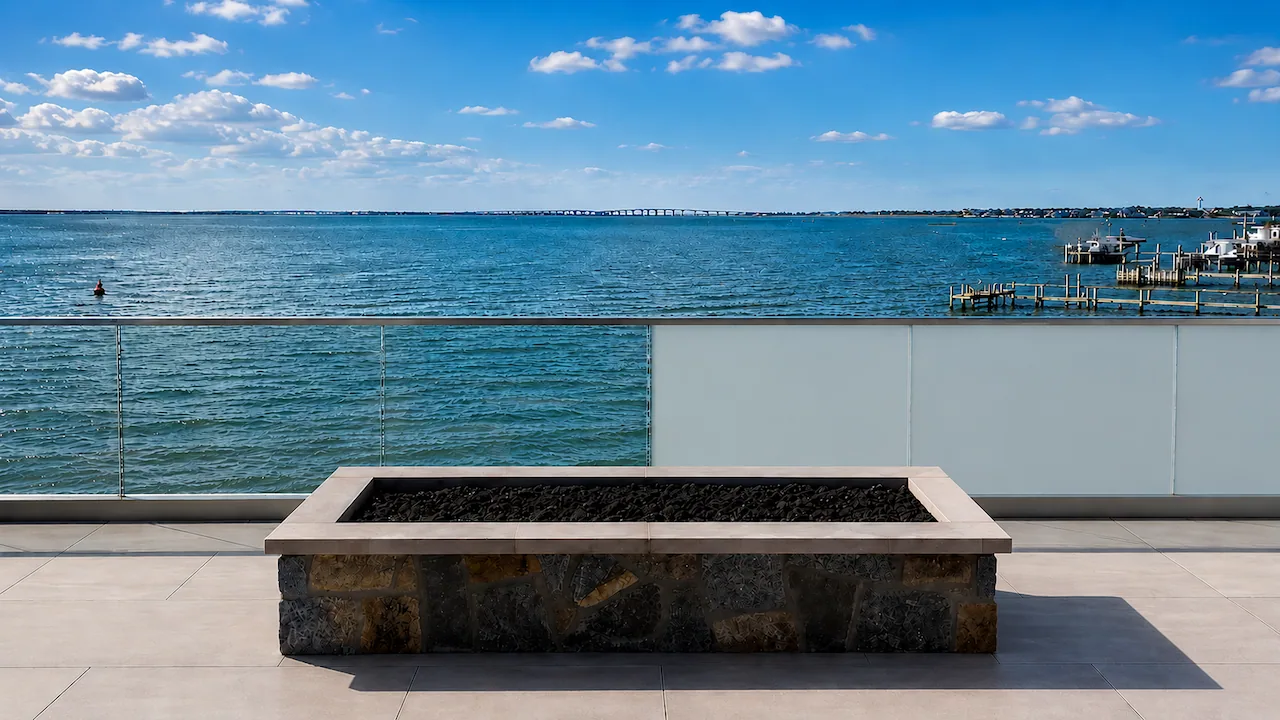
New York waterfront residence
Switchable privacy glass integrated into the exterior railing of a terrace designed around the water and the skyline. Clear it keeps the panorama and the frameless line; switched it frosts for a private terrace. Laminated safety glass engineered for exterior use, on low-voltage switching.
Read the project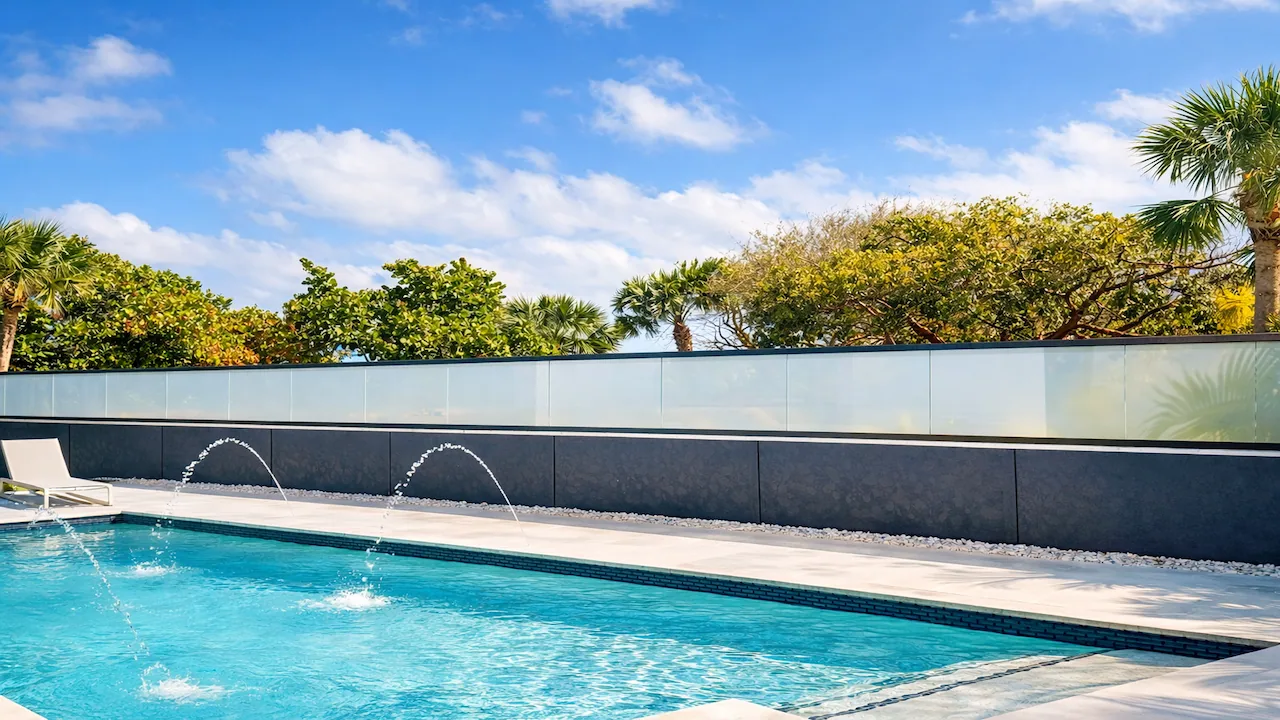
North Palm Beach residence
Reverse switchable glass around a pool deck and garden, in a house where the glazing is the architecture. The railing is transparent unpowered and private on demand, which is the state a pool deck is in for all but a few hours of the week.
Read the projectWorking on one now? Send the run length and the guard detail and we will price the panels themselves — a quotation with the schedule, the transformer and the lead time on it. Rate cards do not survive contact with a real opening. Still deciding? Start with twenty minutes with a project specialist.
Reverse mode, for the same reason the glass is there
A guard is glazed instead of solid so that something can be seen through it. A normal-mode panel would be frosted every hour it is not switched, and that undoes the specification; PNLC is clear with no power and draws under 0.5 W per square foot only for the time it is private.
| PNLC — reverse mode | PDLC — normal mode | |
|---|---|---|
| With no power | Clear | Private |
| Light transmission, clear | 91% glass · 90% film | 88–91% glass · 90% film |
| Switching to private | < 5 ms | < 200 ms |
| Power drawn holding the view | None | < 0.5 W/sq ft |
| Maximum panel | 57 × 143 in | 70 × 143 in glass · 72 × 143 in film |
| Suits a guard specified for the view | Yes — the default | Only where the barrier is private most of the time |
A 42-inch guard height in panels up to 57 inches wide sits well inside the PNLC limit, so the panel widths are set by the posts and the design, not by the product. Reverse mode is covered in full on the PNLC page, every measured value is in the technical reference, and what the safety-glazing certificate covers is on safety glazing.
What a barrier asks that a partition does not
It is a structural element first
A guard has to resist the loads the code puts on it, and that is engineered for the project with the railing system and its supplier. The switchable panels are laminated assemblies of low-iron glass, heat-treated or fully tempered, certified as safety glazing under SGCC 9894. The certificate goes into the submittal, and the barrier calculation is done against the actual system.
The wiring goes through the base
Every panel has a busbar and a tail, and on a railing that tail leaves at the bottom edge and runs inside the base shoe or the posts. Where it exits and how it is concealed is agreed on the shop drawing, before the panel and the railing system are made to fit each other.
The busbar is anchored
The patented anchoring system, US 11,686,966 B2 and CA 3,212,838, is what holds the busbar through the heat and pressure of lamination and the movement afterwards. On an exterior panel that is the connection most likely to be asked to work for twenty years.
Outside is a temperature range
The laminated products are published for -10 to 60 °C. A terrace in Florida is comfortably inside that; a cold-climate exterior is worth raising at technical review instead of assuming, and it is a question the plant answers, not a dealer.
Common questions
Yes. PriWatt has switchable privacy railings in service on a New York waterfront terrace and around a North Palm Beach pool deck, both built as laminated safety glass for exterior use on low-voltage switching. The barrier itself is engineered for the project, as any structural glass guard is.
Reverse mode, in almost every case. A glass guard exists so that the view survives the barrier, so the state it should hold with no power is the clear one, and the panel then draws power only for the time it is private.
Through the base shoe or the posts. The panel runs at low voltage from an isolation transformer sized to the run; where the tail leaves the glass and how the run is concealed is drawn before fabrication, with the railing system.
The laminated switchable products carry SGCC 9894 and the electrical system is evaluated under UL file E514182. Both certificates are available in full. What a particular guard requires structurally is set by the code and confirmed by the engineer of record against the railing system.
A reverse-mode railing goes clear, its unpowered state, and stays a laminated safety-glass barrier throughout. The switchable layer has no structural role. Exterior exposure and the published -10 to 60 °C operating range are reviewed against the specific location before the panels are made.
Guards in service
Ocean-front villa, Los Angeles
A switchable fence in low-iron tempered EVA laminate, on a house automation schedule.
North Palm Beach residence
Eighty feet of reverse smart glass railing: clear over the water, private around the pool.
New York waterfront
Switchable privacy built into a terrace railing. Uninterrupted views by default. Privacy on demand.
Built from the same six products
Office partitions
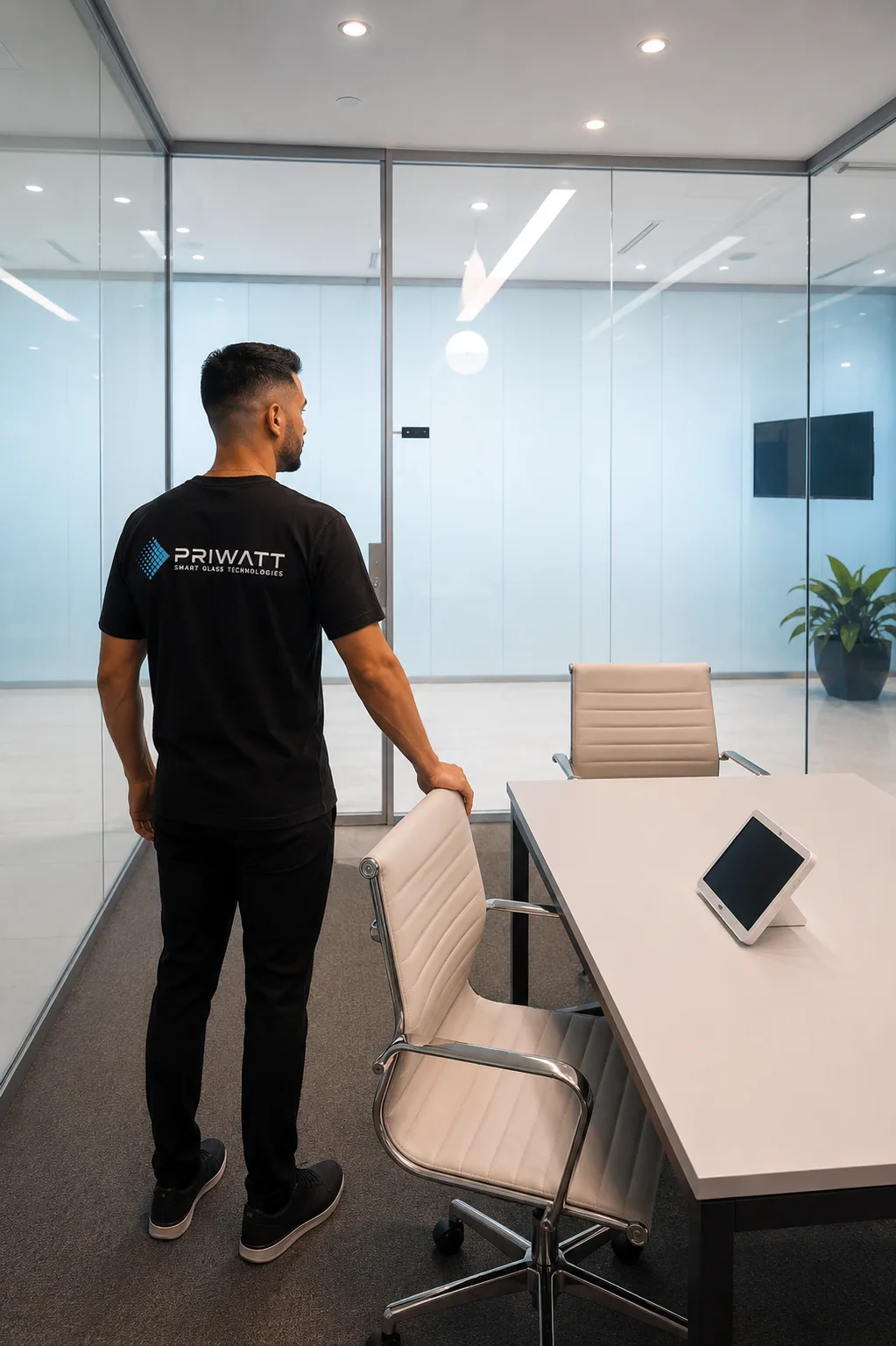
A wall of glass, not one panel: where the joints fall, whether the run switches together, and how a door in the middle is matched to the panels beside it.
Read more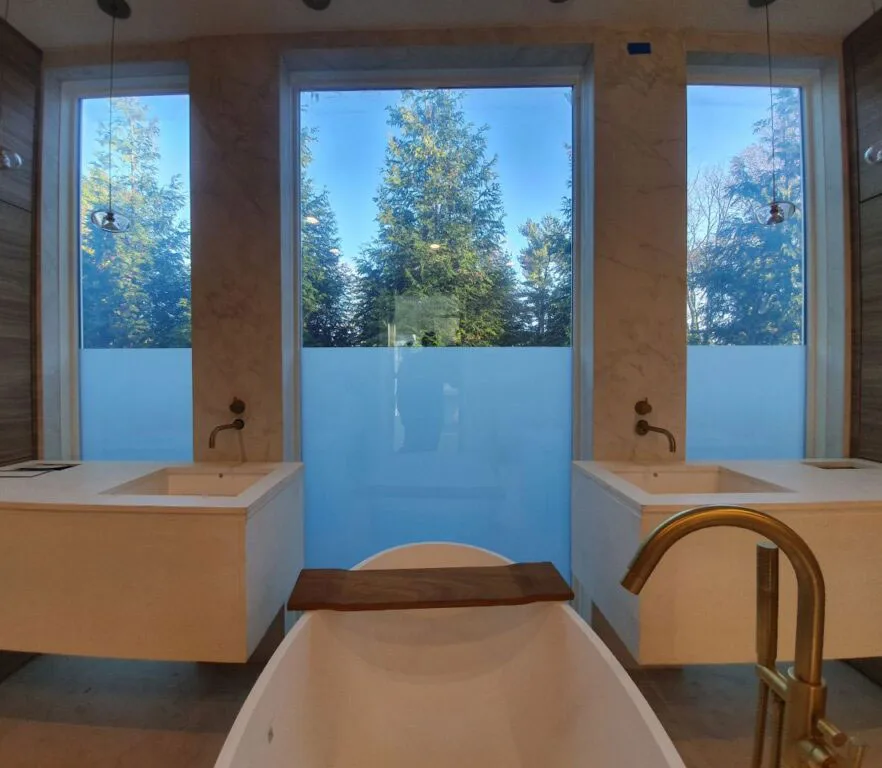
Windows
A window exists to be looked through, so reverse mode is usually the answer. And the honest limit: a switchable window frosts, it does not go dark.
Read more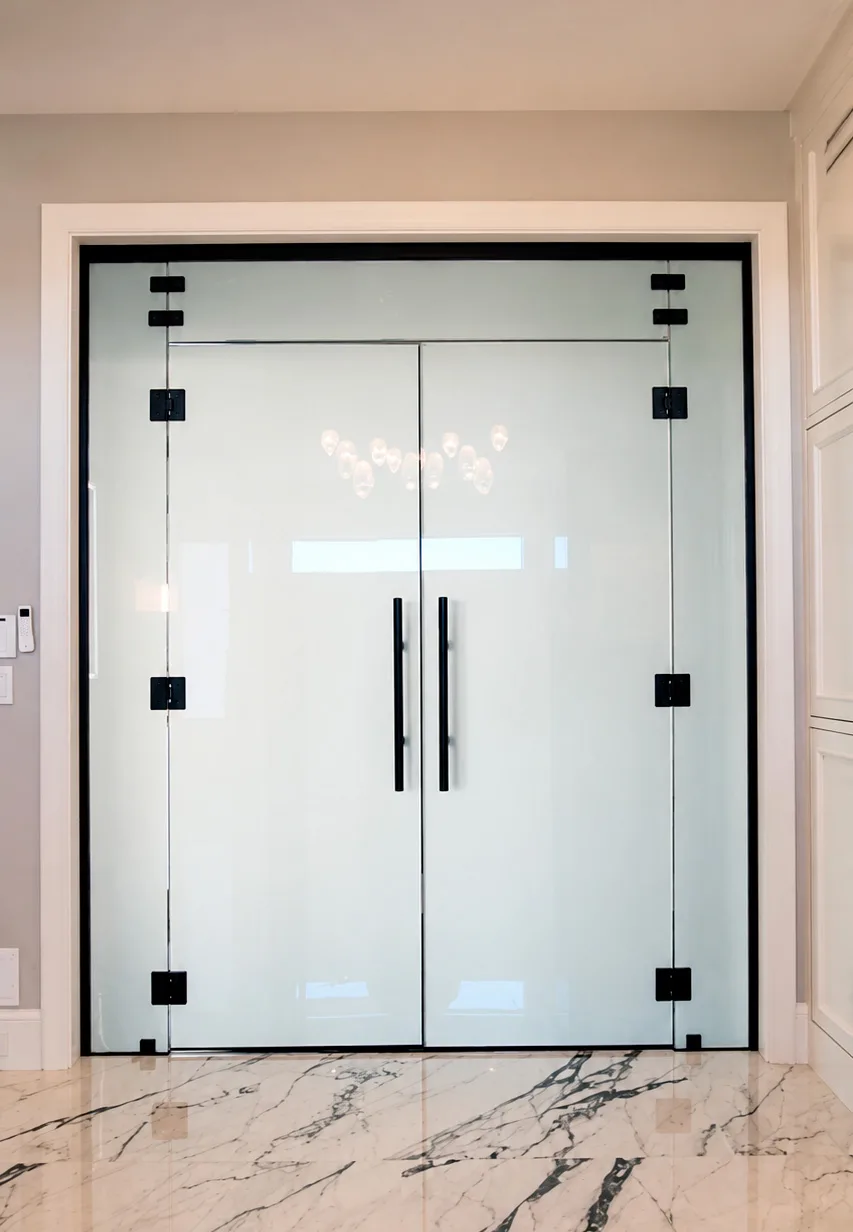
Doors
The one format where the glass moves, so the wiring becomes the detail and not the panel. Internal doors, entrances and glazed leaves in a partition run.
Read more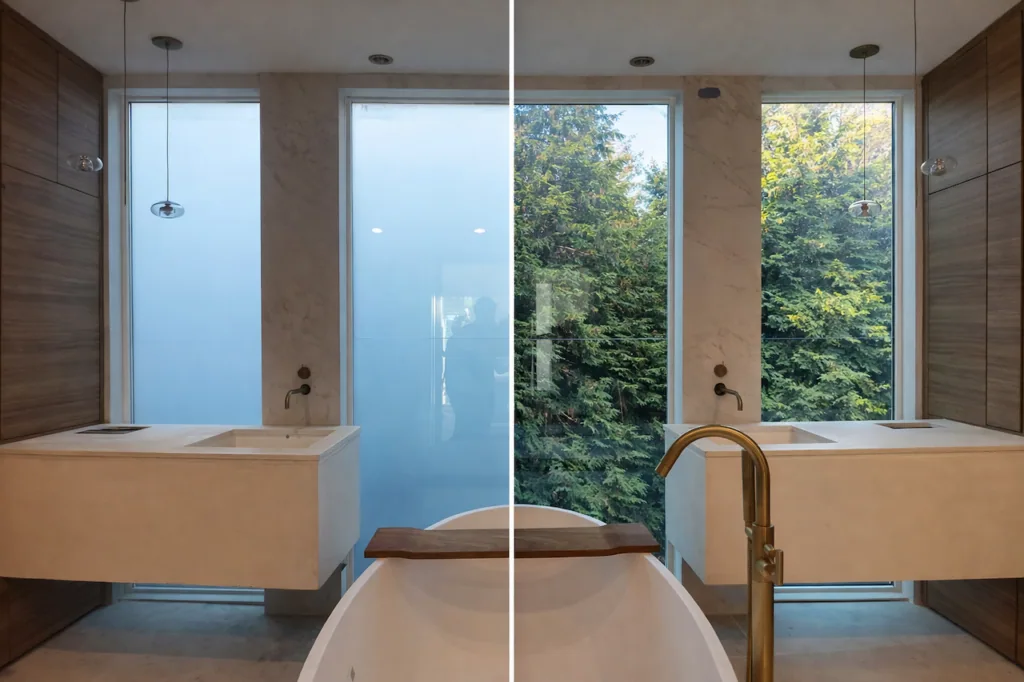
Shower enclosures
The room where the glass is the wall. Normal mode is frosted with no power, so a power cut leaves the enclosure private, the failure state a bathroom wants.
Read more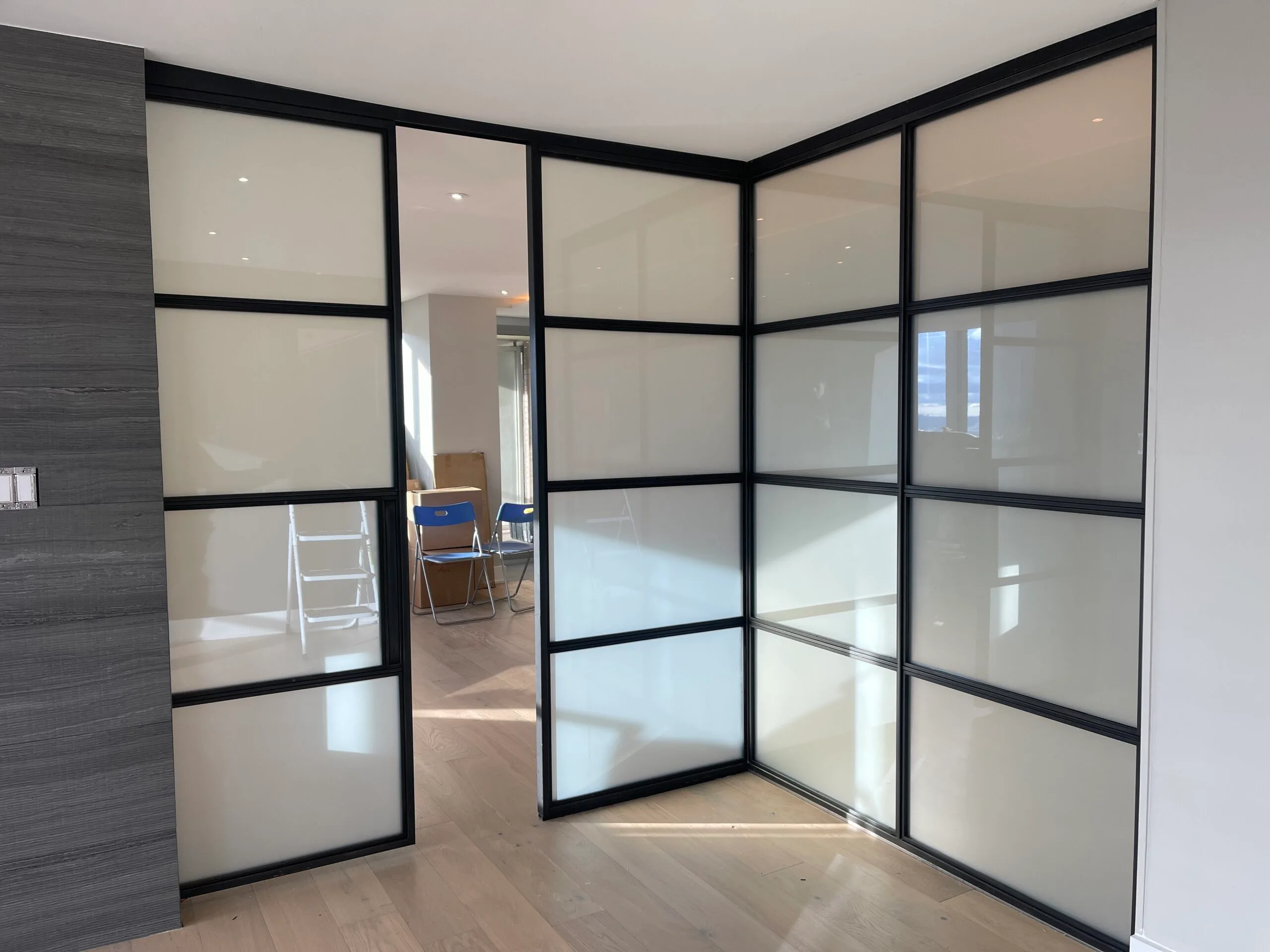
Room dividers
One room, or two. Fixed, sliding, stacking or folding. The question that belongs to this format alone is whether power has to reach a panel that moves.
Read more
Skylights and overhead glazing
Overhead, the problem is usually the sun, not the neighbours. DLC moves between a tinted transparent state and a deep dark one: glare and solar gain, not privacy.
Read more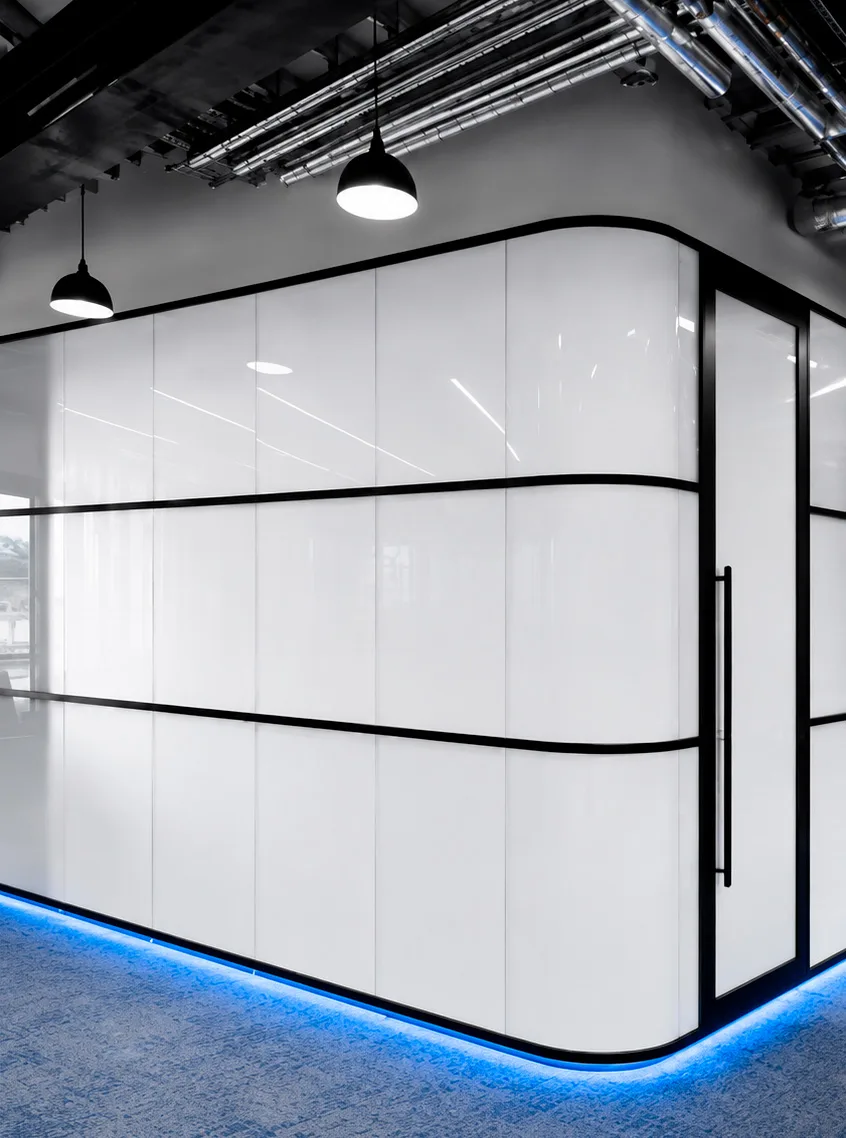
Specialized
Curves, display cases, cleanroom panels, studio sets and rear-projection surfaces. Rarely the shape that makes a project unusual; usually the edge, the movement or the duty cycle.
Read moreSend the opening, not the product code
Sizes, the shapes, whether the glass is already in the building and which state it should hold with no power. That is enough for a price and a lead time. Pompano Beach, Florida; 1-866-PRIWATT (1-866-774-9288).