
Patents & Certifications
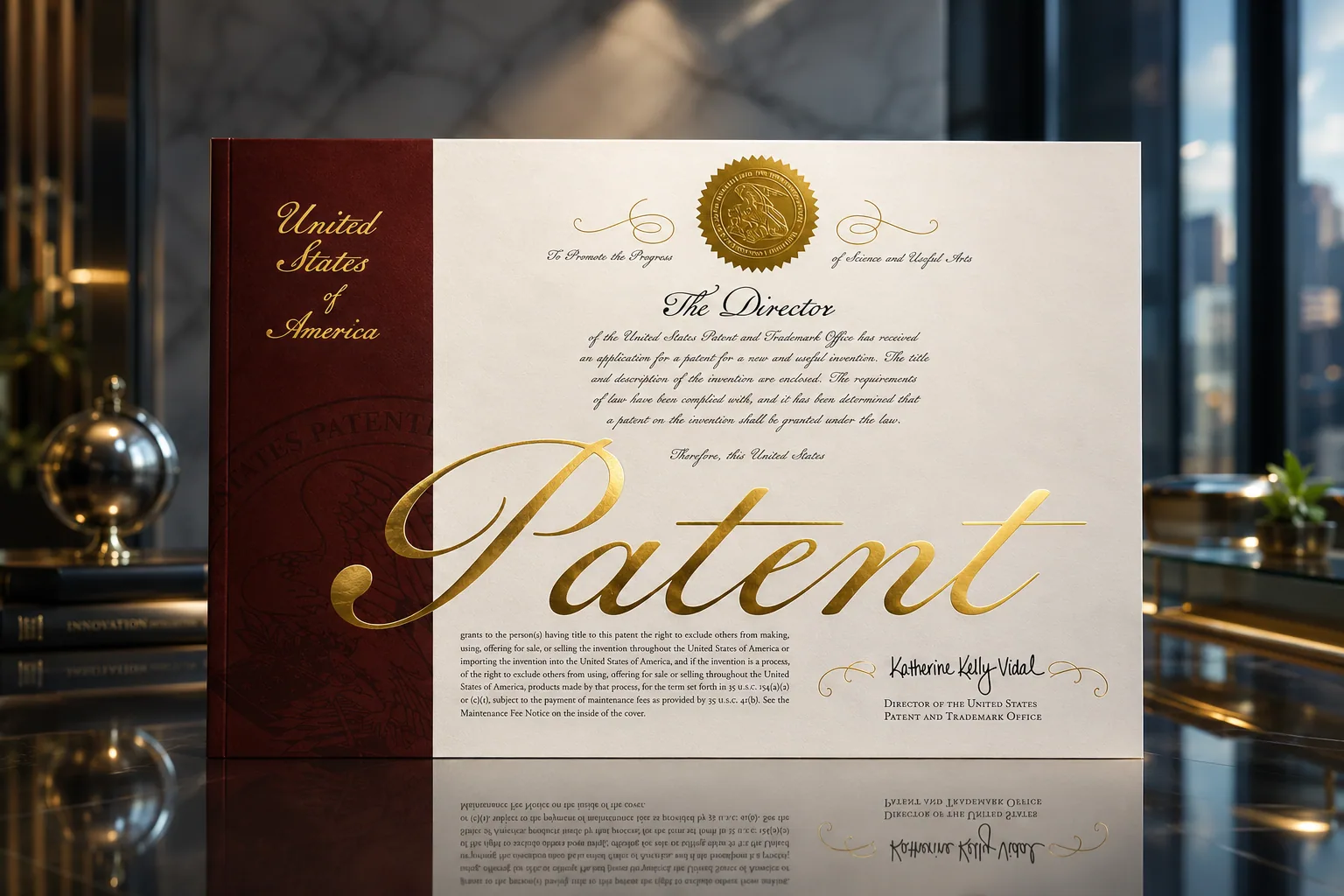
Patented Busbar Anchoring System
The PriWatt Busbar Anchoring System is a patented innovation developed to reinforce the electrical connection within switchable glass and PDLC film assemblies.
Designed to address challenges associated with electrical connection integrity, the system introduces a proprietary anchoring method that helps protect critical connection points from mechanical stresses encountered during manufacturing, transportation, installation, and normal operation.
Protected under U.S. Patent No. 11,686,966, this technology reflects PriWatt's commitment to advancing smart glass engineering through practical innovations focused on reliability, durability, and long-term performance.
Canadian Patent
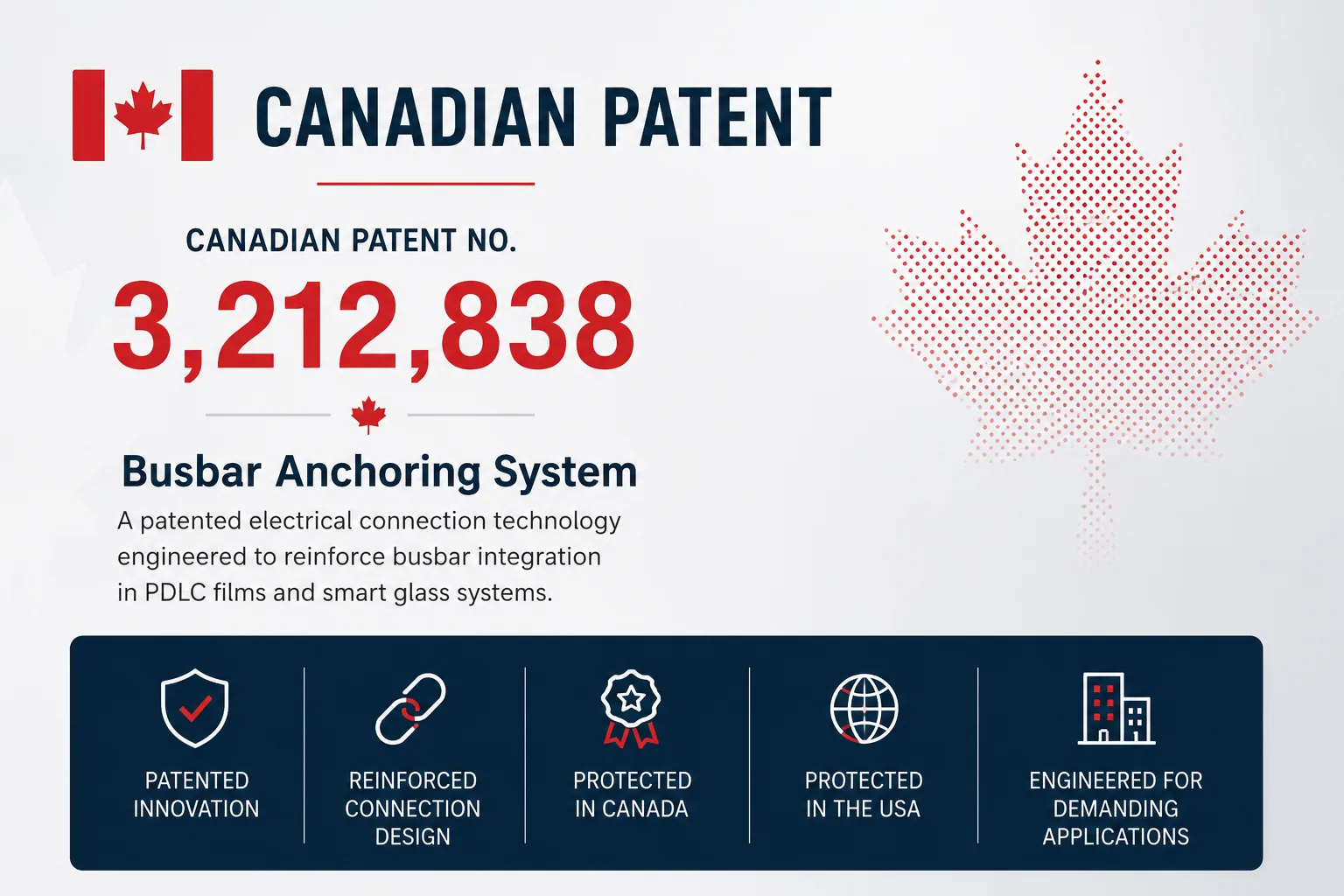
The PriWatt Busbar Anchoring System is protected under Canadian Patent No. 3,212,838, recognizing an innovative approach to electrical connection anchoring within PDLC film and switchable glass systems.
Developed to address challenges associated with electrical connection integrity, the patented technology introduces a proprietary anchoring method designed to reinforce critical connection points and support long-term product reliability.
The patent reflects PriWatt's commitment to advancing smart glass technology through practical engineering solutions focused on durability, performance, and manufacturing excellence.
Protected in both Canada and the United States, the PriWatt Busbar Anchoring System represents a key innovation within our switchable glass product portfolio and demonstrates our ongoing investment in research, development, and intellectual property.
UL Certification
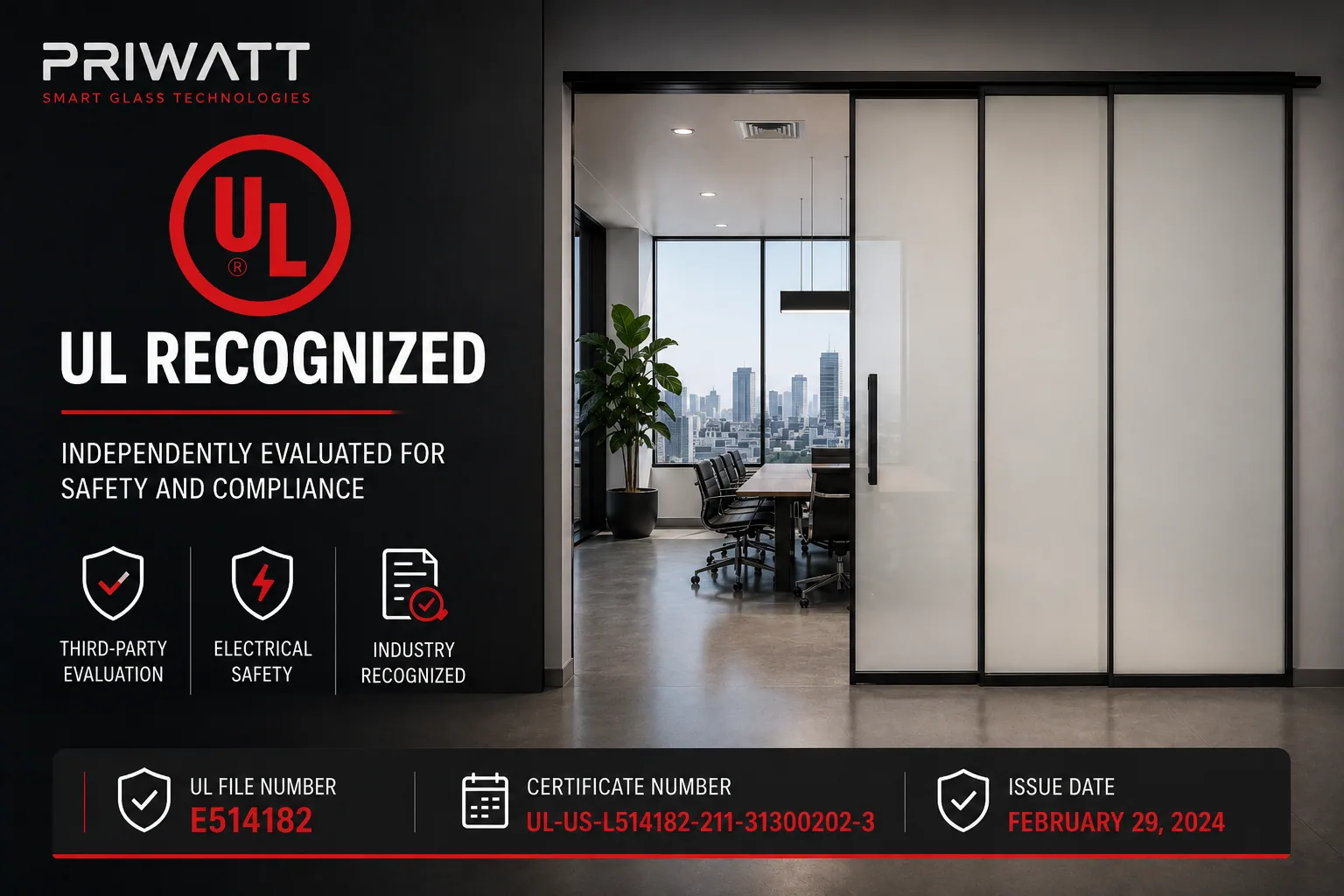
At PriWatt, product performance begins with verified engineering and independent third-party evaluation.
Representative samples of PriWatt switchable glass and PDLC film products have been evaluated by UL Solutions in accordance with applicable UL requirements and standards. This recognition provides architects, designers, contractors, and building owners with additional confidence in the safety and quality of PriWatt technology.
UL is one of the world's most respected safety science organizations, helping verify that products meet established requirements for safety, construction, and performance.
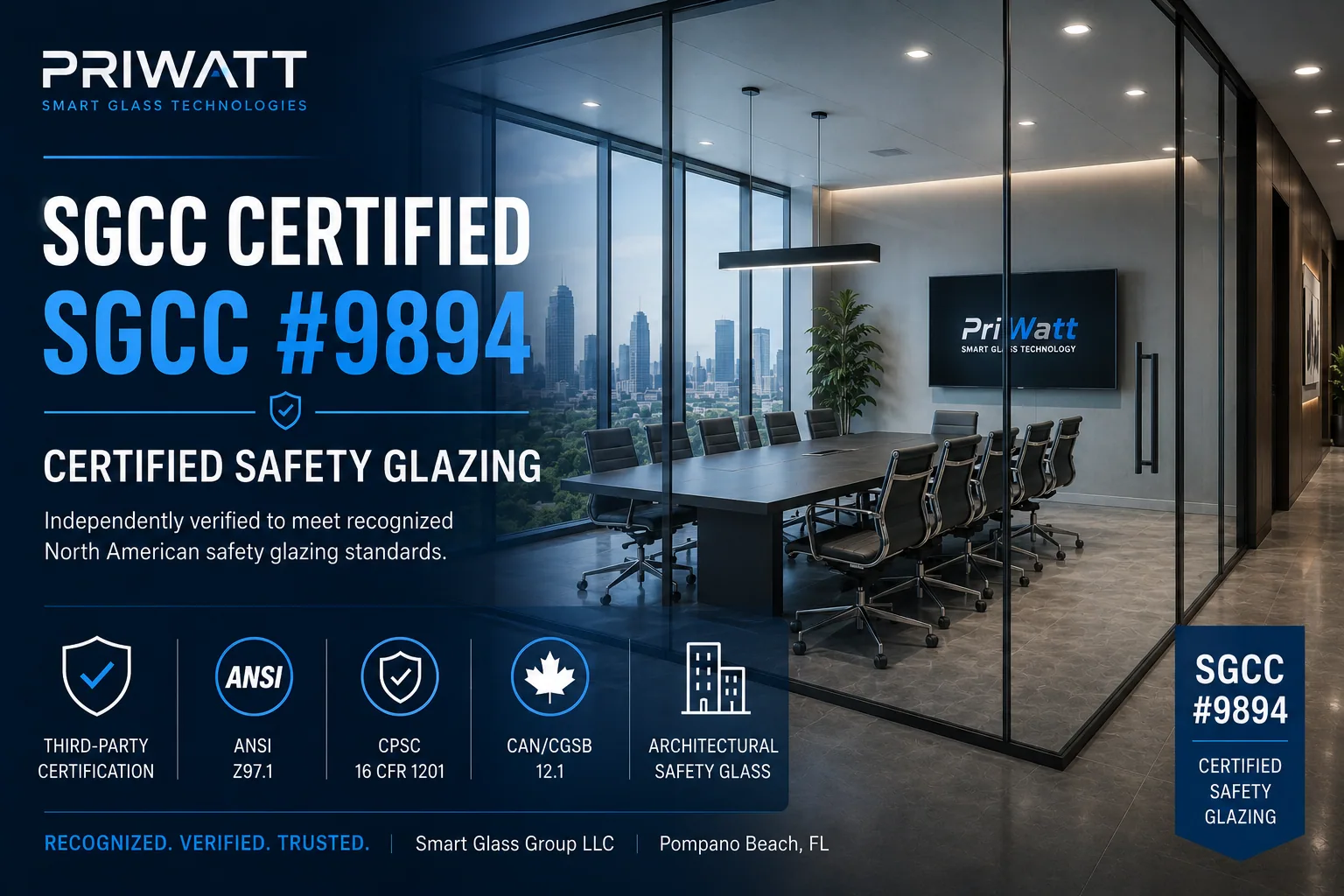
SGCC Certified Safety Glazing
Quality, safety, and compliance are fundamental to every PriWatt glass system.
Smart Glass Group is a licensed participant in the Safety Glazing Certification Council (SGCC®) certification program. Representative samples of certified products have been tested and verified to meet applicable safety glazing requirements established by recognized North American standards.
SGCC certification provides architects, specifiers, glazing contractors, and building owners with confidence that certified products are subject to ongoing compliance verification and quality control requirements.
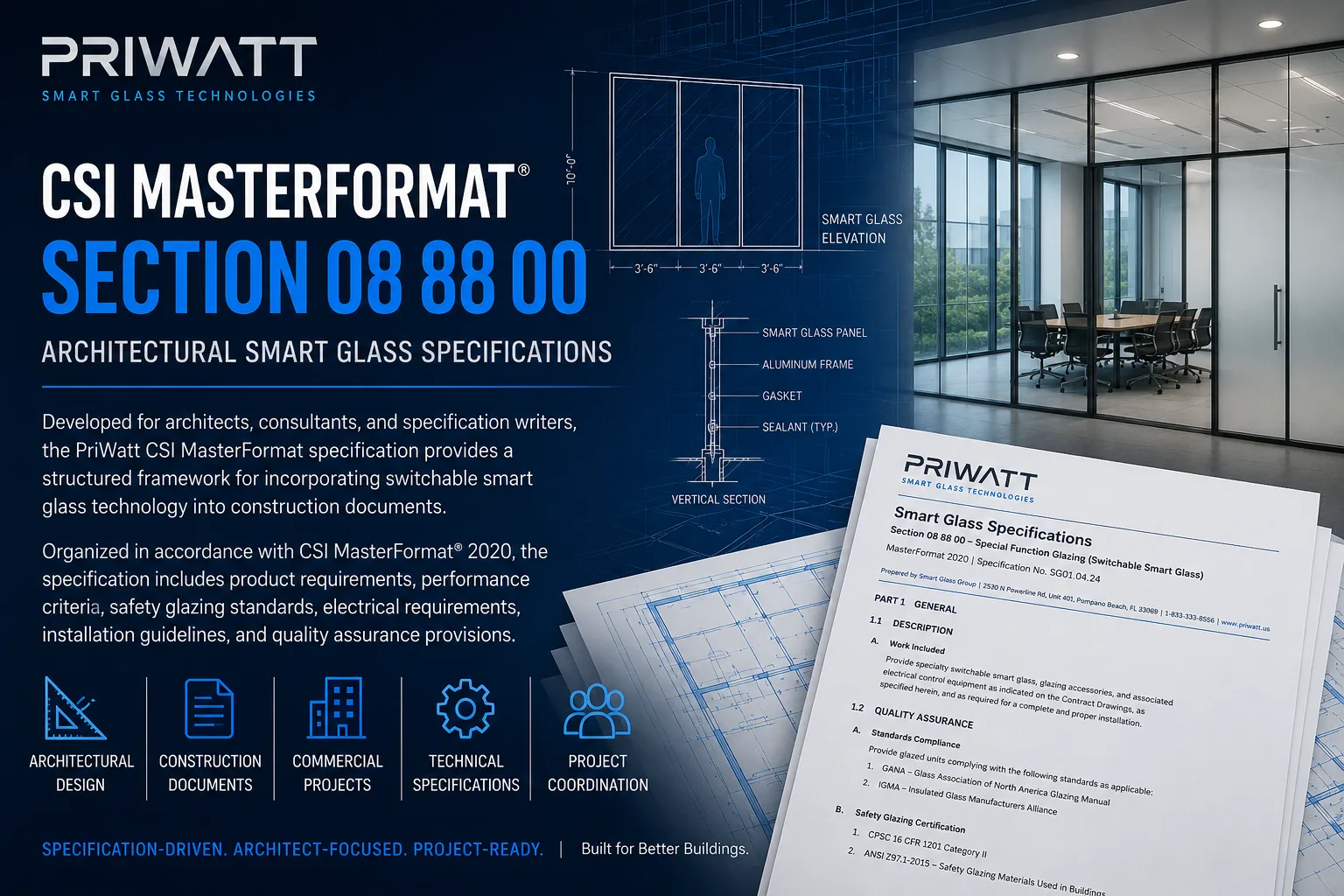
Architectural Smart Glass Specifications
Developed for architects, consultants, and specification writers, the PriWatt® CSI MasterFormat specification provides a structured framework for incorporating switchable smart glass technology into construction documents.
Organized in accordance with CSI MasterFormat® 2020, the specification includes product requirements, performance criteria, safety glazing standards, electrical requirements, installation guidelines, and quality assurance provisions for PriWatt PDLC, PNLC, and DLC smart glass systems.
Whether designing healthcare facilities, commercial interiors, conference rooms, residential projects, or specialty glazing applications, the PriWatt specification simplifies project documentation while supporting accurate product selection and project coordination.
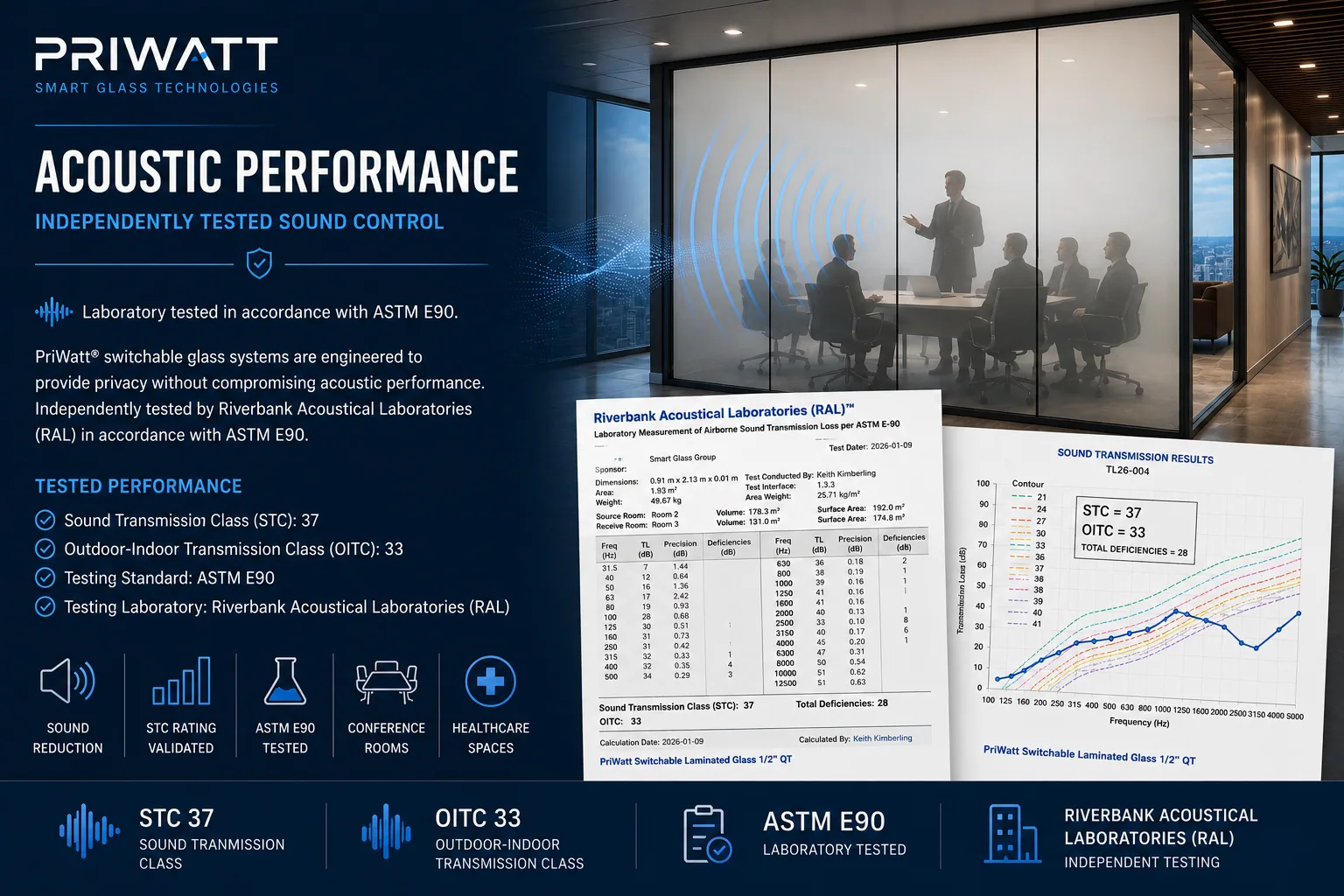
Independently Tested Sound Control
PriWatt® switchable glass systems are engineered to provide privacy without sacrificing acoustic performance.
Representative glass assemblies have undergone independent laboratory testing to evaluate airborne sound transmission performance in accordance with recognized industry standards.
Testing was conducted by Riverbank Acoustical Laboratories (RAL), one of North America's leading acoustic testing facilities, utilizing ASTM E90 procedures for laboratory measurement of airborne sound transmission loss.
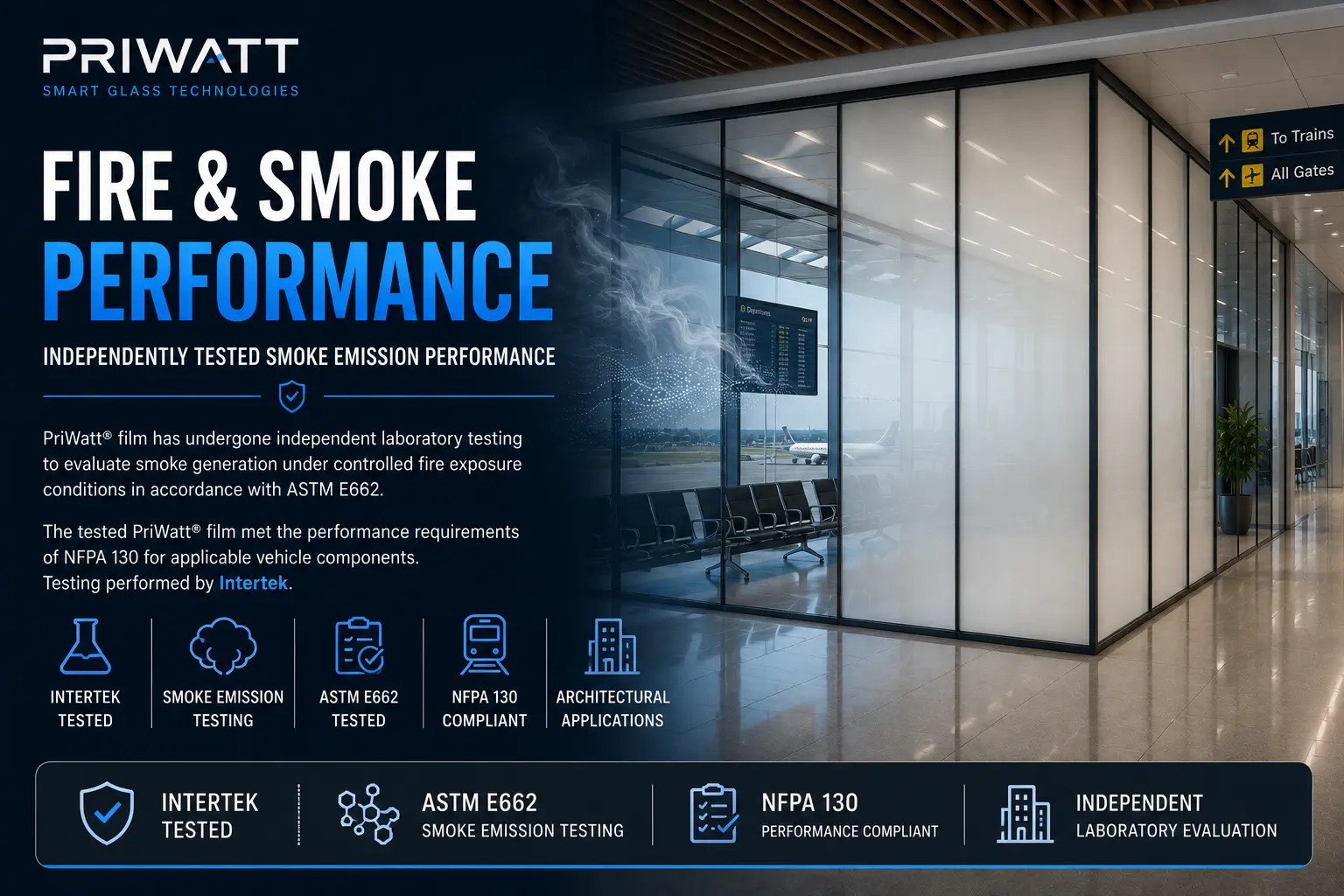
Independently Tested Smoke Emission Performance
PriWatt® film has undergone independent laboratory testing to evaluate smoke generation characteristics under controlled fire exposure conditions.
Testing was performed by Intertek in accordance with ASTM E662, Standard Test Method for Measurement of Smoke Obscuration Using a Conical Radiant Source in a Single Closed Chamber. The evaluation measured smoke density in both flaming and non-flaming conditions to assess material performance during fire exposure.
The tested PriWatt® film successfully met the performance requirements of NFPA 130 for applicable vehicle components, demonstrating compliance with established smoke emission criteria.
Independently Tested Fire Growth Characteristics
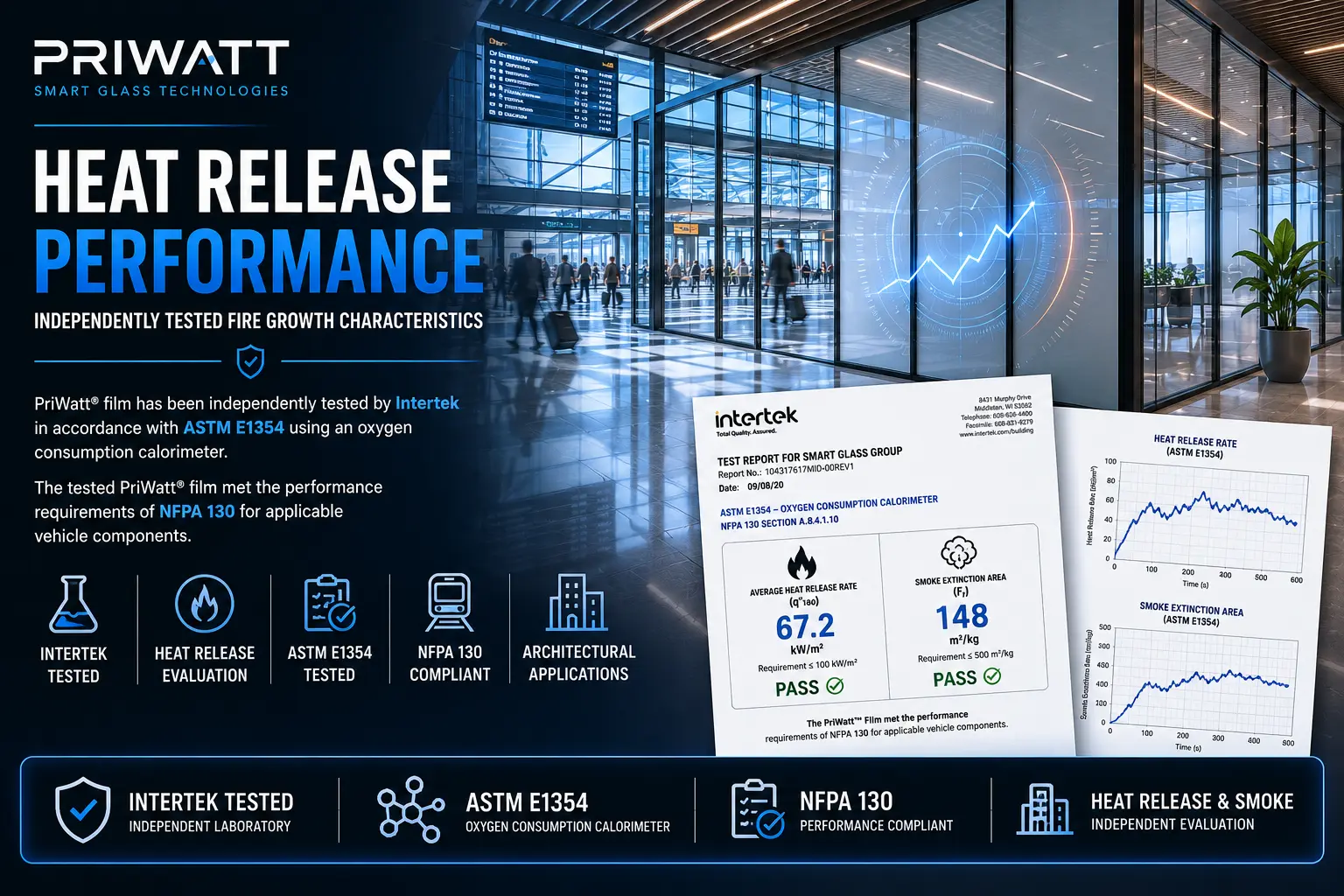
PriWatt® film has undergone independent laboratory testing to evaluate heat release and visible smoke generation under controlled fire exposure conditions.
Testing was performed by Intertek in accordance with ASTM E1354, a recognized test method utilizing oxygen consumption calorimetry to measure fire growth characteristics, heat release rates, and smoke production.
The tested PriWatt® film satisfied the applicable NFPA 130 performance criteria, demonstrating heat release and smoke generation values within the required limits for the evaluated application.
Toxic Gas Analysis
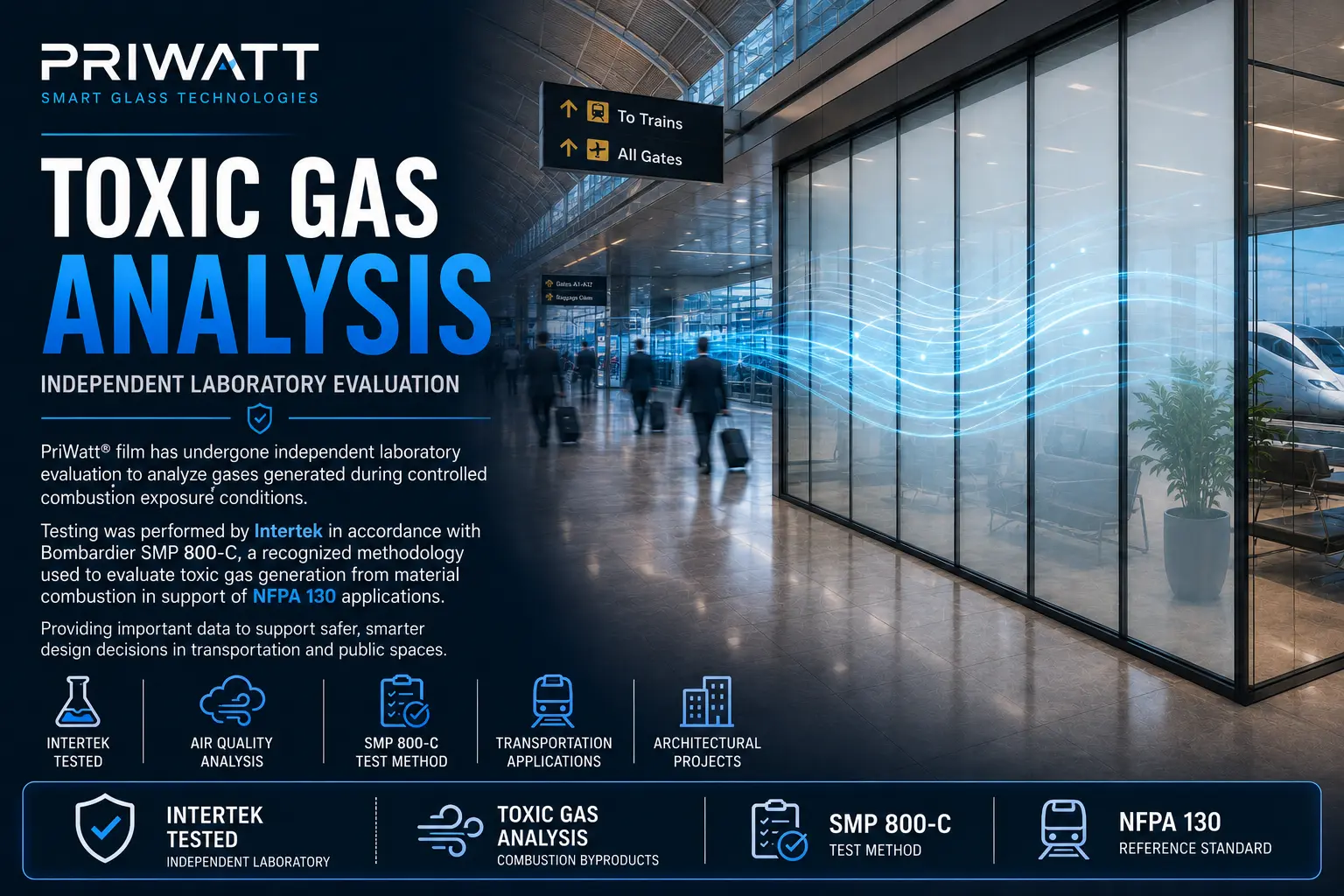
PriWatt® film has undergone independent laboratory evaluation to analyze gases generated during controlled combustion exposure conditions.
Testing was performed by Intertek in accordance with Bombardier SMP 800-C, a recognized methodology used to evaluate toxic gas generation from material combustion. The analysis measured multiple combustion byproducts, including carbon monoxide, hydrogen chloride, hydrogen cyanide, hydrogen bromide, hydrogen fluoride, nitrogen oxides, sulfur dioxide, and other gases relevant to transportation and public occupancy applications.
The testing provides engineers, consultants, and project stakeholders with additional data regarding combustion-generated gas emissions under controlled laboratory conditions.
The certificates and test reports, in full
Fourteen documents: the UL and SGCC certificates, the CSI three-part specification for MasterFormat 08 88 00, four independent test reports, four CAD details as PDF and DXF, two data sheets and the electrical installation guide. Ask for the ones you need and the links arrive by email.
| Document | What it covers |
|---|---|
| UL certification — file E514182 | The electrical system, evaluated by UL Solutions |
| SGCC certificate 9894 | Safety glazing certification for the laminated products |
| CSI specification — 08 88 00 | The three-part spec, ready to edit into a project manual |
| Acoustic performance — STC 37, OITC 33 | Airborne sound transmission measured to ASTM E90 at Riverbank |
| ASTM E662 | Smoke density — met NFPA 130-17, flaming and non-flaming |
| ASTM E1354 | Heat release 52.29 kW/m² and smoke 483.18 m²/kg, both inside the limits |
| Bombardier SMP 800-C | Toxic gas generation — HCN, HCl, HF, HBr, NOx and SO₂ not detected |
| CAD — laminated glass make-up | Isometric, section, glass thickness table and the film types — PDF and editable DXF |
| CAD — film on existing glazing | Retrofit assembly, film section with layer thicknesses, both busbar types — PDF and DXF |
| CAD — wiring schematic | Supply, transformer and panels, with the NFPA 70 requirements — PDF and DXF |
| CAD — maximum panel sizes | Dimensioned size limits, per panel type — PDF and DXF |
| Isolation transformers | Ratings and dimensions for the units that drive the panels |
| Electrical connection guide | Supply, busbar locations, panel chaining, wiring diagrams and the sixteen installation requirements |
| PNLC reverse glass brochure | The reverse-mode product and where it is specified |
Request the documents
Tell us who you are and which documents you need. The links are sent to the address you give and stay valid for seven days.
The detail behind each of these
The patented busbar anchoring system
How the connection is secured inside the film, and why the edge decides how long an installation lasts.
Smart film without UL
What UL certification covers, and how to check a file number for yourself in two minutes.
Safety glazing and the code
Where the code requires it, what SGCC 9894 covers, and why film on existing glass is a different question.
No SGCC certification?
What SGCC tests, the standards behind it, and who carries the liability when glass is not certified.
If you are specifying it now
Send the drawings
Dimensions or an elevation come back as a panel schedule, a transformer and a lead time.
Twenty minutes on the specification
Which certificates apply in your location, and which of the thirteen documents you need.
Every published value
Panel limits, switching, VLT and haze, power draw, cycle life, temperature range.