Smart Film Without UL? What You’re Really Buying
Ask a supplier for a price on switchable film and you will have one within hours. Ask whether the product is UL certified and the reply slows down. That is the answer, arriving slowly.
Ask it first. A large share of the smart film sold today is cut and assembled outside controlled manufacturing conditions, in small-scale operations that finish a roll to order. The film may look identical on a sample board. It is not the same product.
What UL certification actually covers
Switchable film is not a decorative laminate. It is an electrified system bonded to glass, in a building, usually above people’s heads. Certification is what tests it as one:
- Electrical safety: the part that matters most and gets checked least
- The construction of the assembly that carries the current
- Reliable operation under real conditions, not on a bench
And certification is not a single test that a product passes once. It carries a way of making things with it:
- A controlled manufacturing environment
- A consistent production process, batch to batch
- Ongoing inspection and continued compliance
None of that exists in an informal production setup. That is the real difference between two rolls of film that quote within a few per cent of each other.
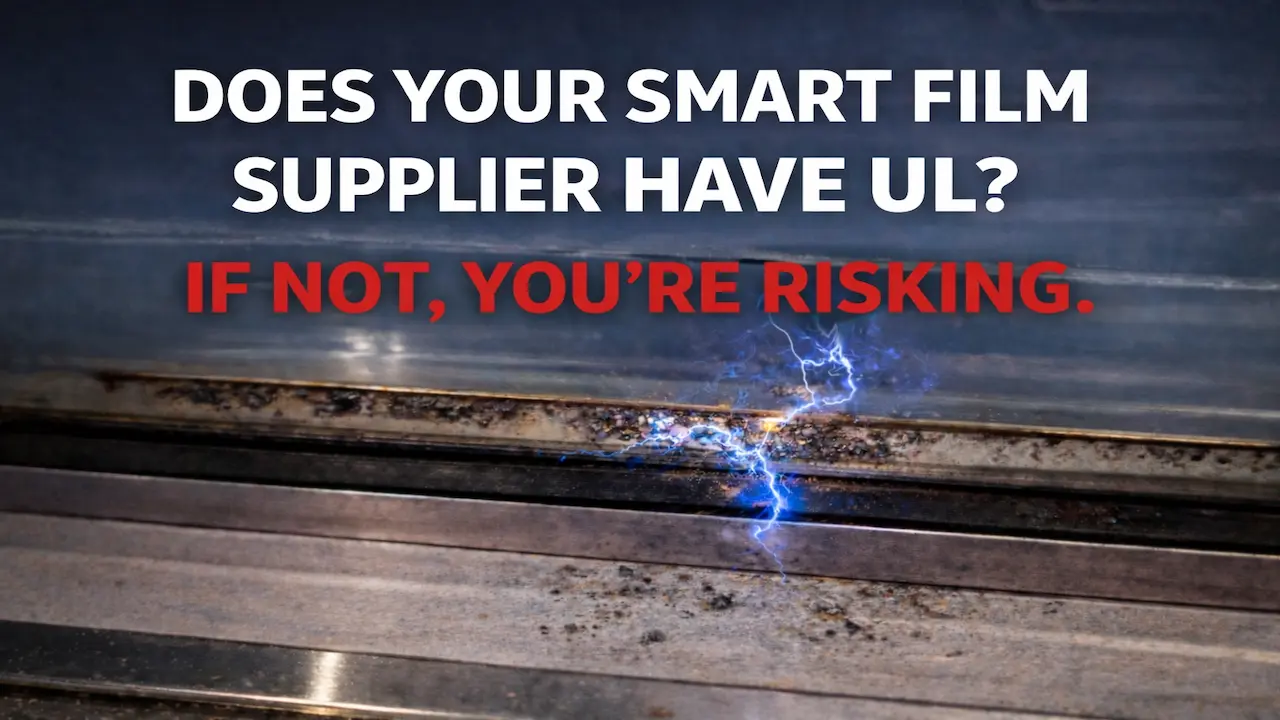
Where switchable film fails: the busbar
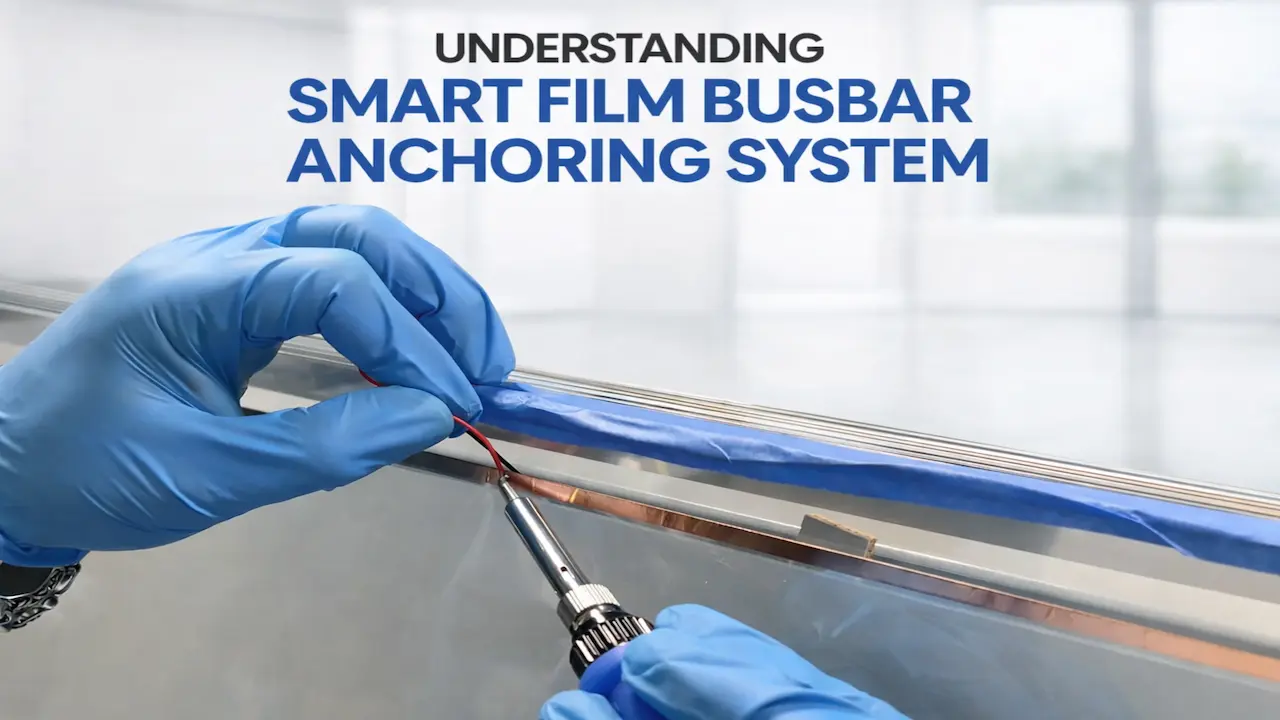
The busbar is the conductive edge that distributes power across the film. It is the least visible part of the product and the part that decides how long it lives. When it is not properly engineered and anchored:
- Switching becomes inconsistent across the panel
- Reliability falls away over months instead of years
- Electrical stability at the edge is compromised
PriWatt’s anchoring system is patented for exactly this: it secures the connection inside the film, holds contact as the assembly ages, and removes the edge failure that ends most switchable installations.
The patented busbar anchoring system
How the connection is made, and why the edge is where film usually fails.
Patents and certifications
What PriWatt holds, and what each certificate covers.
Working on one now? Send the specification you have been quoted against and we will price the panels themselves — a quotation with the schedule, the transformer and the lead time on it. Rate cards do not survive contact with a real opening. Still deciding? Start with twenty minutes with a project specialist.
Check it yourself, in two minutes
Do not take a claim on a datasheet. UL publishes its own database, and anyone can search it by supplier name or by file number:
Look up file E514182 in UL Product iQ
PriWatt’s UL file number is E514182. Type it in.
If a supplier cannot give you a file number, or the name does not appear in the database, the product is not UL certified. There is no third state.
Reading the entry once you have found it
A file number gets you to a record. The record then tells you two things worth knowing, and most people stop before either of them.
The first is the category. UL certifies complete end products, and it separately recognises components: parts intended to go into a larger assembly that somebody else finishes. Switchable film is a component by nature: it becomes part of a glazed assembly built by a fabricator or an installer. So the useful question is not whether the words “UL certified” appear in an email. It is what the file actually lists, and whether the thing you are buying is inside that scope.
The second is the company name on the file. Film is often sold by an intermediary who quotes somebody else’s certification. If the name on the record is not the name on your quotation, ask how the two are related before you go further.
What the file does not cover
This is where the certification argument usually overreaches, so be exact. A UL file on an electrical system says nothing about how the glass breaks, and nothing about what the material does in a fire. Those are separate certificates from separate bodies, and a supplier who answers all three questions with one file number has not answered two of them.
| The question | Who answers it | What PriWatt holds |
|---|---|---|
| Is the electrical system safe | UL Solutions | File E514182 |
| Is the glazing certified safety glazing | Safety Glazing Certification Council | SGCC 9894, on the laminated products |
| What does the material do in a fire | Intertek, to ASTM E662, ASTM E1354 and Bombardier SMP 800-C | Met NFPA 130-17 for smoke; 52.29 kW/m² heat release against a 100 limit |
| How is the connection held for twenty years | Nobody certifies this. It is engineering | Patented busbar anchoring, US 11,686,966 B2 and CA 3,212,838 |
The last row is the one without a certificate behind it, and the one that decides whether a panel is still switching in year eight. Certification is a floor. It is not a substitute for how the thing is built.
The detail sits on safety glazing and on fire, smoke and toxicity, with the reports themselves supplied as documents.
One question, before the price
“Do you have UL certification, and what is the file number?” A certified manufacturer answers it in a sentence. Anything vaguer than a number is the answer you were looking for.
Common questions
Yes. The electrical system is covered by UL file E514182, evaluated by UL Solutions. The number is published here so that it can be checked in UL Product iQ instead of taken on trust.
Search UL Product iQ by file number or by company name. If the supplier cannot give you a file number, or the company name does not appear, the product is not certified. Check the name on the record as well: film is often sold by an intermediary quoting somebody else’s file.
No. UL covers the electrical system. Safety glazing is certified separately by SGCC, and PriWatt laminated products carry SGCC 9894. A supplier who answers both questions with one file number has answered one of them.
No, and this is commonly muddled. Material fire performance is tested independently. PriWatt film was tested at Intertek to ASTM E662, ASTM E1354 and Bombardier SMP 800-C against NFPA 130, and those reports are supplied in full. They are not the UL file.
It is the conductive edge that carries power across the panel, and where switchable film usually fails: switching becomes patchy across the surface, then unreliable. Nothing certifies how well a busbar is anchored, so PriWatt patented its method instead of describing it in a datasheet.
Usually the reason is the way it is made. Certification carries a controlled manufacturing environment, a consistent process batch to batch, and continuing inspection. An operation that finishes a roll to order has none of those costs, and none of those checks.
Certified film, from the manufacturer
PriWatt film is made in Pompano Beach, Florida: UL file E514182, patented busbar anchoring, and a specification you can check before you buy.