PDLC Smart Glass IGU: Smarter Exterior Glass Systems
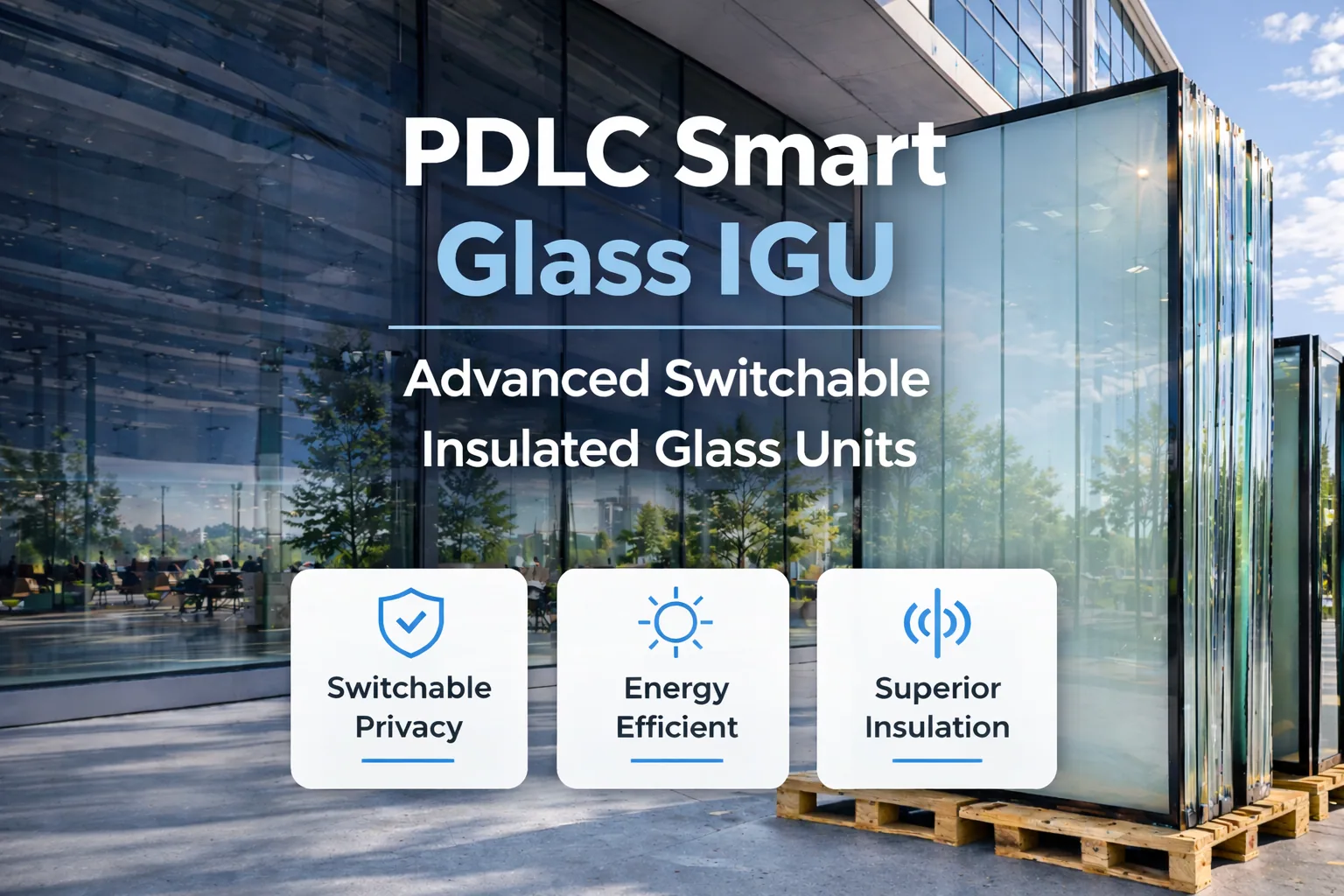
Switchable glass began as an interior product: partitions, meeting rooms, doors. Putting the same technology inside an insulated glass unit moves it into the building envelope. The window itself controls the view out and the heat coming in.
That is the difference between a feature added to a room and a component of the facade.
What a switchable IGU is
An insulated glass unit is two or more panes with a sealed cavity between them, filled with air or gas. A switchable IGU is that same build-up with a PDLC interlayer inside it, so nothing about the glazing format changes. It is fabricated, handled and installed like any other unit in the schedule.
- Thermal insulation from the sealed cavity
- Acoustic performance from the multi-layer build-up
- Condensation control, as in any insulated unit
- And privacy that is switched, not hung in front of the glass
Powered, the unit is transparent. Unpowered, it is opaque with high diffusion, around 98% privacy. That is the state a facade spends its evenings in.
What it does for the building, not just the room
Privacy is the visible benefit. The one that shows up in the energy model is that a switchable IGU is still an insulated unit, and can be built like one:
- Solar heat gain reduced, when the unit is specified with Low-E coatings
- Thermal insulation from the cavity, gas-filled where the climate asks for it
- A lower HVAC load, because less of the day is spent correcting the glazing
- Indoor temperature that holds steadier through the afternoon
And in the opaque state the glass diffuses light instead of stopping it, so it takes glare out of a room without taking the daylight with it.
Fewer components on the facade
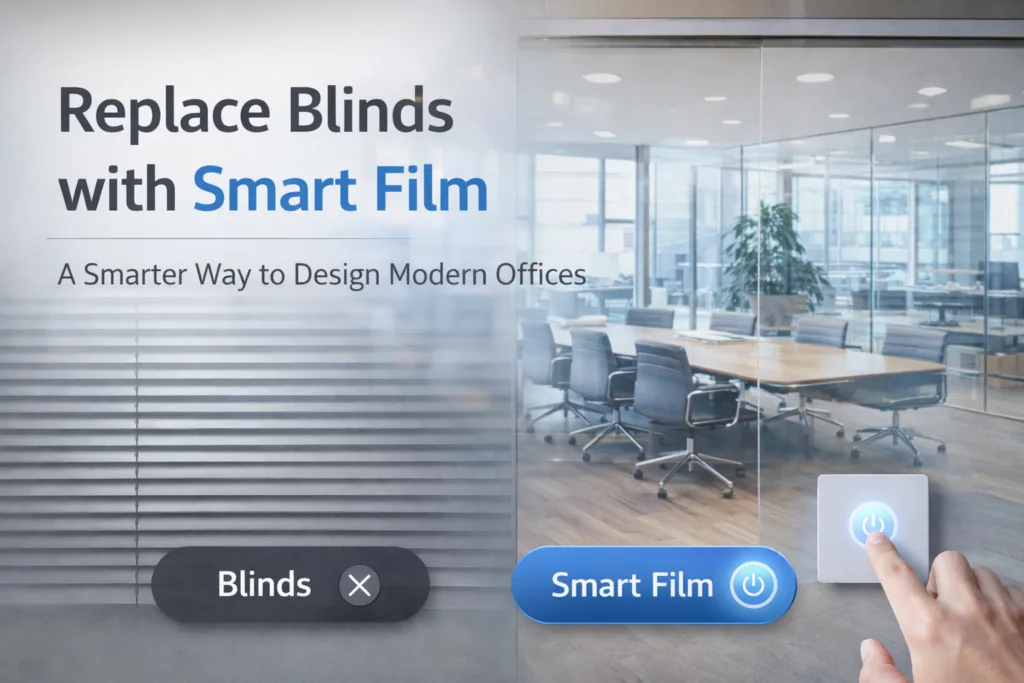
Every shading system is a second system: a headbox to detail, a motor to power, a control to commission, a part to replace in year seven. A switchable unit removes it from the drawing.
- No blinds, shades or louvres to coordinate with the glazing
- No moving parts on the elevation
- Cleaner lines, and a facade that reads as glass
- Fewer things that can fail, and less to maintain when they do not
Got one in front of you? Send the facade drawing and the orientation. What comes back is a quotation: panel schedule, transformer, lead time. No square-foot figure, because there is not an honest one. Earlier than that, twenty minutes with a project specialist is the place to start.
Where they are specified
- Residential windows and sliding doors
- Commercial facades and curtain walls
- Conference rooms with an exterior wall
- Healthcare and hospitality buildings
- Educational facilities
The common requirement is the same each time: daylight, insulation and privacy that can be changed during the day.
How they are made
PriWatt smart glass IGUs are manufactured in the USA, and that keeps the lead time and the coordination workable when a unit has to be adjusted or replaced. Each one is built to the project:
- Size and configuration, made to the opening and not to a catalogue
- Glass type: tempered, laminated, Low-E, or a combination
- Electrical integration planned with the rest of the glazing
A sealed unit with a wire coming out of it
Every switchable panel has a busbar along one edge and a tail leaving it. An insulating unit is defined by its seal. Those two facts meet at the edge of the glass, and how they are resolved is the whole engineering question of a switchable IGU.
It is resolved routinely, and on the shop drawing. It cannot be an afterthought: an IGU whose wiring route is decided after the unit is specified is an IGU that gets built twice.
| Line | What it settles |
|---|---|
| Which pane is switchable | The switchable layer sits inside a laminate, and that laminate is one pane of the unit, not something suspended in the cavity |
| Where the tail leaves | Which edge, and how it passes the spacer and the edge seal without compromising either |
| Cavity and gas fill | Unchanged by the switchable layer, and specified as it would be on any unit |
| Low-E surface | Which surface carries the coating, and how it sits relative to the switchable laminate |
| Frame and glazing pocket | The pocket has to take a unit with a connection leaving it, and the installer has to reach that connection |
| Transformer location | Low voltage at the panel, mains at the transformer, and a route between them that the facade allows |
Most switchable IGUs are built by a glass or IGU fabricator who already makes units for that facade, using switchable laminate supplied to them. That route, and the four questions it raises about interlayer, process, busbar handling and warranty, is set out for glass and IGU fabricators.
What the switchable layer actually does to solar gain
"Reduces solar heat gain" is the kind of sentence every glazing product makes. These are the published figures for the laminated switchable products, the ones that go into the unit:
| Clear state | Private or dark state | |
|---|---|---|
| PDLC glass — solar heat gain coefficient | 0.74 | 0.31 |
| PDLC glass — infrared blocked | 20% | 80% |
| PDLC glass — visible light transmission | 88 – 91% | Diffused, not blocked |
| DLC glass — visible light transmission | 36% at 18 · 28% at 1:15 | 4.5% at 18 · 1.5% at 1:15 |
| UV blocked, both | 99% | 99% |
| Power drawn | < 0.5 W/sq ft, in the state that needs it | — |
The SHGC figure is the one to argue from: 0.74 to 0.31 is a shading device, operated in the glass, on a switch. Be precise about what PDLC does in its private state. It diffuses light instead of blocking it, which controls glare and keeps the daylight. Where a facade needs the light itself reduced, DLC is the product: down to 1.5% transmission. Every measured value is in the technical reference. The trade-off against electrochromic glazing, which holds a tint at almost no power and wins on a facade tinted all day, is in technologies compared.
Common questions
Yes. The switchable layer sits inside a laminate, and that laminate is one pane of the unit. The cavity, the spacer and the gas fill are specified as they would be on any other IGU. What has to be designed, and not assumed, is where the wiring leaves the panel and how it passes the edge seal.
No, and the distinction matters. The liquid crystal is laminated between glass. Nothing is suspended in the air or gas gap, so the cavity performs as a cavity and the unit is sealed the way any insulating unit is sealed.
On PDLC laminated glass the published solar heat gain coefficient moves from 0.74 clear to 0.31 in the private state, and infrared blocked from 20% to 80%. That is a shading device operated in the glass. Where the requirement is to cut the light itself rather than to diffuse it, DLC goes down to 1.5% transmission.
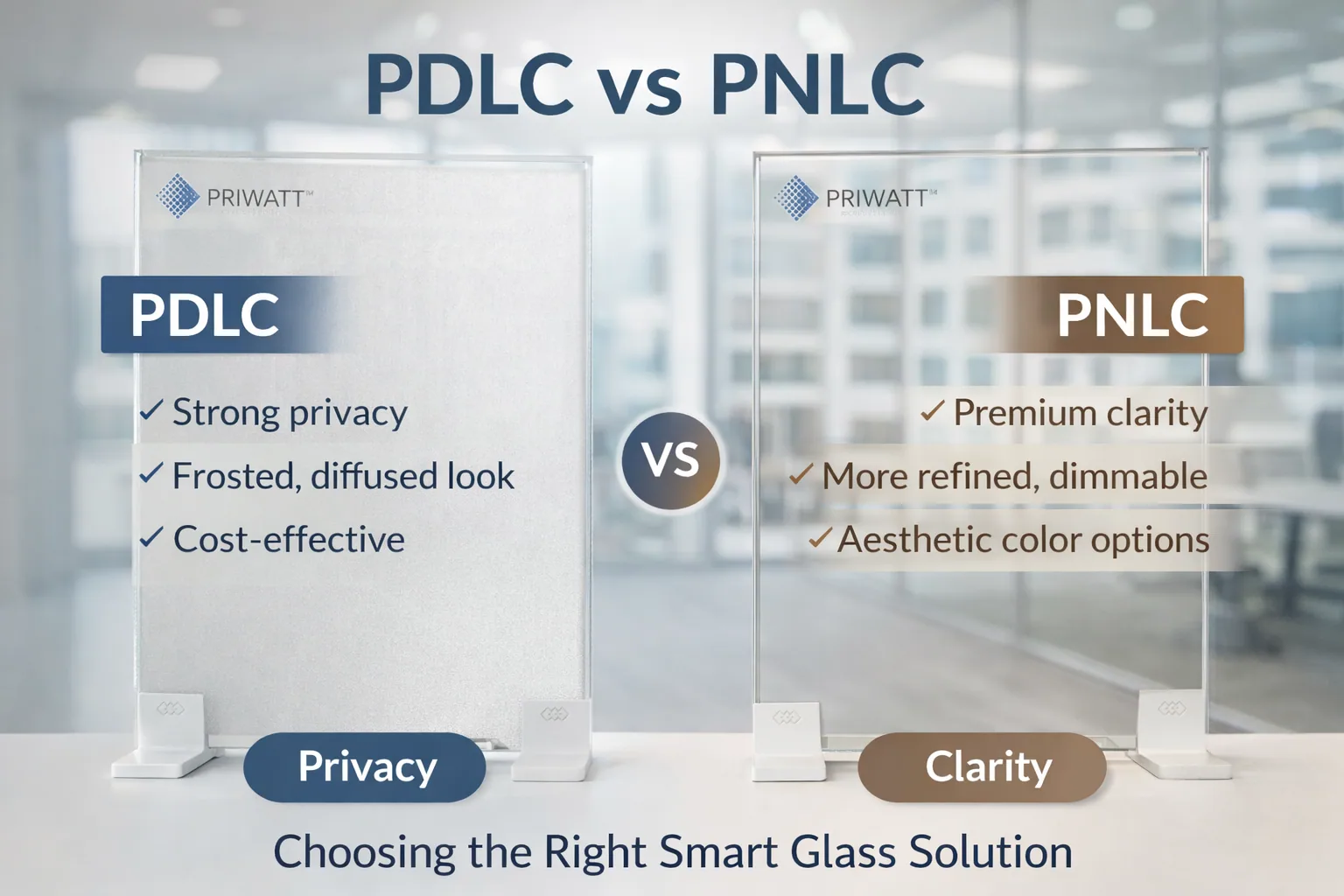
Usually reverse mode. A facade is transparent for most of the week, so the state it should hold with no power is the clear one, and the unit then draws power only for the hours it is switched. Normal mode is the answer where the glazing is private most of the time.
Usually a glass or IGU fabricator who already makes units for that facade, using switchable laminate supplied to them. PriWatt also makes complete units. Which route suits a project depends on the facade contractor and the programme.
The switchable laminate reaches 70 × 143 in on PDLC and 57 × 143 in on PNLC and DLC. The unit around it is made to the facade; the switchable pane is the constraint.
What it costs
PDLC smart glass IGUs typically run $140 – $230 per square foot, depending on size and thickness, the glass specification and how complicated the project is. The ranges for every product, and the five things that move the number, are on the pricing page.
That is more than standard glazing, and it is the wrong comparison. The unit replaces the shading system that would otherwise be specified alongside the glass, along with its installation, its maintenance and its eventual replacement. And it contributes to the building’s energy performance instead of sitting in front of it.
What it changes for the architecture
The usual way to control light and privacy is to add something in front of the glass. A switchable IGU makes the glass the control, leaving the elevation uninterrupted and the interior free of hardware: a passive material turned into an active part of the envelope.
PriWatt PDLC glass
The laminated switchable panel that goes into the unit.
PriWatt PNLC reverse glass
Clear unpowered, and usually the better default on an exterior wall.
PDLC vs PNLC
Which way round the glass should fail, and why it depends on the elevation.
Glazing that is also the shading
Send the window schedule or the facade drawings and we will come back with the unit specification and a quotation. PriWatt is made in Pompano Beach, Florida.