PDLC vs PNLC Smart Glass: What Architects Should Know
Two technologies, one specification line, and a decision most projects make by accident: the supplier proposes what they stock, and the drawing says "switchable glass".
PDLC and PNLC both work. They are not interchangeable, and the difference is not a grade. It is which state the glass is in when nothing is switched on.
The difference in one line each
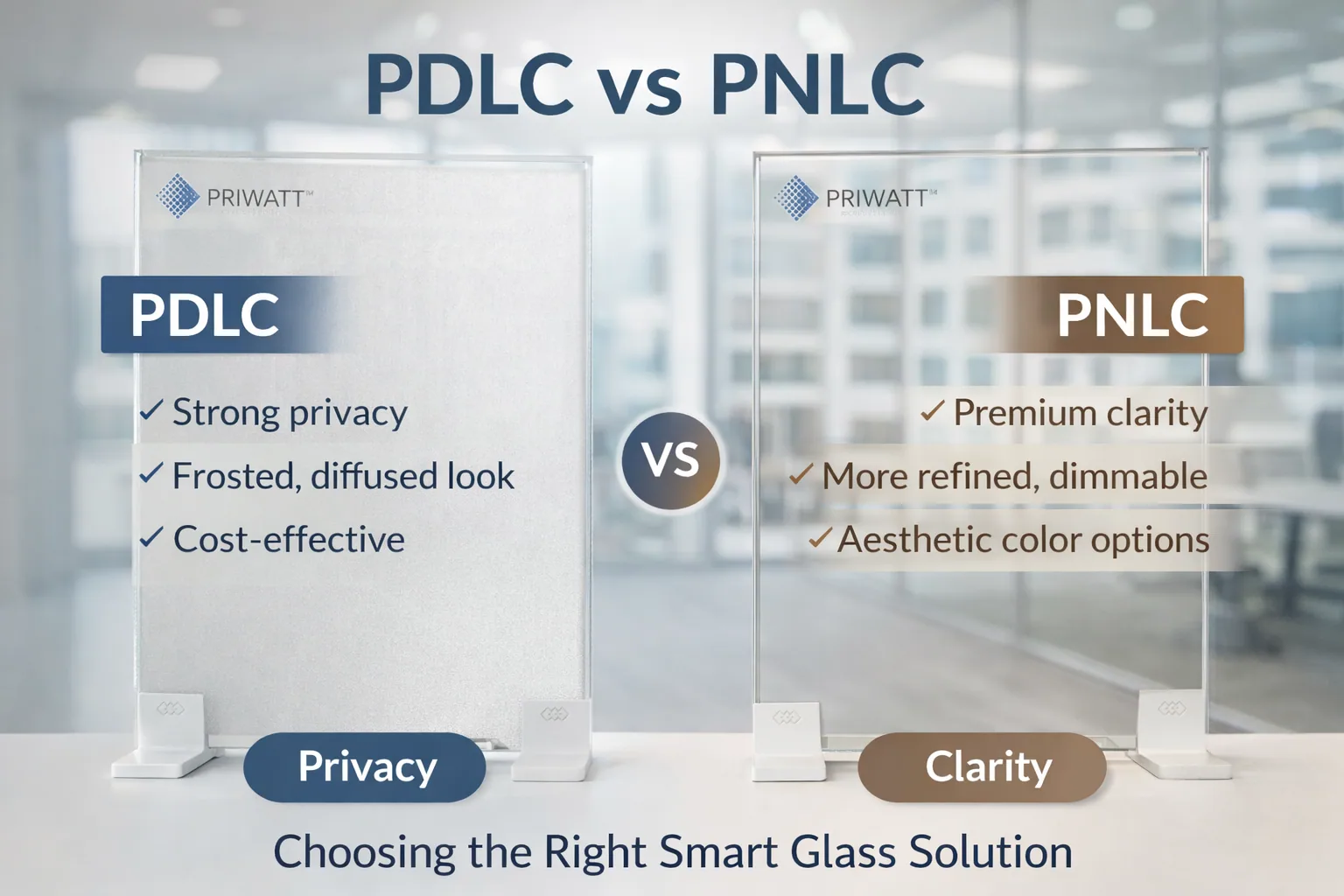
PDLC — clear when powered
Power on, the glass is clear. Power off, it is a frosted white. This is the standard smart glass and the one most installations use.
PNLC — clear when unpowered
The reverse. With no current the glass is clear; it turns opaque only when it is switched, and it can be specified in white, grey or bronze.
Which way round that should be is not a preference. A wall that is transparent most of the working day wants PNLC: it draws nothing to be in its normal state, and a power cut leaves the building looking the way it is meant to look. A room that is private by default and opened occasionally wants PDLC, for exactly the same reason.
How private is private
PDLC reaches around 98% privacy. The scatter is strong enough that shapes and shadows do not read through it. Where privacy is the requirement and not the effect, that is the one to specify.
PNLC reaches about 93–94%. It is not fully diffused: light and the suggestion of movement can still register. Controlled privacy, then, and not complete concealment: right for a boardroom, worth thinking about for a consulting room.
What the choice does not change
A comparison makes two things look further apart than they are. Both are liquid crystal systems bonded to architectural glass, and most of what a specifier has to think about is the same either way.
- Both switch instantly and silently, with no moving parts and nothing to service
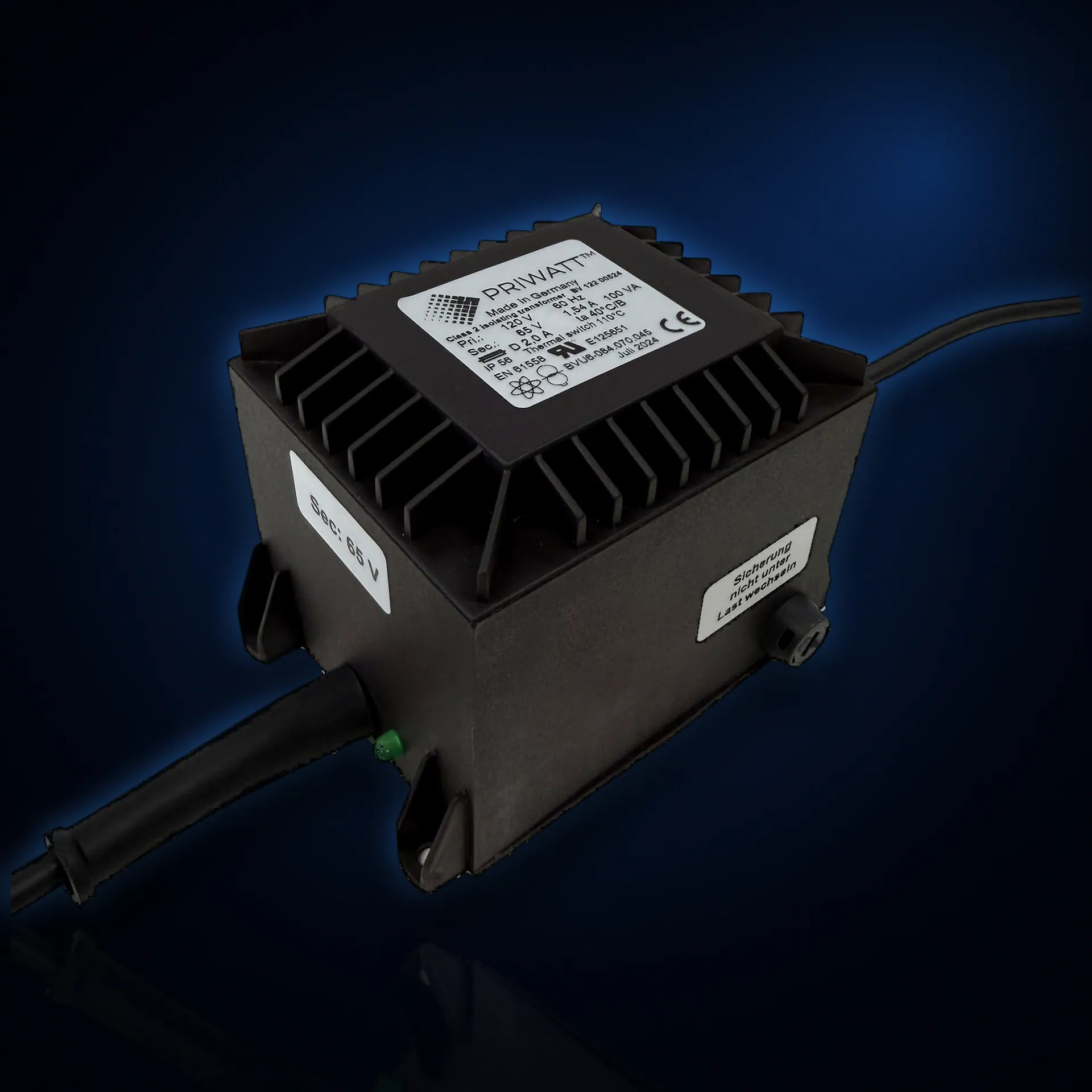
- Both are driven the same way: low voltage through an isolation transformer, switched at the wall, by remote, or from the building system
- Both are made to size, in any shape, with the holes, notches and cut-outs the hardware needs, though the maximum panel is not the same for both, and the table below carries it
- Both carry the same certification from the same manufacturer: UL file E514182 and SGCC 9894
- Both fail in the same place, and it is not the film
That last one is worth dwelling on, because a datasheet never compares it. Switchable glass rarely fails in the liquid crystal. It fails at the busbar, the conductive edge that distributes power across the panel, where switching goes patchy across the sheet and then stops. It happens to PDLC and PNLC alike, and it comes down to how the connection was made, not which technology was chosen. PriWatt anchors it by a patented method for that reason.
Cycle life is published per product, not per technology, and runs from over 600,000 switching cycles to over two million depending on the construction. Ask for the figure for the panel you are actually buying.
Working on one now? Send the room and how it spends its day, because that answer is the product and you get back a quotation: the panel schedule, the transformer, the lead time. Not a price per square foot. If the drawings are not there yet, twenty minutes with a project specialist gets you further.
The numbers, side by side
| Attribute | PDLC | PNLC |
|---|---|---|
| Unpowered appearance | Milky white, translucent | Clear |
| Powered appearance | Clear, slight haze | Opaque — white, grey or bronze |
| Clarity in the clear state | Good, slight haze remains | Excellent, high optical purity |
| Haze in the clear state | 3–10% | <1–3% |
| Privacy in the private state | ~98% | ~93–94% |
| Switching speed | 10–100 ms | 1–10 ms |
| Operating voltage | 40–110V AC | 5–60V AC |
| Power consumption | ~5 W/m² | ~1–3 W/m² |
| Viewing angle | Wide, with scatter | Wide, minimal distortion |
| Cost as film, per sq ft | $65 – $75 | $78 – $110 |
| Cost as laminated glass, per sq ft | $78 – $115 | $120 – $165 |
| Maximum panel, film | 72 × 143 in | 57 × 143 in |
| Maximum panel, laminated glass | 70 × 143 in | 57 × 143 in |
| Colours, as film | White, light grey, dark grey, black | White |
| Colours, as glass | White | White, grey, bronze |
| Available as retrofit film | Yes, widely | From PriWatt and selected suppliers |
| Temperature sensitivity | Moderate | Good across standard ranges |
| Maturity | Very mature, since the late 1980s | Proven in commercial installations |
PDLC, in more detail
PDLC has been commercially available since the late 1980s and accounts for most of the switchable glass installed anywhere. That maturity is worth something on a project: an established supply chain, failure modes people understand, and competitive pricing from more than one direction.
Its opacity works by scatter. With the voltage removed, randomly oriented droplets diffuse light in every direction, so the private state glows instead of blocking: a soft, warm frost. In partitions, hospital rooms and bathrooms that is often the appearance people actually want.
Clear, it lets in a lot of daylight with a slight softening. For most privacy glass, that is the right trade between performance and price.
- Decades of installed base behind it
- $65–$75 per square foot as film, the accessible end of the category
- Available as self-adhesive film, so it retrofits onto glass already in place
- Soft, warm frost in the private state, and natural glare reduction
- Compatible with standard glazing systems
Best suited to
- Offices, clinics and hospital partitions
- Residential bathrooms and shower enclosures
- Retrofits onto existing glass
- Large areas where the budget is the constraint
- Rooms where a soft, diffused light is the design intent
PNLC, in more detail
Where PDLC disperses droplets, PNLC forms a continuous polymer network. The liquid crystals align more predictably inside it, and that shows up in three places: a more uniform look when opaque, higher clarity when clear, and measurably less haze.
In practice PriWatt PNLC glass transmits enough light in its clear state to read as architectural glass and not as a switchable panel. Every liquid crystal system has some haze; this one has noticeably less of it.
The second advantage is colour. PNLC is made in white, grey and bronze, so the private state can be matched to the timber, metal and stone around it instead of arriving as a white rectangle in the middle of a considered palette.
PNLC reverse smart glass covers what reverse mode changes on a project: the energy it draws over its life, what the building looks like during a power cut, and the rooms it is and is not right for.
- Clear when unpowered: the state most rooms spend the day in
- High optical clarity and low haze in that state
- A uniform, controlled private state, not a milky one
- Fast switching and lower power draw than PDLC
- White, grey or bronze
Best suited to
- Offices, meeting rooms and conference spaces
- Residential interiors
- Education and training environments
- Healthcare, where a cleaner glass appearance is preferred
- Premium commercial interiors and hospitality
- Anywhere the glass tone has to coordinate with the material palette
PriWatt PNLC reverse glass
The product, its specification and where it is used.
PriWatt PDLC glass
The standard mode, laminated for new work and replacement.
PDLC smart glass IGU
What changes when the switchable layer goes into an insulated unit.
Glass or film: the other half of the decision
Normal against reverse is a decision about the room. Laminated glass against self-adhesive film is a decision about the building programme, and the two are independent: a project can land on any of the four combinations.
Film goes onto the pane that is already there. Nothing is removed, no glazing is re-ordered, and the floor stays in use while it is fitted. That is why almost every retrofit is film. It is also the only route when the glass is structural, or listed, or simply too expensive to replace for the sake of a privacy requirement that arrived later.
Laminated glass puts the switchable layer inside the laminate, between two panes of safety glass, with the wiring designed into the edge instead of added to it. It is the better unit whenever the panel is still to be made, and the only one that goes into an insulated unit for exterior work.
PDLC has been available as both for years. PNLC is newer as a retrofit film, and PriWatt makes it in both formats. That matters on a project with some existing glass and some new, which would otherwise have to match two suppliers and hope the two whites agree.
When the answer is neither
Both technologies control what can be seen. Neither controls how much heat and glare come through, because both work by scattering light, not absorbing it. A frosted panel on a west facade is still a west facade at four in the afternoon.
Where solar gain and glare matter as much as sightlines, the third option is DLC: a guest-host system of dichroic dye in a liquid crystal matrix that moves between a tinted transparent state and a deep dark one, not between clear and frosted. It runs at 60V AC and is specified by contrast ratio, 1:8 or 1:15, transmitting 36% or 28% of visible light in its clear state. That is a tinted glass with a switch, usually specified on the outside of the building.
If a brief says "privacy" but the complaint behind it is heat, this is the page the conversation should have started on.
Where PriWatt sits in this
PriWatt manufactures both in Pompano Beach, Florida, and does not import finished panels. That is what keeps the lead time predictable, the quality controllable and the technical support a phone call instead of a time zone.
- Manufactured in the USA, with consistent quality control and lead times
- Laminated systems built for architectural glazing, not adapted to it
- Reverse-mode PNLC as a specialism, not a line item
- Direct support through specification, fabrication and installation
Choosing between them
Both are proven. The decision belongs to the project, not to the price list.
PDLC where privacy is the requirement: the highest concealment, the wider budget range, and the only one of the two that retrofits onto existing glass as standard.
PNLC where the glass is transparent most of the time and has to look like glass when it is: clearer, lower haze, lower power, and a private state that can be coloured to match what it sits in.
One correction to the price line in the table, because it is the figure most projects decide on. PNLC costs more per square foot and less to run: it draws roughly a third to a fifth of the power, and in the state a transparent room spends most of its day in it draws nothing at all. Whether that closes the gap depends on the area, the hours and the tariff. But comparing the two on the purchase price alone compares them on the half of the cost that is paid once.
What the specification has to say
Switchable glass arrives on drawings as "smart glass" more often than it should. Six lines make it buildable:
- The mode (normal or reverse) stated as which state the panel holds with no power, not as a product name
- The format: laminated switchable glass, or self-adhesive film applied to existing glazing
- Panel sizes and shapes, with the holes, notches and cut-outs the hardware needs; the maximum panel is 143 in tall and 57 to 72 in wide depending on the product
- The transformer and the control, sized to the run and named; a panel without them is half a system
- The edge condition: how the busbar is anchored and how the wiring leaves the panel
- Certification you can cite, not assume: UL file E514182 for the electrical system, SGCC 9894 for safety glazing
Add an acoustic figure where the room needs one. It is a property of the whole glass make-up and not of the liquid crystal, so it is quoted per build-up: a switchable partition at a Toronto investment office was specified at Rw 35–36 dB, and the same panel doubles as a rear-projection screen.
Three ways this goes wrong
Deciding on price per square foot
It is the one number both suppliers will quote and the one that says least. It excludes the transformer, the control, the running cost and whether the panel will still be switching evenly in five years.
Treating the privacy figures as interchangeable
98% and 93–94% sound close and are not the same requirement. One conceals; the other controls. In a consulting room or a briefing room that difference is the specification, not a detail of it.
Leaving the edge to the installer
The busbar and the wiring exit are where switchable glass fails, and they are decided when the panel is made, not when it is fitted. A drawing that stops at the glass has left out the part that ages.
The first of those is the easiest to check before it costs anything: what a published range actually covers is broken out per product, with the items a square-foot figure leaves out listed separately.
Specifying one or the other
Send the drawings or the room and we will say which of the two the project actually wants, including when that is the cheaper one. Made in Pompano Beach, Florida; (833) 333-8556.