
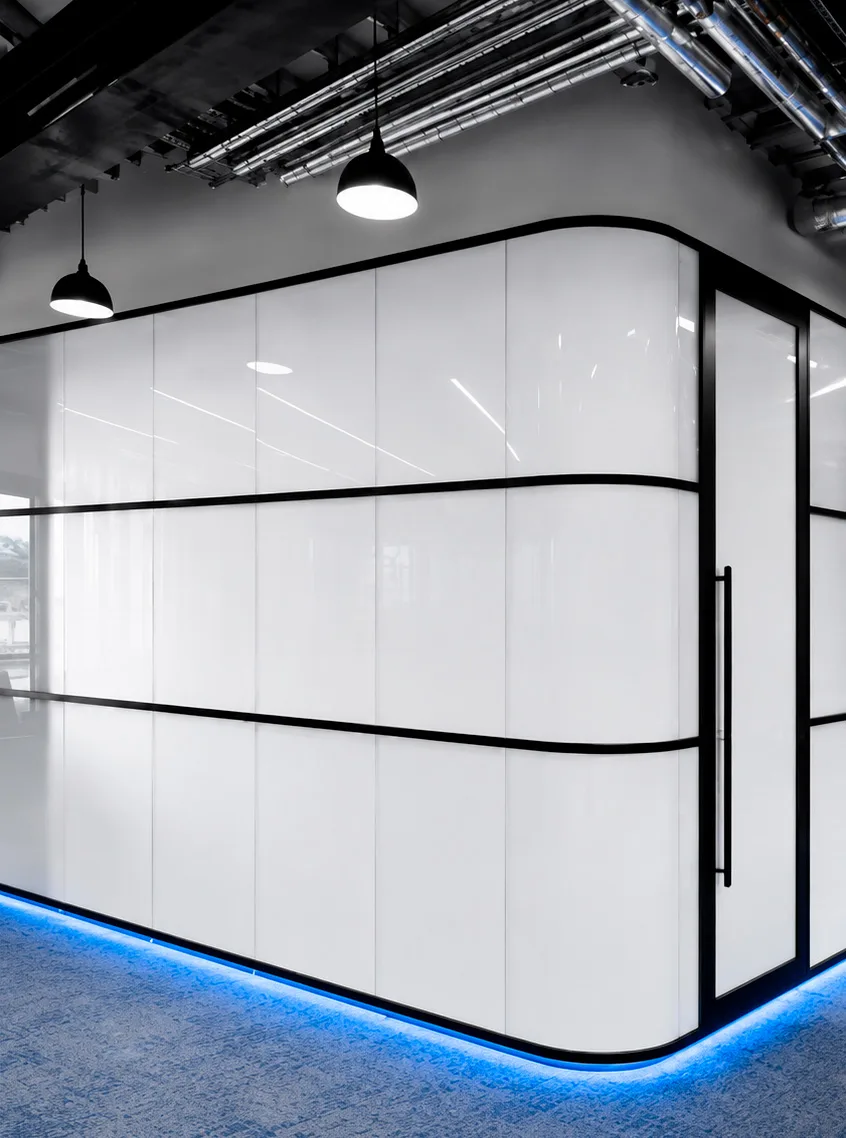
PNLC Reverse Smart Glass
Glass that is clear when nothing is switched on
Standard switchable glass is frosted with no power and turns clear when you switch it. Reverse mode is the other way round: clear unpowered, private when switched. PriWatt builds it on PNLC (polymer network liquid crystal) and manufactures it in Pompano Beach, Florida, as laminated glass and as self-adhesive film.
That sounds like a preference. It is not. Which state the glass holds with no power decides how much energy it draws over its life, what the building looks like during a power cut, and whether the default condition of a room is the one it was designed for.
Three consequences of the unpowered state
Energy, counted in years not hours
A boardroom is transparent most of the working day. In normal mode that means holding it clear under power for eight hours to look the way it is meant to look. Reverse mode draws nothing to be in its everyday state, and PNLC draws less when it is switched: ~1–3 W/m² against ~5 W/m² for PDLC.
What a power cut leaves behind
Normal-mode glass goes opaque when the power fails: a storefront that whites out, a lobby that closes itself, an atrium that loses its daylight. Reverse-mode glass goes clear. The failure state is the state the architect drew.
How the glass reads when it is clear
Every liquid crystal system keeps some haze in its clear state. PNLC keeps measurably less, under 1–3% against 3–10%. That is the difference between glazing that reads as architectural glass and glazing that reads as a switchable panel.
The polymer network is where that comes from. PDLC disperses liquid crystal droplets through a polymer; PNLC forms a continuous network, and the crystals align more predictably inside it. The result is a clearer clear state, a more uniform private state, and switching in 1–10 ms instead of 10–100.
Have a project open? Send the room and how many hours a day it is open. A quotation comes back as a panel schedule with a transformer and a date, priced on the panels you actually need. Nothing drawn yet? Book twenty minutes with a project specialist.
When reverse mode is the wrong answer
It is not the better technology. It is the right one for a particular kind of room, and the wrong one for another.
| The room | What it needs | Mode |
|---|---|---|
| Transparent most of the day, closed occasionally | The clear state as the default | PNLC reverse |
| Private by default, opened occasionally | The private state as the default | PDLC normal |
| Concealment, not the suggestion of it | ~98% privacy, not ~93–94% | PDLC normal |
| A private state matched to the material palette | Grey or bronze, not white | PNLC reverse |
| Solar gain and glare as much as sightlines | A tinted state, not a frosted one | DLC dynamic shading |
Privacy is the honest trade. PDLC reaches around 98%: shapes and shadows do not read through it. PNLC reaches about 93–94%: controlled privacy, not complete concealment. Light and the suggestion of movement can still register. Right for a boardroom. Worth thinking about for a consulting room, and a decision to make before the glass is ordered, not after.
The full comparison, with every figure side by side, is in PDLC vs PNLC: what architects should know.
Whether the glass is already in the building
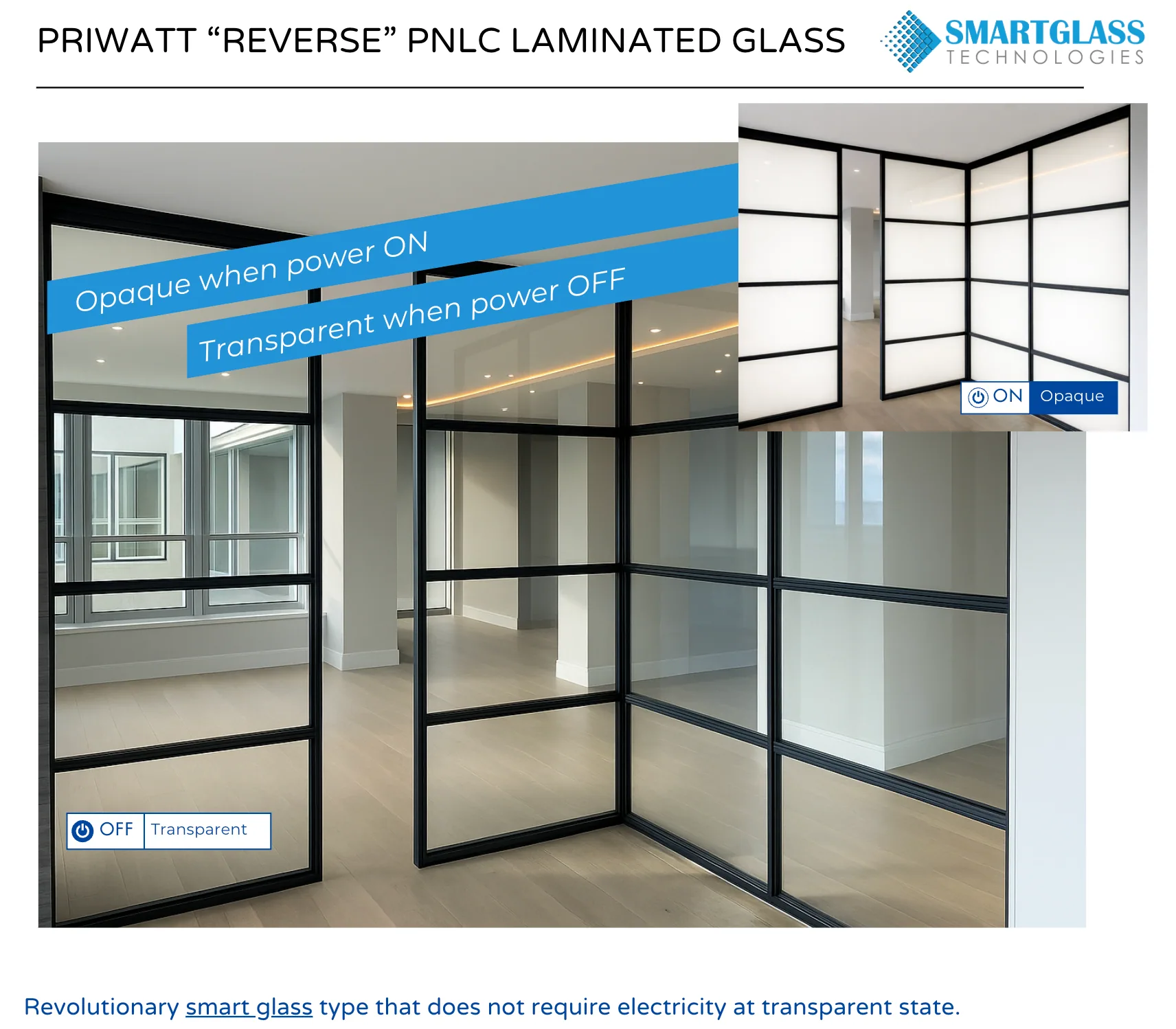
PNLC reverse smart glass
Laminated: the switchable layer sits between two panes of architectural safety glass, protected, with the wiring designed into the edge instead of added to it. For new work and for replacement glazing, made to size up to 57 × 143 in, in any shape, with the holes and cut-outs the hardware needs.
View product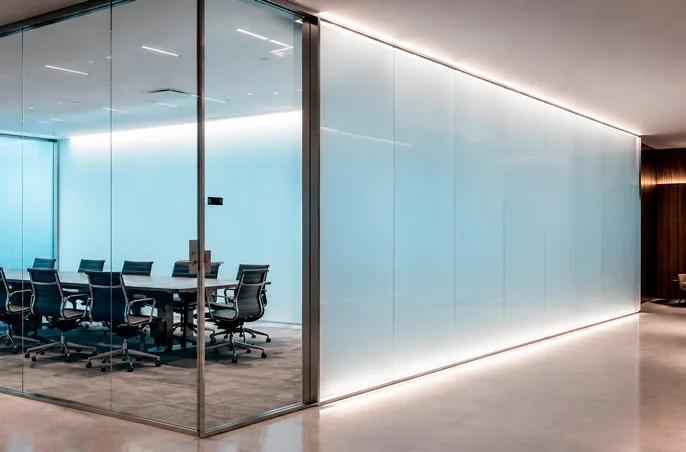
PNLC reverse smart film
Self-adhesive, applied to the pane that is already in the building. Nothing is removed, no glazing is re-ordered, and the floor stays in use while it is fitted. That is why most retrofits are film and not glass.
View productA private state that matches what it sits in
Switchable glass is normally white when private, and a white rectangle in the middle of a considered palette of timber, metal and stone is a compromise everybody notices. PNLC is made in grey and bronze as well, so the private state can be specified to the material it sits beside instead of against it.
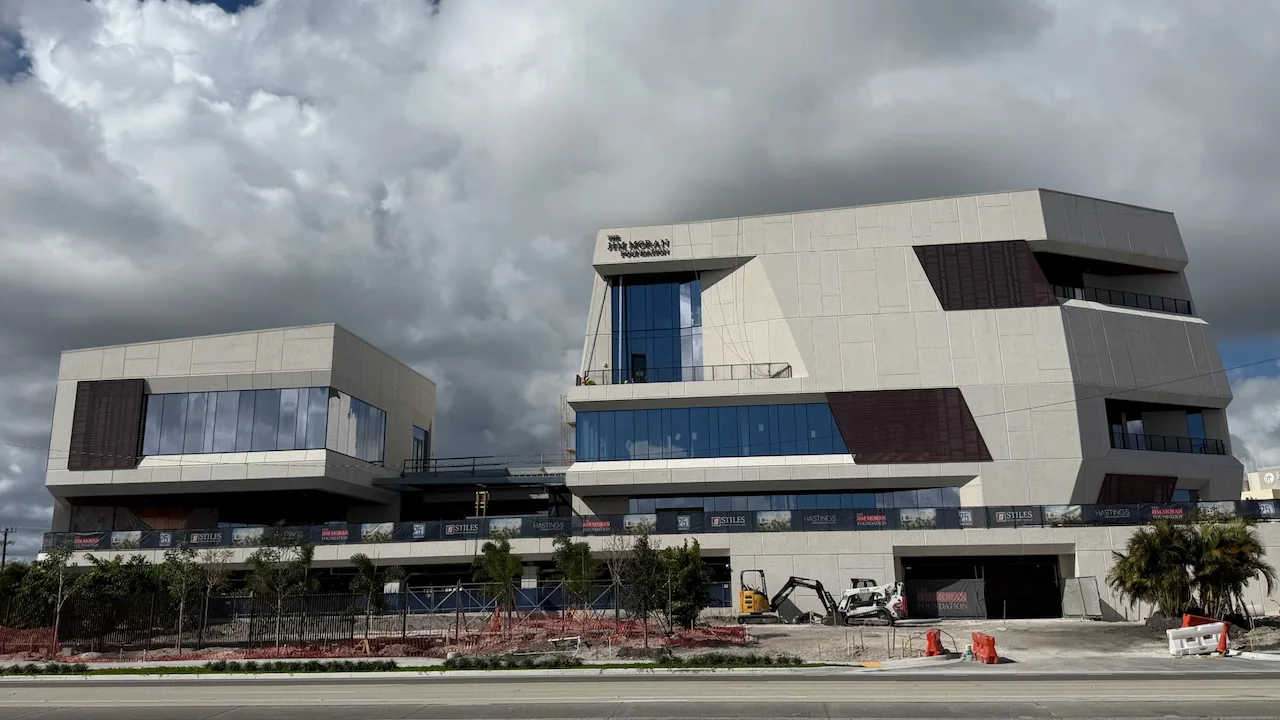
At the Jim Moran Foundation in Fort Lauderdale that is the reason the glass is there: clear with no power, private at a press, and in a colour that was chosen, not accepted.
Reverse mode as a specialism, not a line item
Most of the reverse-mode film on the market is imported. PriWatt laminates and wires it in Pompano Beach, so the lead time is a schedule, not an estimate, and technical support is a phone call, not a time zone.
- Manufactured in the USA — lamination, electrical assembly and testing under one roof
- UL file E514182 and SGCC certificate 9894, both checkable by number before you buy
- The busbar anchored by a patented method: the connection at the edge, where switchable film usually fails
- The isolation transformer and control sized to the run, and shop drawings before anything is made
- Glass and film from the same manufacturer, so a project can use both without matching two suppliers
The patented busbar anchoring system
How the connection is secured inside the film, and why the edge decides how long an installation lasts.
Patents and certifications
UL E514182, SGCC 9894, and patents US 11,686,966 B2 and CA 3,212,838, with what each covers.
Inside an insulated unit
What changes when the switchable layer goes into an IGU: solar gain, HVAC load, and what comes off the facade.
Where the clear state is the point
Eighty feet of reverse smart glass railing at a North Palm Beach residence is clear over the water by default and private around the pool at a switch. The view is the reason the glazing exists, so that is the state the glass holds when nothing is switched on. A New York waterfront terrace does the same with the panorama, and the Jim Moran Foundation does it in a colour matched to the interior.
Reverse, or normal?
Send the drawings, the dimensions or a description of how the room is used, and we will say which mode the project actually wants, including when that is the cheaper one. Made in Pompano Beach, Florida; 1-866-PRIWATT (1-866-774-9288).