How Much Electricity Switchable Glass Uses, and How It Is Wired
The question turns up in most enquiries, usually as a worry rather than a question: if the glass has to be powered to stay clear, what does it cost to run a wall of it all day? The answer is easy to publish, and small enough to be disappointing: under half a watt per square foot.
That number settles the electricity bill and almost nothing else. Two other figures decide the job. One is which state the room holds when nothing is switched on, because that is what the glass does for most of its life. The other is measured in volt-amperes, not watts. That is the one the transformer, the cable and the inspector care about.
What the meter sees
PriWatt publishes under 0.5 W per square foot (about 5.4 W/m²) in the powered state, and nothing at all in the unpowered one. Independent measurement lands in the same place. A 2024 study of a PDLC window in an Istanbul office building measured its test bench at 8 W/m² driven at 60 V AC; the technology comparison in the same paper puts PDLC and suspended-particle film at roughly 5 W/m² and electrochromic glass at 2.5 W/m².
So take a 100 sq ft glazed partition, about the size of a conference-room wall. Hold it clear through a ten-hour working day, 250 days a year. That is 50 watts for 2,500 hours: 125 kWh. At 13.8 cents per kilowatt-hour, the US commercial average for the twelve months to June 2026, it costs about $17 a year. The wall draws what a single 50 W lamp draws, because 50 watts is 50 watts.
Four things move that figure, and only one of them is the film:
- Area, linearly. Double the glass and you double the current; that is measured, not assumed
- Hours in the powered state: a question about the room, not the product
- Which mode was specified, normal or reverse, and that is the big one
- The local tariff, which ranges from about 9 to 20 cents across the US commercial sector
The state that costs nothing
Standard switchable glass is private with no power and clear when switched. Reverse mode is the other way round: clear unpowered, private when switched. PriWatt makes both, and the choice between them is the single decision that sets the annual number.
A conference room is clear most of the working day and private for an hour of it. In normal mode that means holding it under power for eight hours to look the way it is meant to look. That is the $17 above. Put the same wall in reverse mode, private for two hours a day, and the film draws for 500 hours instead of 2,500, at a lower rate while it does. The running cost falls to a couple of dollars a year.
The rule is short: whichever state the room spends its day in should be the state that needs no power. Reverse mode costs more per square foot to buy, so on a small installation the electricity never repays the difference. On a large one that is clear all day, the electricity is not the point. The point is a wall that stays clear when a breaker trips.
Watts are not volt-amperes, and the transformer knows it
Electrically, switchable film is a capacitor with a liquid-crystal dielectric. Its current runs ahead of its voltage, which means the supply has to deliver more apparent power, measured in volt-amperes, than the real power the utility bills as watts. Size a supply on the wattage in a brochure and it will be undersized.
The published laboratory figure is useful here. Measuring four film areas at 65 V, researchers recorded about 160 nA/mm² of current and about 10.4 µVA/mm² of apparent power, or 10.4 VA per square metre, and found both constant no matter how the area changed. Double the film, double the current and double the VA. Nothing about a larger panel is more efficient than a smaller one.
That is why every transformer on this site carries a VA rating, and why sizing leaves headroom for the moment of switching, not for the steady state.
Working on one now? Send the panel sizes and how they group, because that is what a transformer is sized on and you get back a quotation: the panel schedule, the transformer, the lead time. Not a price per square foot. If the drawings are not there yet, twenty minutes with a project specialist gets you further.
Why it runs on AC, and what a DC supply does to it
PDLC and PNLC film both need alternating current. This is not a preference. The crystals reorient in an alternating field, and every published specification for the technology, peer-reviewed comparisons included, lists it as AC-driven, against electrochromic glass, driven by DC.
Under a steady DC field the damage is slow and then permanent. Liquid crystal carries mobile ionic impurities; a constant field drives them to the electrodes, where they build up and screen the field the crystals are supposed to see. The display industry calls the mild version residual DC and sees it as image sticking. In a window it shows up as a panel that no longer clears evenly, and then as one that does not clear at all.
Three practical consequences follow, and they catch people who are used to LED work:
- A bench DC supply at the right voltage will destroy the film. The voltage was never the specification — the waveform was
- A dimmer built for LED or incandescent loads does not dim switchable glass. The controller varies the AC drive itself on panels that offer levels
- The film is wired through an isolating transformer with an AC secondary, not a driver, not a power supply, not a relay board off a DC rail
What a run actually looks like
From the panel board it is short. A 120 V branch circuit feeds an isolating transformer. The transformer steps down to a 48 or 65 V AC secondary at mains frequency. That secondary runs to the busbar bonded along the edge of the film, and the busbar distributes current across the panel. Everything that fails in this product fails at that last connection. That is why the busbar anchoring is patented, and why it has an article of its own.
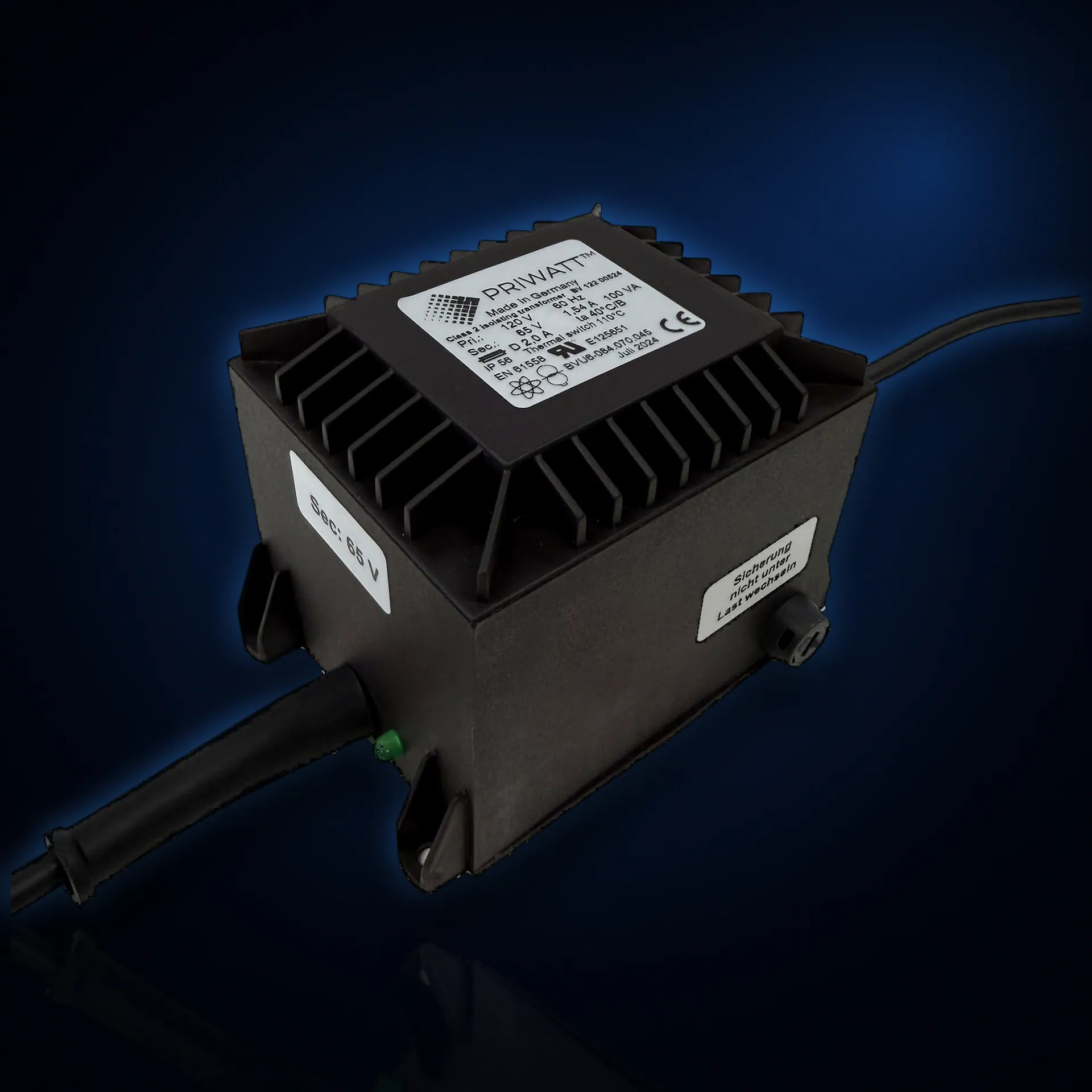
The transformers PriWatt supplies are 100 VA and 300 VA units, 110–120 V AC in, 48 or 65 V AC out at 50–60 Hz: 2.08 A and 6.25 A on the 48 V pair, 1.54 A and 4.61 A on the 65 V pair. Each is potted, IP 56, isolation class B, protected by a glass micro fuse and a thermal switch that resets itself at 110 °C, built to EN 61558 and carried on UL files E125651 and E466710.
Two things about placement need settling on the drawings, before anybody is on site. The transformer has to stay reachable: a ceiling void, a closet, a cabinet, somewhere dry and ventilated that somebody can open in five years. And voltage drop on a 48 V secondary is a real constraint, not a rounding error, so the run length between transformer and glass belongs on the drawing with the panel schedule.
Where this sits in the electrical code
"Low voltage" is a description, not a classification. In the National Electrical Code, Article 725 sorts power-limited circuits by what the listed source can deliver, and Chapter 9, Table 11(A) sets the limits. A Class 2 source may deliver up to 100 VA at 30 V or less; above 30 V the same class is held to milliamps. Class 3 covers the band from 30 to 150 V, still capped at 100 VA.
Switchable film runs at 48 to 65 V AC, which puts it above the 30 V line before anything else is considered. A 100 VA transformer sits at the ceiling of what a power-limited circuit may carry there; a 300 VA transformer is above it. That does not make either one non-compliant — it makes the wiring method a determination somebody has to make, with the nameplate in hand.
A manufacturer supplies the nameplate, the listings and the ratings. The engineer of record specifies the circuit and the authority having jurisdiction accepts it. Any supplier who answers "it is low voltage, run it anywhere" has told you they have not read the table.
Sized by the panel, not by the square footage
Total area is the wrong input for a transformer. It is also the one most quotes are built on. Panels switch together, so the load arrives at once; a busbar has a length and a resistance; a run of eight small panels and a run of two large ones can have the same square footage and different answers. PriWatt sizes on panel dimensions and grouping, so the transformer and the control are quoted with the run instead of afterwards.
What a sizing sheet needs from a drawing:
- Panel dimensions and quantity, not just the total area
- Which panels switch together, and which switch on their own
- Cable run from the intended transformer position to each group
- How the glass is switched: wall switch, touch panel, app, remote or building system
- Whether the space needs the glass clear or private when the power is off
Controls, and where the switch goes
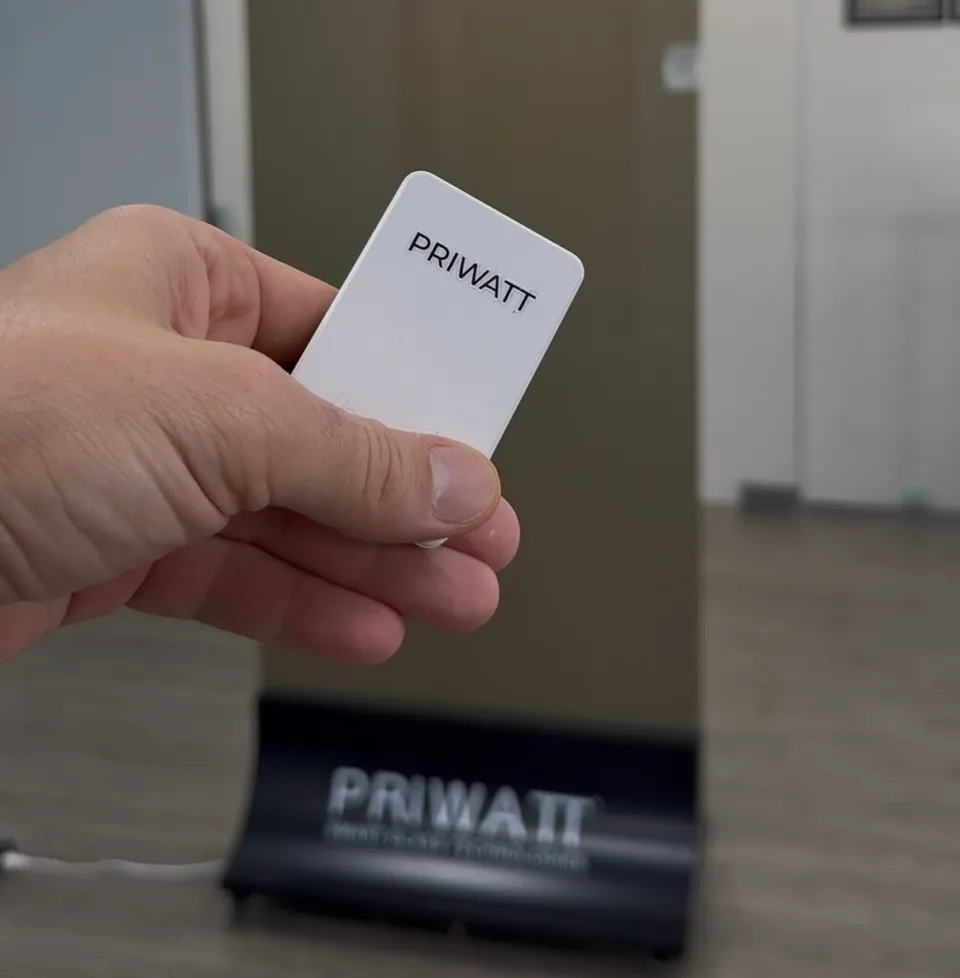
A PriWatt panel takes five kinds of control: a wall switch, a touch panel, a mobile app, a handheld remote, or the building automation system. Electrically they divide into two. A wall switch interrupts the supply feeding the transformer, so a smart glass wall can be switched by a device that knows nothing about smart glass. Occupancy sensors, timers and BMS commands all arrive as a contact closure or a relay module at the controller.
The distinction matters at tender. A wall switch is not a building management integration, and the two are not priced the same. On DLC panels, where the control sets a tint level and not just a state, it is doing more than switching and is specified with the panel.
Does it save energy? Not the way a tinting window does
Switchable film scatters light; it does not reject much heat. The peer-reviewed comparison puts PDLC solar heat gain at 0.69 clear and 0.55 scattered. Electrochromic glass moves from 0.46 down to 0.06. It also holds its state once switched: as Lawrence Berkeley National Laboratory puts it, those glazings "have memory, so they only need power to make a change in transmission". Switchable film has no memory. It holds a state only while it is energised.
So the honest specification is this. Buy switchable glass for privacy on demand, for glare control, and for a wall that changes without anything moving or collecting dust. Do not buy it as an HVAC measure. If the brief is solar control, the brief wants electrochromic or a shading system, and saying so early is cheaper than saying it in commissioning.
There is one saving that has been measured. In the Istanbul office study, running the PDLC window as part of a daylight strategy alongside dimmable LED lighting cut lighting energy by 22% against artificial light alone. That is a controls result, not a glazing one, and it only appears where somebody designs for it.
What happens when the power goes out
Nothing dramatic, and nothing that needs resetting. The panel returns to its unpowered state and waits there. In normal mode that means the glass goes private; in reverse mode it means the glass goes clear. When power comes back, the last commanded state returns with it.
Which of those two is the safe failure is a question about the room. Ask it while the mode is still a choice. An ICU that needs a sightline to the bed and a boardroom that needs the opposite are the same product specified in opposite directions. It is one of the few decisions on a glazing package that cannot be changed afterwards without replacing the glass.
Common questions
No. In normal mode the unpowered state is the private one and it draws nothing; in reverse mode the unpowered state is clear and draws nothing. The film only consumes power in the state it has to be held in. The transformer itself has a small no-load loss. Worth asking about on installations running to hundreds of panels, negligible on a meeting room.
Around $17 a year for 100 square feet held clear ten hours a day, 250 days a year, at the US commercial average tariff. The arithmetic is 0.5 W per square foot, so 50 watts, so 125 kWh. Scale it linearly for a bigger wall; there is no efficiency gain in area.
No, and the attempt is the most expensive mistake available. The film needs an alternating field. A steady DC field drives ionic impurities in the liquid crystal to the electrodes, where they screen the field and the panel stops clearing properly. Damage from this is not reversible by switching back to AC.
It depends on panel dimensions and how the panels are grouped, not on total square footage. PriWatt supplies 100 VA and 300 VA isolating transformers with 48 V and 65 V secondaries, and sizes them against the panel schedule. Send dimensions, quantities and the switching groups and the sizing comes back with the quote.
Not automatically. Class 2 and Class 3 are defined in NEC Article 725 by what the listed power source may deliver, and film runs at 48 to 65 V AC, above the 30 V threshold where the Class 2 allowance drops to milliamps. The classification and the wiring method are for the engineer of record and the AHJ; PriWatt supplies the transformer ratings, the listings and the UL file numbers they need.
The load rarely justifies one on its own — a 300 VA transformer is a small draw on a 120 V branch. What decides it is usually access and grouping: how many transformers are being fed, where they sit, and whether the installation is being commissioned and serviced as a system rather than as an accessory.
Sources
The figures above that are not PriWatt’s own published data come from these:
- H. Gundogdu, M. Terkes, A. Demirci, U. Cali, “Assessing energy savings and visual comfort with PDLC-based smart window in an Istanbul office building”, Energy Reports 12 (2024), 4252–4265, open access — test-bench power draw, the EC/SPD/PDLC comparison and the 22% lighting result.
- “Performances of Polymer-Dispersed Liquid Crystal Films for Smart Glass Applications”, Polymers 15(16):3420, 2023 — current and apparent power per unit area, measured across four film sizes.
- Lawrence Berkeley National Laboratory, Windows and Daylighting, Electrochromic Materials — on electrochromic glazings holding their state without power.
- US Energy Information Administration, Electric Power Monthly, Table 5.3 — commercial electricity price, 13.80 cents/kWh for the twelve months ending June 2026.
Send the panel schedule and we will size the electrics with the quote
Panel dimensions, quantities, switching groups, and which state the space should hold with no power. That is enough to come back with transformers, control and a run that an electrical engineer can put on a drawing. Pompano Beach, Florida; (833) 333-8556.