
Smart glass or smart film?
Usually the building has already decided
Switchable glass and switchable film are the same technology in two deliveries. The liquid-crystal layer is identical. The difference is whether it arrives laminated inside a panel made for the opening, or as a self-adhesive film applied to glazing that is already there.
So the decision is mostly made for you. If the glass is in the building and the building is in use, it is film. If the panel is being made anyway (new work, a replacement, an insulated unit, a railing) it is laminated glass. The interesting cases are the few where both are genuinely available.
The two, side by side
| Self-adhesive film | Laminated switchable glass | |
|---|---|---|
| Where it goes | Onto glazing already in the building | Made for the opening and glazed in |
| The glass | Whatever is already there | Low iron, heat-treated or fully tempered |
| Cost per sq ft | PDLC from $65 · PNLC from $78 · DLC from $65 | PDLC from $145 · PNLC from $185 · DLC from $90 |
| Maximum panel | 72 × 143 in PDLC · 57 × 143 in PNLC and DLC | 70 × 143 in PDLC · 57 × 143 in PNLC and DLC |
| Thickness added | 380 – 482 μm of functional film | 3/8 · 1/2 · 9/16 in overall |
| Weight | Negligible on the existing glass | ~5 lb/sq ft |
| Operating temperature | -20 to 60 °C | -10 to 60 °C |
| Switching cycles | > 800,000 PDLC · > 600,000 PNLC and DLC | Same film, laminated |
| Acoustic | Whatever the existing glazing does | STC ~37, quoted per make-up |
| Safety glazing | A question about the existing glass | SGCC 9894 |
| Shapes and cut-outs | Cut to the glass that is there | Curves, holes, notches made into the panel |
| Disruption | Applied in place; the area stays in use | Glazing work, with the programme that implies |
Two rows are worth a second look. Film runs to a wider cold range, -20 °C against -10 °C, because on a made panel the limit is set by the laminate and not by the film. And PDLC film reaches 72 inches wide against 70 for the laminated product, so on the widest single panels film is not the compromise.
Working on one now? Send whether the glass is already in the building, because that one answer settles it and we will price the panels themselves — a quotation with the schedule, the transformer and the lead time on it. Rate cards do not survive contact with a real opening. Still deciding? Start with twenty minutes with a project specialist.
What it does that glass cannot
Film exists for buildings that are finished. It is the only route that does not require the glass to come out, and on a working floor that is not a cost saving so much as the difference between the project happening and not.
The building keeps working
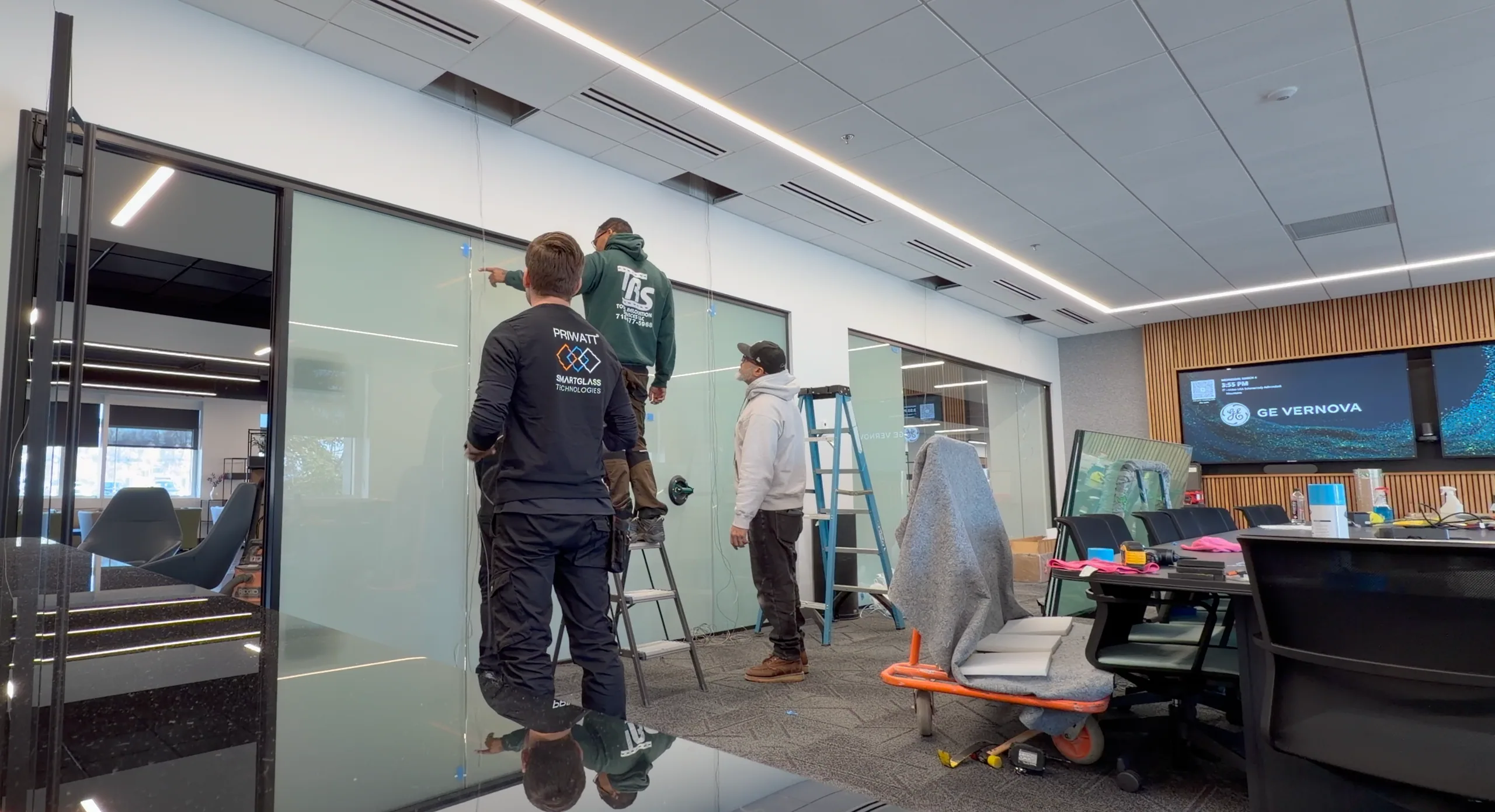
GE Vernova retrofitted existing interior partitions across offices, a conference room and the boardroom without replacing a single panel, in a building that stayed in use throughout. Replacing that glass would have closed the floor for weeks.
Roughly half the cost
PDLC film starts around $65 per square foot against about $145 for the laminated panel. Add the glazing work a replacement needs and the gap is wider than the rate suggests.
It works on exteriors too
DLC film on an exterior storefront at the Titleist Performance Institute: daylight into the training rooms, no view in from the car park, on glazing that was already installed.
What it needs in return: glass in sound condition, one face accessible and dry, and a route for the wiring to leave the panel. Existing tinted, reflective or coated glazing changes the optical result, so the make-up is worth confirming before the order, not after. Send a photograph and the glass spec with the sizes.
What film cannot do
Film cannot make a panel that does not exist. Everything below follows from that.
Certified safety glazing
The laminated products carry SGCC 9894. Where film goes onto glass already in the building, the safety-glazing question is about that glass and not about the film. That matters in a door, a shower, a railing or anywhere else the code calls a hazardous location.
Shapes, holes and cut-outs
Curves, notches and the holes hinges, patch fittings and locks need are made into the panel. Film is cut to glass that already has whatever geometry it has.
The edge is inside the laminate
On a made panel the switchable layer and the busbar are sealed between the glass, with the patented anchoring holding the connection through lamination. On film they sit on the face of the glass, behind the frame or a trim.
Acoustics and insulated units
STC ~37 is a property of the laminated build-up, and a switchable layer can go inside an insulating unit for the envelope. Neither is available by applying film to a pane that is already in the wall.
Film supplied cut, for someone else to laminate
There is a route between the two, and it is the one glass fabricators and window manufacturers use: PriWatt supplies the switchable film cut to size, and the partner laminates it into their own units on their own line. The panel is theirs; the switchable layer, the busbar anchoring and the electrical system are ours.
That is a supply relationship, not a product decision. The pages for glass fabricators and window manufacturers cover it. Four questions decide whether it suits a given line — the interlayer and the process, how the busbar is handled, where warranty sits when a third party laminates, and the commercial terms — and they are answered against your process rather than in general.
Common questions
It is the same liquid-crystal layer, with the same switching, the same voltage and the same power draw, and PDLC film is rated for over 800,000 switching cycles. What differs is everything around it: a laminated panel carries SGCC 9894 safety glazing, an STC rating and any shape you draw, while film inherits whatever the existing glass already is.
Yes — that is what it is for. The glass has to be sound, accessible and dry on one face, and there has to be a route for the wiring to leave the panel. Offices, clinics and storefronts are converted this way without any glazing being replaced.
Film, by a margin on the material: PDLC film starts around $65 per square foot against about $145 for laminated PDLC glass. The gap grows once the glazing work a replacement panel needs is counted.
It is in service on an exterior storefront at the Titleist Performance Institute, and the film is published for a wider cold range than the laminated products — -20 °C against -10 °C. Existing coated, tinted or reflective glass changes the optical result, so the make-up is confirmed before the order.
PriWatt supplies switchable film cut to size for fabricators and window manufacturers who laminate it into their own units. That is a supply arrangement rather than a retail one, and it starts on the glass fabricators or window manufacturers page.
PDLC film reaches 72 × 143 in and PDLC laminated glass 70 × 143 in; PNLC and DLC reach 57 × 143 in in both deliveries. Larger areas are divided into panels, which is a joint line rather than a limit.
Send the opening and we will say which one
Sizes, whether the glass is already there, what it is made of, and which state the room should hold with no power. That is enough for a price and a lead time on either route — including when the cheaper one is the right one. Pompano Beach, Florida; 1-866-PRIWATT (1-866-774-9288).