
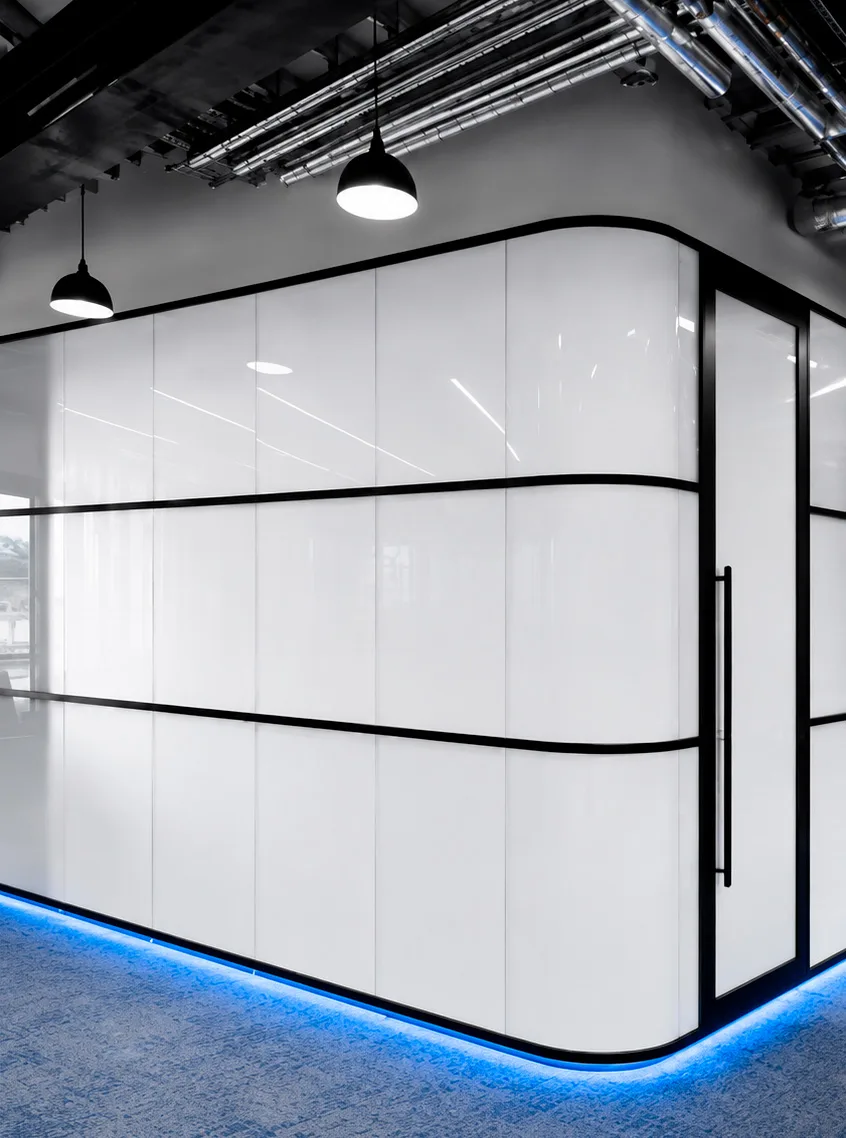
Curved glass
The curve is in the glass. The switchable layer follows it
Nothing about switchable glass is flat by nature. The liquid-crystal layer is a film thinner than half a millimetre, flexible enough to be applied by hand to glass already standing in a building. The geometry comes from the glass it is laminated between. So a curved switchable panel is a curved glass panel with a switchable layer in it, made the way any curved laminate is made.
PriWatt makes rectangles, curves and whatever else the opening requires, with the holes, notches and cut-outs the hardware needs. A curve is fabricated. It is not chosen from a list of sizes.
Two ways to a curved switchable surface
Laminated curved glass
The panel is made to the geometry: curved low-iron glass, heat-treated or fully tempered, laminated around the switchable layer. This is the route for a curved wall, a column, a radiused partition or a cylindrical enclosure, and the photograph above shows it.
Film onto curved glazing
Self-adhesive film applied to a curve that is already in the building. Film conforms in one direction, so a single-curvature surface (a bowed partition, a curved shopfront) is a retrofit. A compound curve is not.
Which of the two applies is usually decided for you: if the glass is already there and the building is in use, it is film. If the panel is being made anyway, it is laminated glass, and the switchable layer costs nothing in geometry that the curve has not already cost.
Have a project open? Send the radius and the developed length. A quotation comes back as a panel schedule with a transformer and a date, priced on the panels you actually need. Nothing drawn yet? Book twenty minutes with a project specialist.
The radius, the direction and the developed size
| Line | Why it is asked first |
|---|---|
| Radius | The tightest curve on the drawing, confirmed against what the glass can be formed to before anything is quoted |
| Single or compound curvature | A single curve is routine. A surface that bends in two directions is a different fabrication and, for film, not a retrofit |
| Developed size | The panel limit — 70 × 143 in on PDLC glass, 57 × 143 in on PNLC and DLC — is measured around the curve, not across the chord |
| Which edge the wiring leaves | The busbar sits on an edge; on a curve, which edge that is affects both the framing and the run |
| How it is held | Channel, clamps, patch fittings or a structural silicone joint — the fixing is designed with the panel, not after it |
| Joints between panels | A long curve is several panels. Where the joints fall is a design decision, and cheaper to make early |
Every project starts with a technical review and shop drawings before fabrication. On a curve that review is the project: send the radius and the developed sizes with the enquiry and the answer comes back as a price and a lead time, not as another question.
Reverse mode is the usual choice, and not for a technical reason
A curved glass wall is almost never built to be looked at frosted. It is built for the geometry, and the switching is there for the hour a room behind it needs to be private. That is the argument for reverse mode: clear with no power, private only while it is switched, and no power drawn for the ninety per cent of the week that the curve is doing what it was designed to do.
PDLC is the cheaper product and holds frosted unpowered. That suits a curved enclosure around something private: a stair core, a treatment room, a cylindrical meeting pod. Both are made to the same shapes.
Reverse mode in full
Clear with no power: what it changes for energy, the failure state and haze, and where it is wrong.
PDLC against PNLC
Haze, privacy, switching, voltage, power draw and panel limits, side by side.
What a shape costs
Curves, notches and holes are made, not ordered. What that does to the number.
Common questions
Yes. The switchable layer is a flexible film laminated between the glass, so the geometry is set by the glass. Curved panels are made to the drawing, along with the holes, notches and cut-outs the fixings need. The radius is confirmed at technical review before the panel is quoted.
It depends on the glass thickness, the make-up and the panel size, so it is answered against the actual drawing instead of published as a single figure. Send the tightest radius on the project with the developed sizes and it comes back confirmed or qualified. That is the first thing technical review looks at.
On a single curve, yes. Film conforms in one direction, and that is what turns a bowed partition or a curved shopfront into a retrofit instead of a rebuild. A compound curve, bending in two directions at once, is not a film application.
No. The panel runs at the same voltage from the same isolation transformer and draws under 0.5 W per square foot. The curve changes which edge the wiring leaves from and how the run is concealed. Both are drawn before fabrication.
Yes. A rectangle is the cheapest thing a plant can make; a curve is fabricated to the geometry. The pricing page has the ranges and what moves them. A curved panel is quoted against the drawing, never off a rate.
Built from the same six products
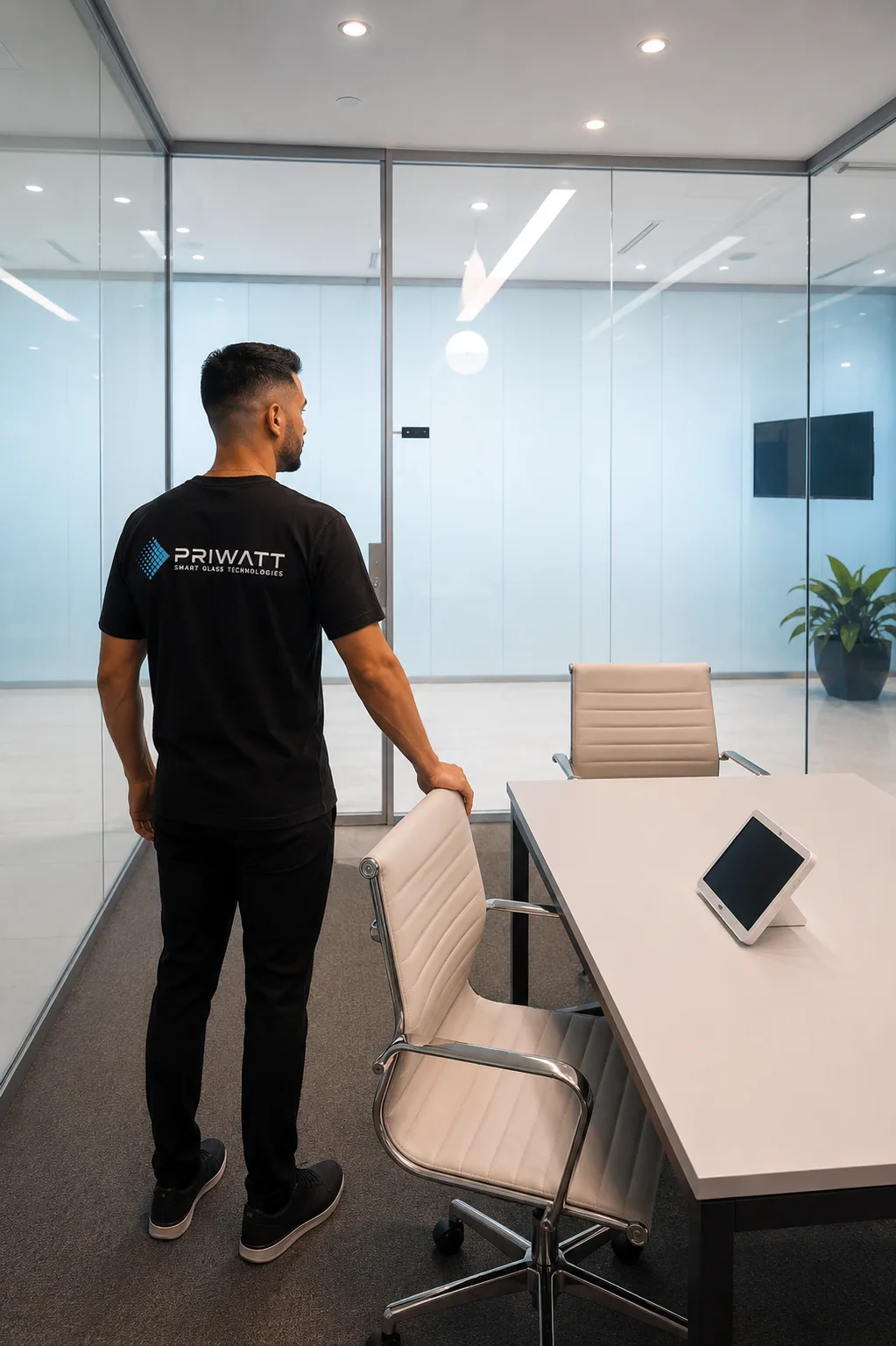
Office partitions
A wall of glass, not one panel: where the joints fall, whether the run switches together, and how a door in the middle is matched to the panels beside it.
Read more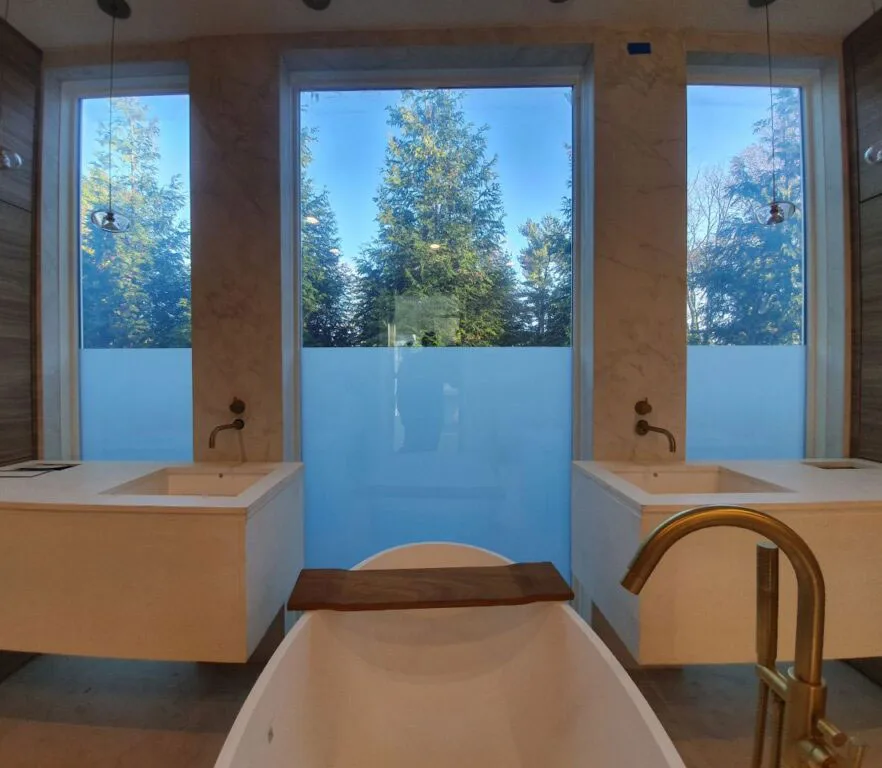
Windows
A window exists to be looked through, so reverse mode is usually the answer. And the honest limit: a switchable window frosts, it does not go dark.
Read more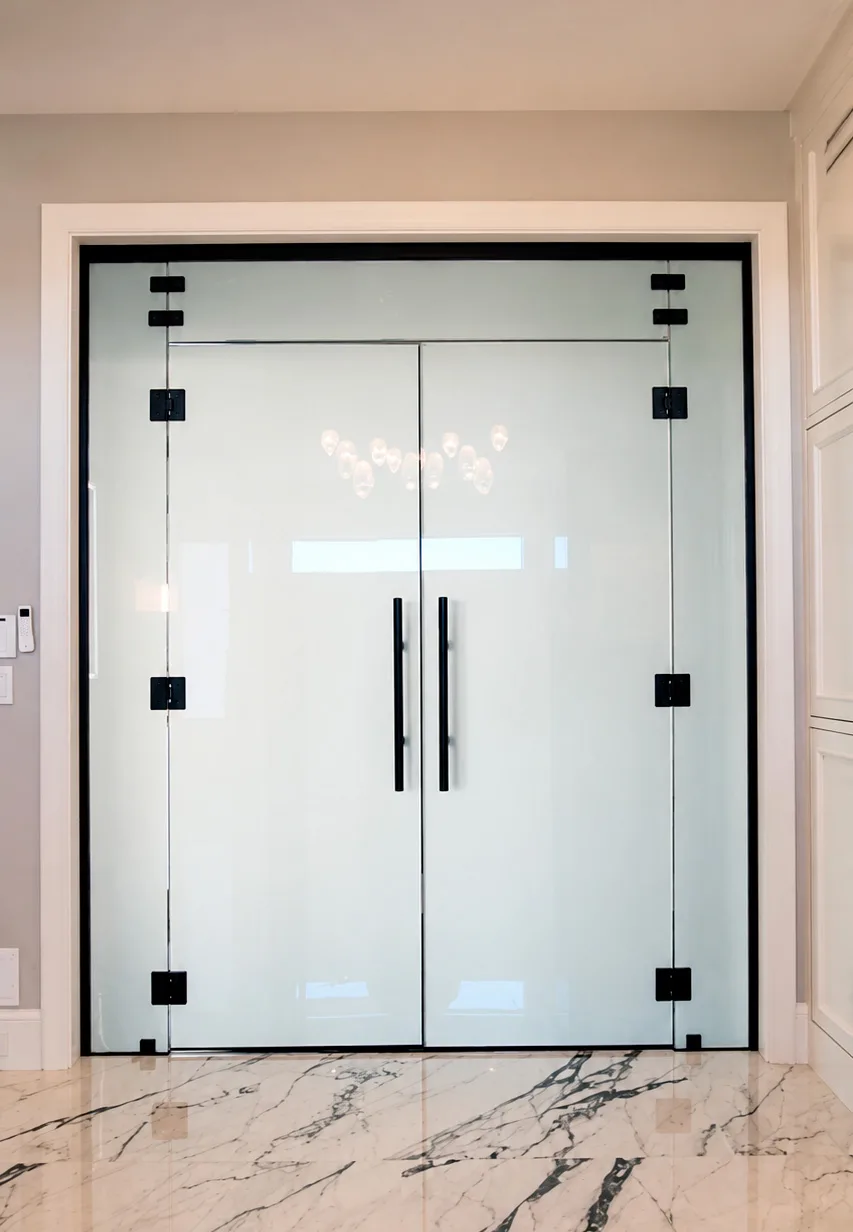
Doors
The one format where the glass moves, so the wiring becomes the detail and not the panel. Internal doors, entrances and glazed leaves in a partition run.
Read more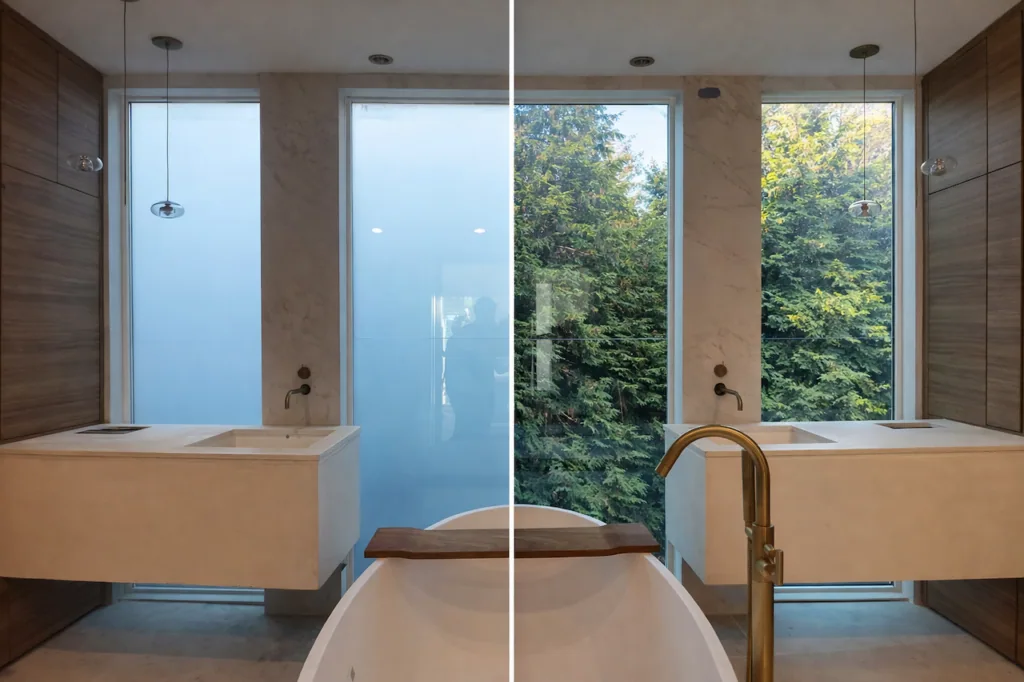
Shower enclosures
The room where the glass is the wall. Normal mode is frosted with no power, so a power cut leaves the enclosure private, the failure state a bathroom wants.
Read more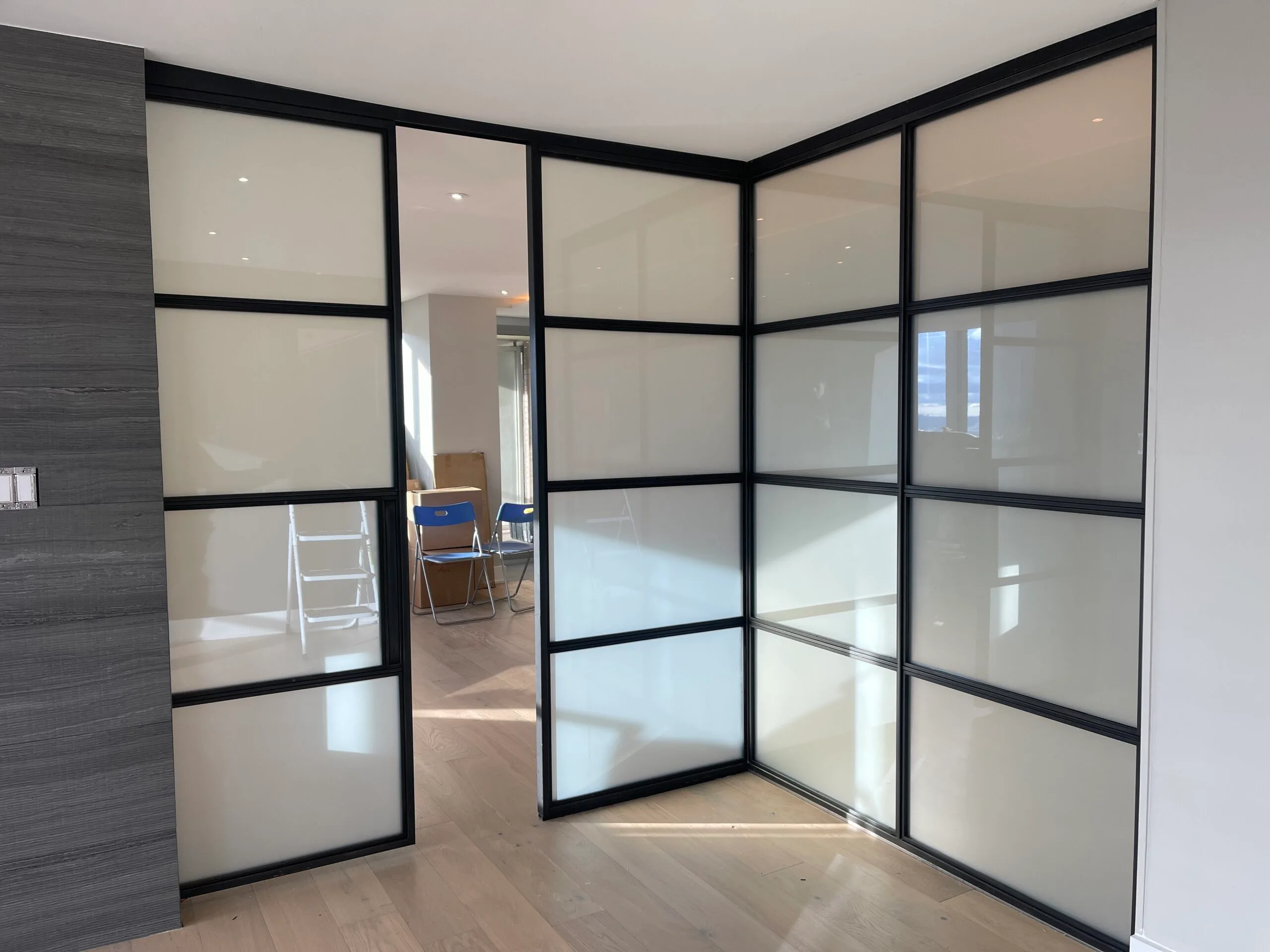
Room dividers
One room, or two. Fixed, sliding, stacking or folding. The question that belongs to this format alone is whether power has to reach a panel that moves.
Read more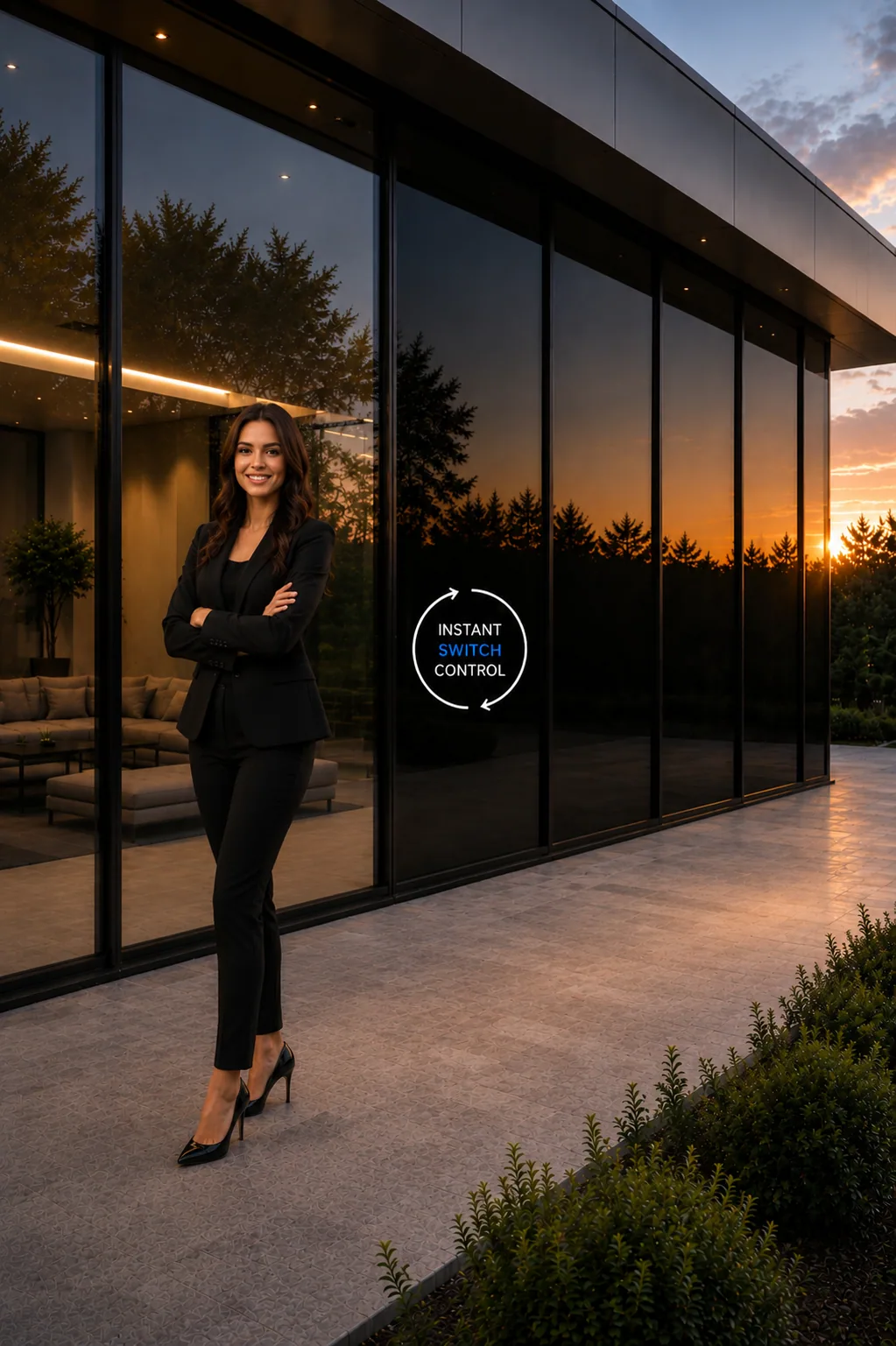
Skylights and overhead glazing
Overhead, the problem is usually the sun, not the neighbours. DLC moves between a tinted transparent state and a deep dark one: glare and solar gain, not privacy.
Read more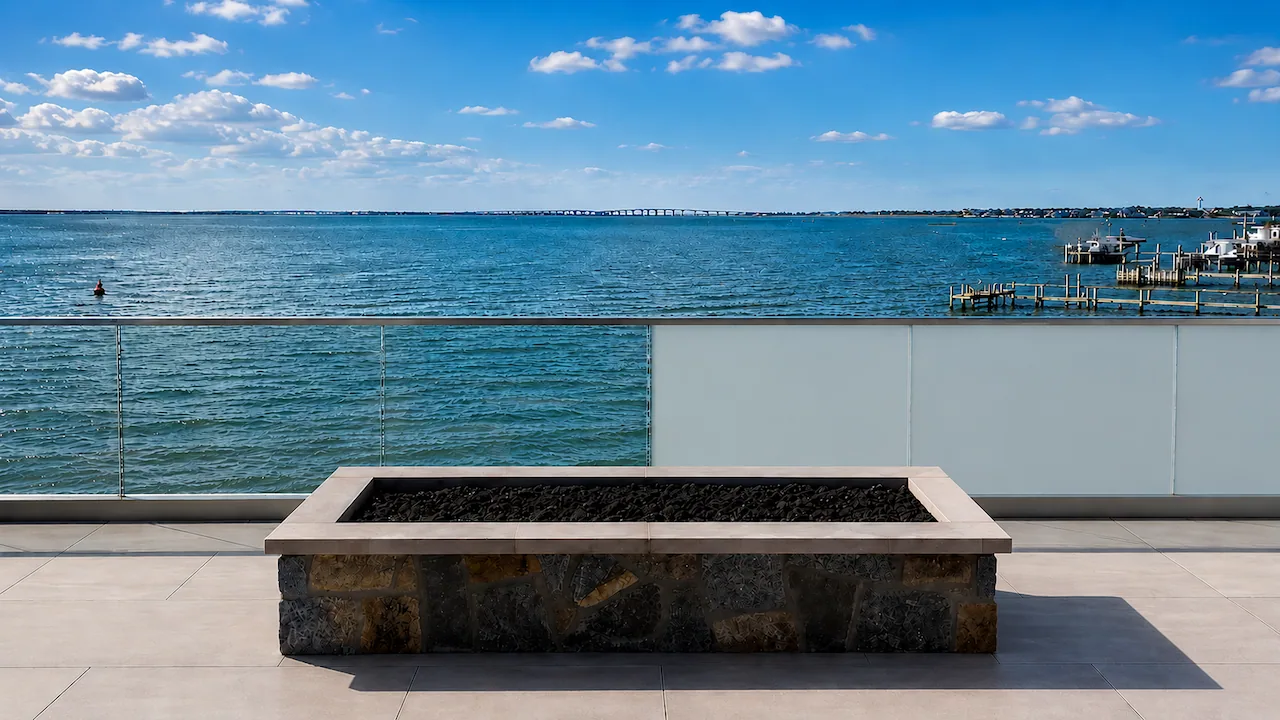
Railings and balustrades
Two projects in service: a New York waterfront terrace and a North Palm Beach pool deck. Reverse mode holds the view with no power drawn, and frosts for the hour it is wanted.
Read moreSpecialized
Curves, display cases, cleanroom panels, studio sets and rear-projection surfaces. Rarely the shape that makes a project unusual; usually the edge, the movement or the duty cycle.
Read moreSend the opening, not the product code
Sizes, the shapes, whether the glass is already in the building and which state it should hold with no power. That is enough for a price and a lead time. Pompano Beach, Florida; 1-866-PRIWATT (1-866-774-9288).