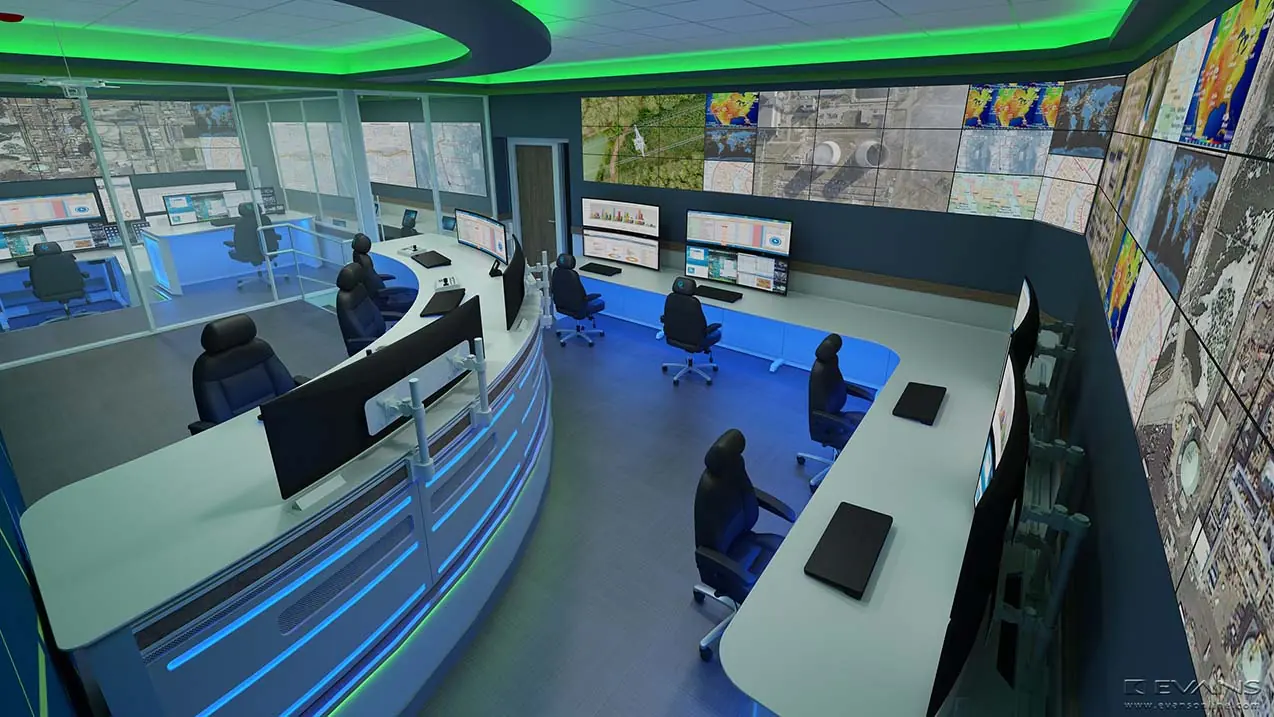
PriWatt film in Florida Power & Light’s drone command room
Four trades, one glass wall
FPL flies drones to inspect its network — routine checks that find a fault before it becomes an outage, and, after a storm, assessments of flooded ground nobody can walk on. The command room those flights are run from was built with a glazed front and a motorised sliding door.
Over 130 square feet of PriWatt film went onto it, across three days. What makes this project worth reading is not the film. It is who else was on it.
Who did what
| Scope | Who |
|---|---|
| Glass and glass frames | Mercury Glass & Mirror, supplied and installed |
| Motorised sliding door | A separate specialist partner |
| Prewiring and all high-voltage work | FPL’s own people; it is an electricity utility |
| Switchable film, and the low-voltage side of it | The PriWatt installer, over three days |
That table is the honest shape of most switchable projects, and the thing brochures leave out. PriWatt makes a switchable layer and the transformer that drives it. The glass, the frames, the door gear and the mains supply belong to other people, and the job succeeds or fails on whether those scopes were drawn against each other before anyone ordered anything.
On this one they were, and that is why 130 square feet took three days instead of three visits.
The sliding door is the part to design first
A motorised leaf is a switchable panel that changes position, and power has to reach it wherever it is. There are two answers and they have to be chosen, not discovered: power travels with the leaf through the track, or the leaf is switched only in its closed position, which, for a room that is private when it is shut, is usually all anyone wanted.
- Which of the two, agreed with the door supplier before the glass is made
- Where the busbar sits on a leaf whose edge is occupied by the operator and the track
- Whether the fixed panels beside it switch on the same circuit or separately
- What the door does on loss of power, which on an automated leaf is a life-safety question and not only a privacy one
Doors and room dividers take the same problem through a hinged leaf and a manual slider.
What the room actually needed it for
Screens that should not be read in passing
A command room is full of monitors. Most of the time that is fine and occasionally it is not, and the requirement changes by the hour, not by the room.
A room that is meant to be seen
It was glazed on purpose — an operations room that reads as open is worth having, and a solid wall would have removed the reason for building it that way.
Switched, not managed
Under 200 ms from clear to private, at a switch. Nothing to draw, nothing to raise, nothing that depends on somebody being near the glass.
PriWatt panels take five kinds of control — wall switch, touch panel, app, remote, or the building’s automation system — and on an operations floor the last of those is worth asking about early, because a room that closes on a condition beats a room that closes when somebody remembers.
Specified on this project
PriWatt PDLC switchable film
Self-adhesive film applied to glass already in the building. Private unpowered, clear when switched.
Switchable doors
A leaf moves, so power has to cross a joint that moves with it.
Offices and boardrooms
Partitions, meeting rooms and executive offices — the application this belongs to.
A project like this one
A control room, an operations floor, or any glazed enclosure where a motorised door is part of the assembly. PriWatt manufactures in Pompano Beach, Florida. Every quote is worked from the project’s own drawings, so send dimensions. A photograph with the sizes written on it does the same job. Earlier than that, book the call.