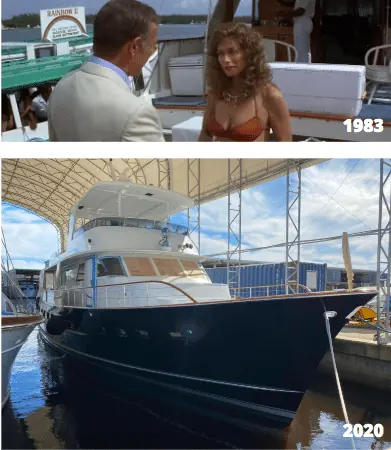
PriWatt film on the windows of a yacht from Never Say Never Again
Eight windows, no two the same
Small World appeared in Never Say Never Again in 1983 and was forty-four years old when this work was done. Her owner had tried shutters and wanted the glass itself to do the job: sun and privacy controlled at a switch, with nothing added to a saloon where every surface is bespoke.
PriWatt self-adhesive film went onto eight windows: 77 square feet in total, on three transformers and three separate switches, in two days on board.
The measured job
| On this project | |
|---|---|
| Windows | 8 |
| Switchable area | 77 sq ft |
| Transformers | 3 |
| Switched zones | 3, independently |
| Time on board | 2 days |
| Product | PriWatt PDLC self-adhesive film, onto the existing glazing |
Three transformers for 77 square feet looks generous until you see why: it is not the area that needed splitting, it is the control. Three switches means three parts of the boat close independently, which on a vessel is the difference between a useful system and one that darkens the saloon because somebody wanted the cabin private.
Sizing works the same way everywhere. A unit is rated for the area on its circuit, and the number of circuits is a decision about how the space is used. That sizing is worked through on isolation transformers.
Two problems that do not occur in a building
Nothing is rectangular
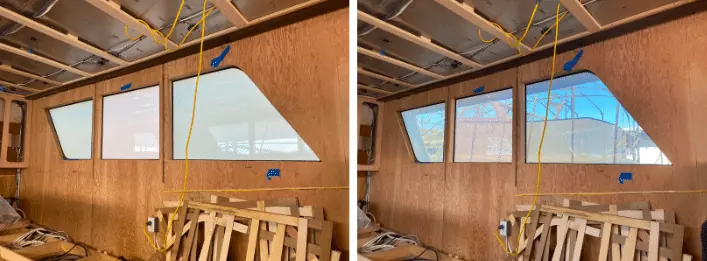
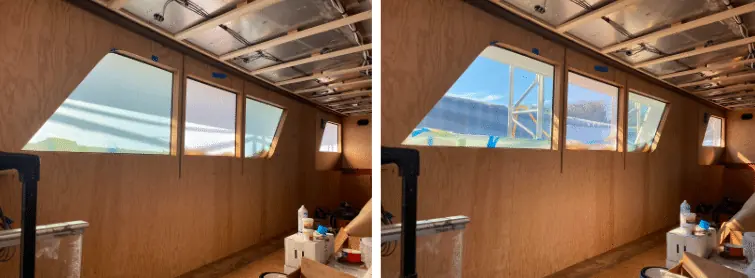
Every window had radiused corners and every one was a different size, because everything on a boat is custom. Film has to be cut to the opening before it goes anywhere near it.
The glass is green
Marine glazing is tinted, and a scratch that is obvious on clear glass is hard to see on green. Finding them before the film goes on is the difference between a defect and a callback.
The corners were solved with patterns, not with a tape measure. Blue tape was laid to the shape and lifted as one piece; that was refined into timber patterns cut frame to frame, which the installer could offer up and adjust at each corner before anything was cut. It is slow. It is also the reason the film fits.
Shape is a normal request, not a special one. PriWatt fabricates to the drawing, including curves, notches and cut-outs. What changes on a boat is that the drawing has to be taken off the vessel first.
Why film and not glass, on a boat particularly
- The glazing is structural and sealed against water; replacing it is a refit, not an upgrade
- Film is applied to the inboard face of what is already fitted, so nothing is removed from the hull or superstructure
- It is cut to shape on board, which a laminated panel ordered to a drawing cannot be
- The film blocks ultraviolet, which on a vessel matters to the joinery and upholstery as much as to the people
On the last point, PriWatt states UV blocking as a property of the film and publishes no percentage for it, so none is quoted here. Everything that is measured (switching times, haze, panel limits, power draw, cycle life, temperature range) is in the technical reference. The film’s rated range is −20 to 60 °C, the figure worth checking on a boat that sits in the sun.
Specified on this project
PriWatt PDLC switchable film
Self-adhesive film applied to glass already in the building. Private unpowered, clear when switched.
Switchable windows
Exterior glazing, where solar gain matters as much as privacy.
Specialized
Curves, cases, cleanrooms and sets.
A project like this one
A yacht, a shaped opening, or any glazing where nothing is a standard rectangle. PriWatt manufactures in Pompano Beach, Florida. Every quote is worked from the project’s own drawings, so send dimensions. A photograph with the sizes written on it does the same job. Earlier than that, book the call.