A home cinema projected onto switchable glass walls
The wall is the screen, and the rest of the time it is a window
The client wanted to project onto his glass walls. That is possible because of what a switched PDLC panel is: in its private state the liquid-crystal droplets sit at random angles and scatter light in every direction, precisely the property a rear-projection screen is bought for.
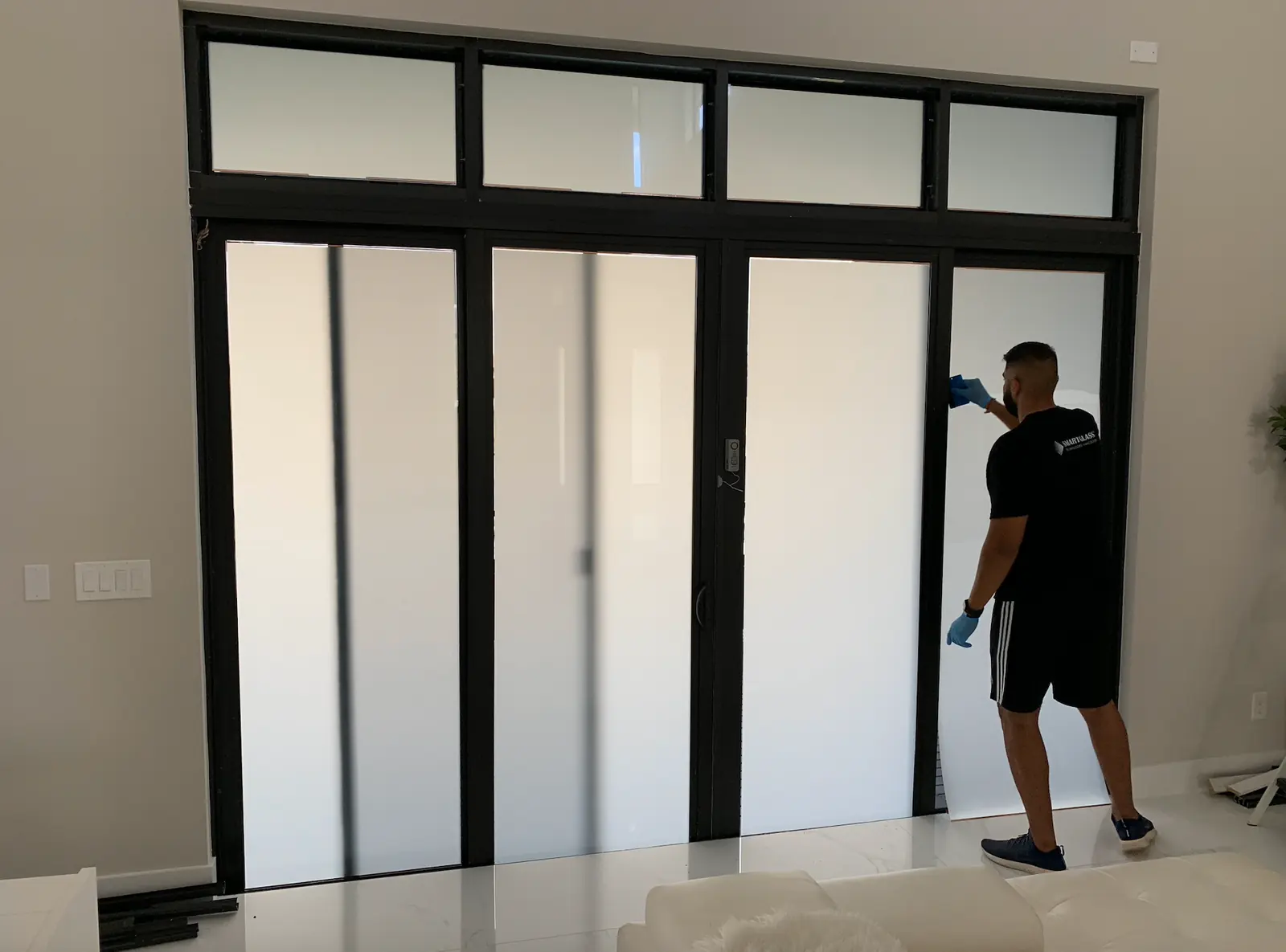
About 600 square feet of PriWatt film went in: 200 on an exterior window and sliding doors, and 400 across two custom-built home cinemas. Ten days to manufacture the film, six to install it.
What a film installation actually consists of
This project was documented step by step. That is unusual, and worth publishing in full, because "peel and stick" describes about a fifth of the work.
| Stage | What happens |
|---|---|
| Clean and inspect | Not a normal clean. The glass is gone over in detail and every imperfection is found and noted, because a scratch or a chip under the film is permanent once the film is on it |
| Inspect the roll | The film is unrolled and checked before any of it goes near the glass |
| Application | Worked onto the pane by feel as much as by eyea bubble or a piece of lint is found with a hand before it is seen, and there is a technique for lifting each out |
| Seal the edges | Non-conductive silicone around the perimeter, against condensation and against water finding the edge during cleaning |
| Wiring | Two problemsconcealing the runs, and getting power to panels in doors that move |
| Final connection | A certified electrician makes the connection to the mains. The low-voltage side is the installer’s; the supply is not |
| Final inspection | The whole installation is switched and gone over again |
The first row is the one that decides how the job looks in five years, and it happens before anything is applied. The fourth is the one people skip.
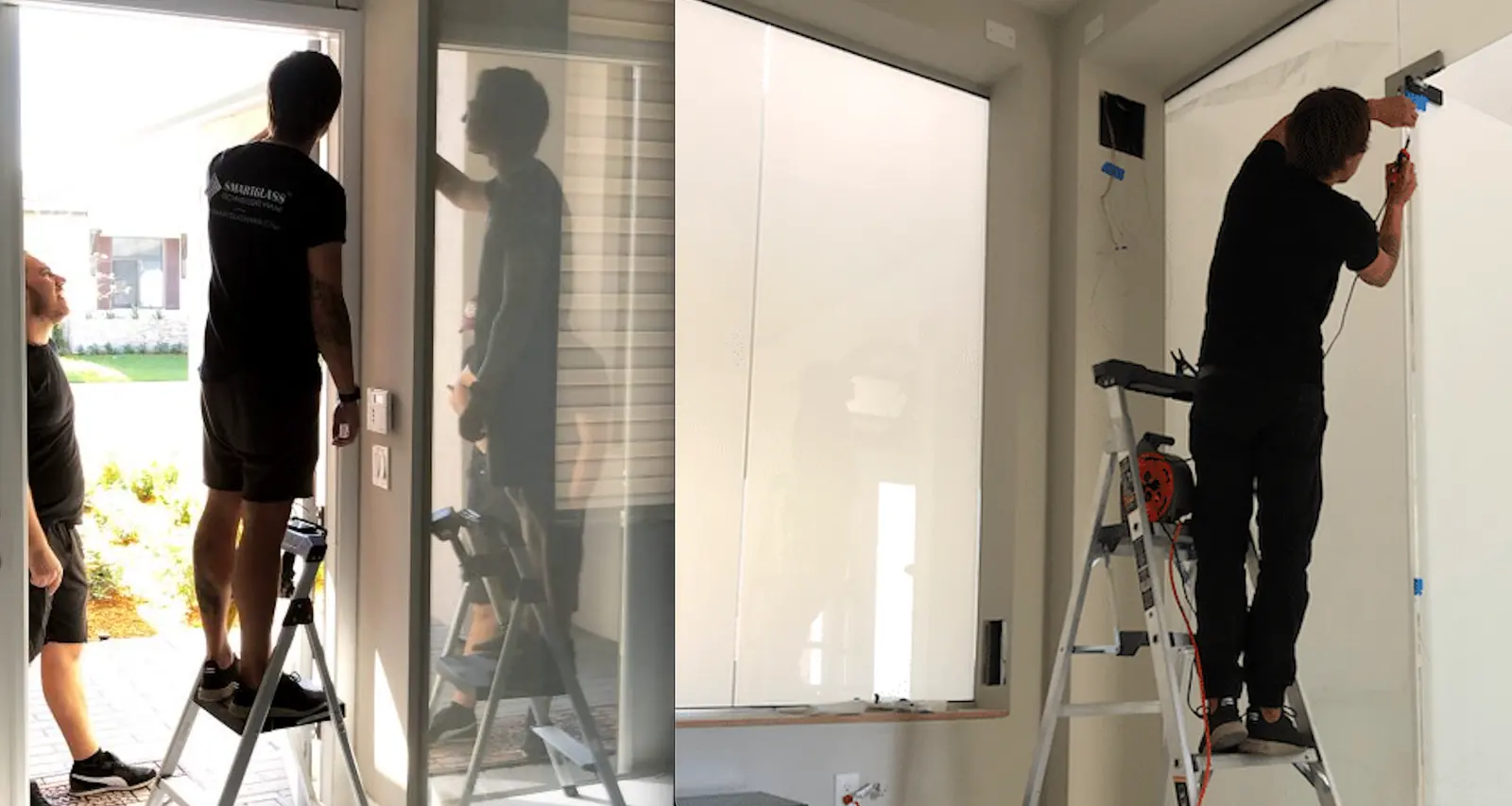
Getting power into a door that moves
Two hundred of the six hundred square feet were on an exterior window and sliding doors, and a moving leaf is the part of any switchable project that has to be solved, not assumed. There is no single answer; there is a set of them, and which one suits depends entirely on the door gear.
- Reel cables, which pay out and retract as the leaf travels
- Coil wires, for shorter runs where the slack can live in the head
- Transfer hinges, which carry the conductor across a hinged joint
- Armoured cable where the run is exposed to anything
- Custom tracking, where the door system has no provision and one has to be made
Sliding, swinging and tilting systems each behave differently, and the choice is made with whoever supplies the door, before the glass is made and not after it arrives. In a commercial setting the same problem turns up on doors and room dividers.
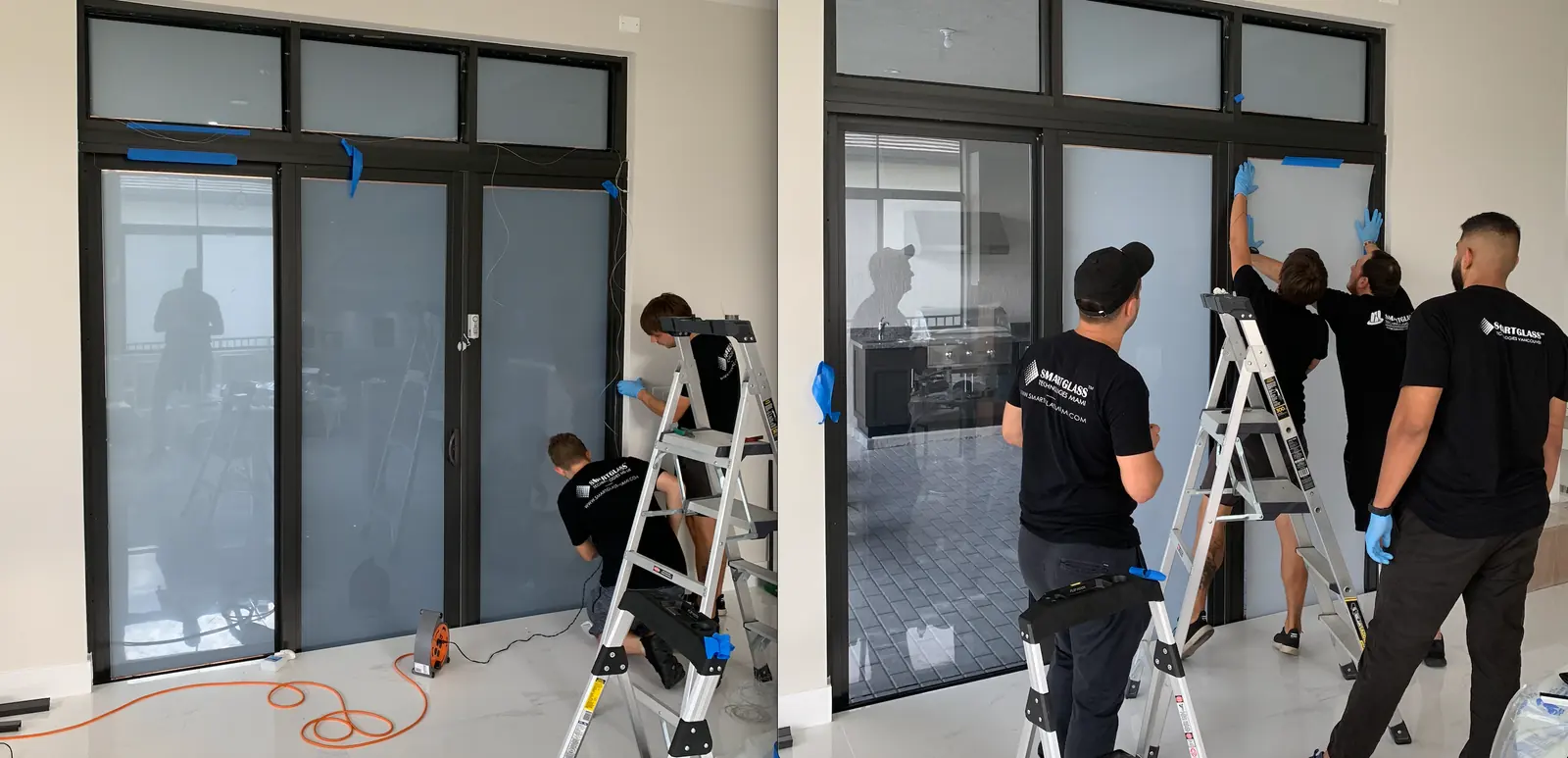
Sixteen days, and where they went
Ten days manufacturing, six installing. Worth stating in that order, because the assumption is usually the reverse: that a film job is quick and the material is off the shelf. It is not. The film is made to the panel schedule, and the site work is the shorter half.
That is also the argument for settling the drawing early. Sizes, the state each panel should hold with no power, where the wiring leaves, and how power crosses every moving joint are all manufacturing inputs. Once they are fixed, six days is what a house this size takes.
Specified on this project
PriWatt PDLC switchable film
Self-adhesive film applied to glass already in the building. Private unpowered, clear when switched.
Rear-projection surfaces
A switched panel is a 94–95% haze diffusing surface, which is what a projection screen is.
Residential
Bathrooms, glazed stairwells, terraces and railings.
A project like this one
A home cinema, a media room, or any wall that has to be a window most of the time and a screen for the rest of it. The glass and the film are made in Pompano Beach, Florida, and nothing here is priced off a rate card. Send dimensions, or a photograph with the sizes written on it, and the quote comes back against your panels. If you are not that far along, book the call.