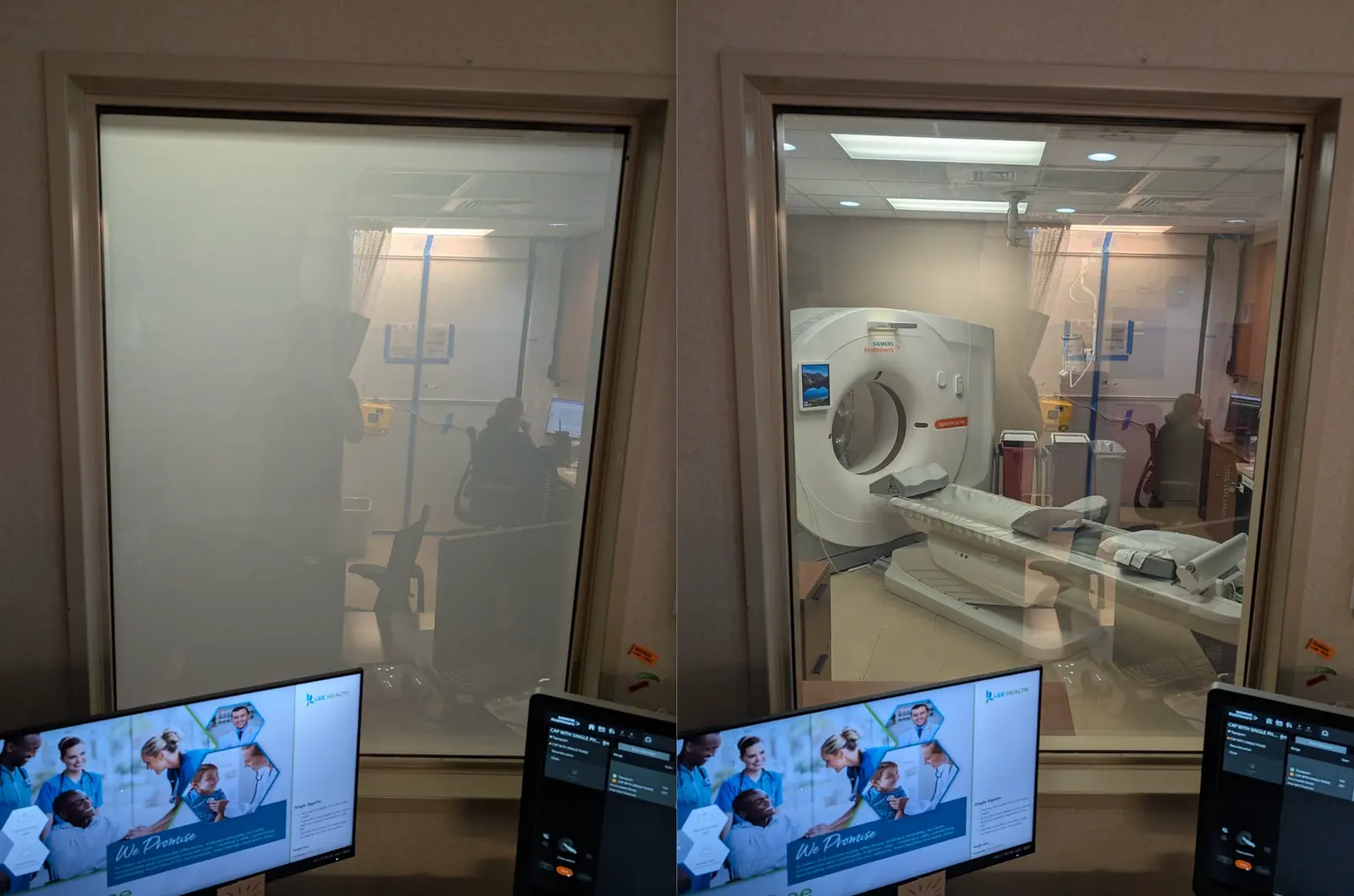
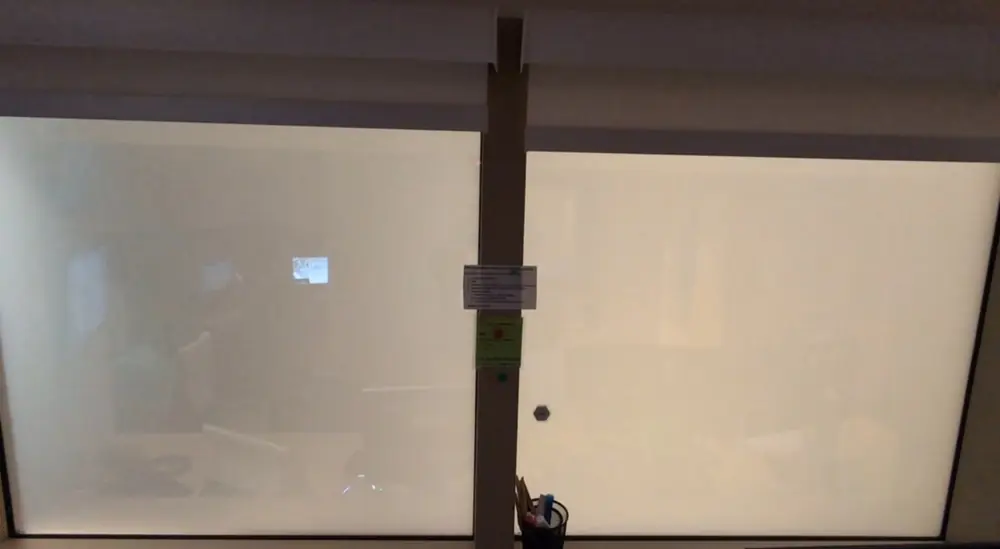
PriWatt film on the MRI observation window at Lee Health, Fort Myers
The window was already there. Only what it does changed.
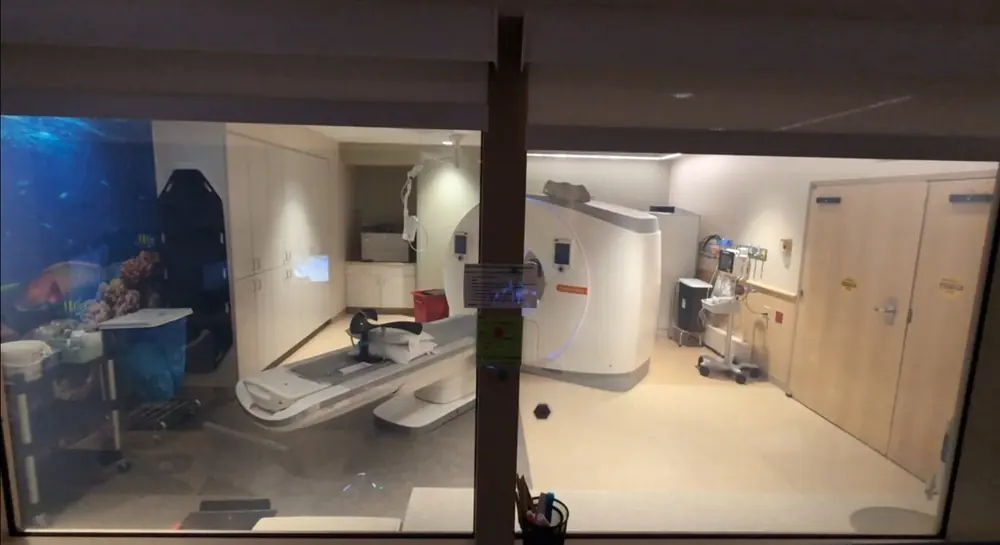
An MRI control room has an observation window because it has to: the operator sits outside a shielded room and the glass is the only line of sight to the patient. What that glass could not do was stop being transparent.
PriWatt PDLC film was applied to the interior surface of the existing window at Lee Health’s Outpatient Center in Fort Myers, with the low-voltage wiring concealed inside the frame and run to a wall control. Nothing was re-glazed and the room was not rebuilt.
Why the retrofit route matters in an imaging suite
An imaging room is one of the more expensive rooms in a hospital to take out of service, and its glazing is not a plain window. It sits in a shielded partition whose integrity somebody has certified. Every option that involves removing that pane is a bigger project than the privacy requirement justifies.
- The pane stays, so the shielded assembly is left exactly as it was commissioned
- The work is on the control-room side, not inside the magnet room
- The wiring is concealed in the existing frame: no surface trunking in a clinical space
- A single wall control, so the change is part of the operator’s routine and not an extra system to learn
The last one is what makes it get used. A privacy measure that requires anybody to walk anywhere is a privacy measure that happens sometimes; a switch beside the console happens every time.
Which state, and when
| Moment | The window |
|---|---|
| Patient arrives and is positioned | Opaque; this is when the room is least private and most people are in it |
| Scan running | Clear, for continuous observation, up to three quarters of an hour |
| Patient sedated or anaesthetised | Clear, and not negotiable |
| Changing, before and after | Opaque |
| Room empty between patients | Either. On normal-mode film, opaque is the state that costs nothing |
The film here is normal mode: private with no power, clear while switched. In an imaging suite that is almost always the right way for it to fail: a supply interruption leaves the window opaque instead of exposing a patient. The reverse arrangement, reverse mode, suits a room that is open most of the day and is the wrong instinct here.
Two things stated more carefully than the industry usually does
Cycle life is a lifetime figure, not a daily one. PriWatt publishes over 800,000 switching cycles for PDLC film. An imaging suite switching twenty times a day would take a century to reach it, which is the point. But the number is a total, and seeing it quoted as a daily capability is how specifiers end up mistrusting the whole datasheet.
Curtains are not prohibited. Fabric privacy curtains remain in use across hospitals under laundering protocols, and saying otherwise overstates the case for this product. The honest comparison is narrower and still favourable: there is no textile in the room, nothing leaves it to be washed on a schedule, and the surface is cleaned with the glazing.
The same distinction, and what a switchable panel does not do acoustically, is on on the Moffitt Cancer Center page.
Specified on this project
PriWatt PDLC switchable film
Self-adhesive film applied to glass already in the building. Private unpowered, clear when switched.
Healthcare and clinics
Observation walls, consulting rooms and imaging suites.
Glass or film
When a project wants a laminated panel and when it wants film on the pane that is already there.
A project like this one
An imaging suite, a control room, or any observation window that has to be converted without closing the room. PriWatt makes the glass and the film in Pompano Beach, Florida, and quotes every project off its own drawings. Send dimensions, or a photograph with the sizes written on it. No drawings yet? Take the call instead.