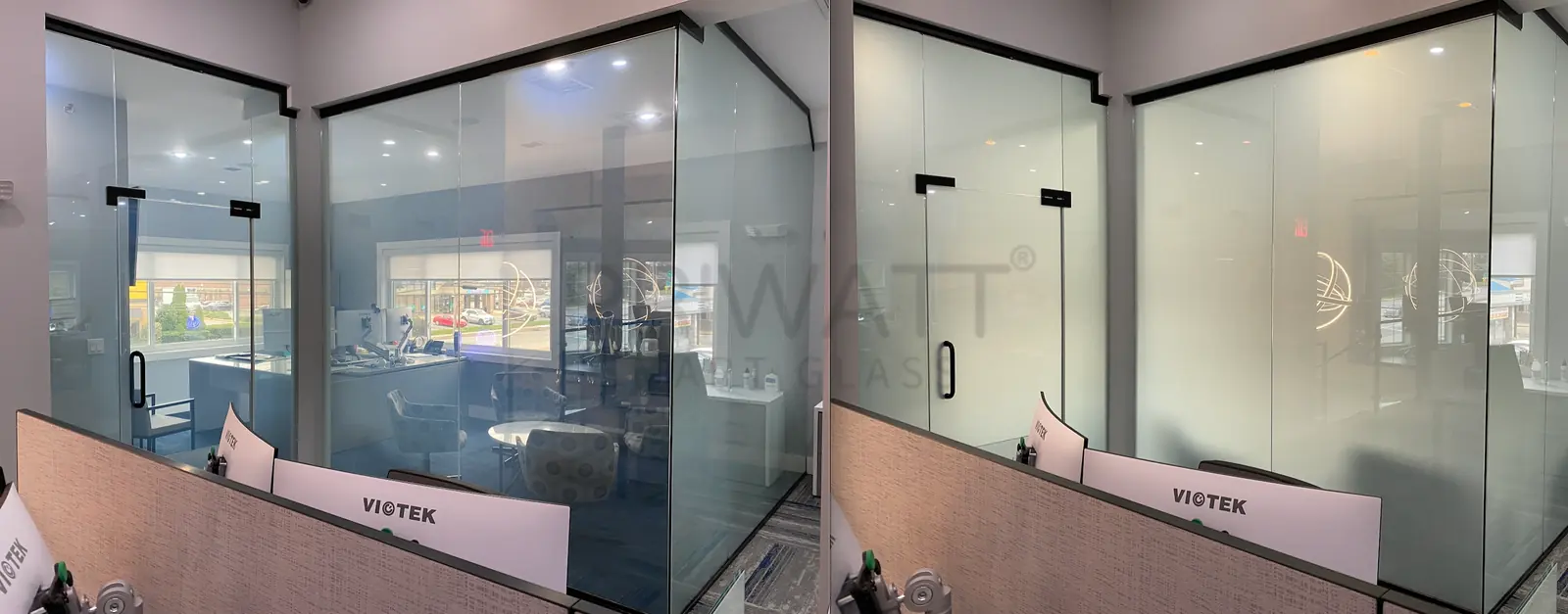

PriWatt film in the private event areas at Dave & Buster’s
A room that is sold twice
An entertainment venue makes money from its floor twice over. Most of the week it is open, and the whole point is that the place looks busy from wherever you are standing. Then it is hired out for a birthday, a corporate evening or a private party, and the same area has to become a room somebody has paid to have to themselves.
PriWatt switchable film went into the VIP and private-event areas at selected Dave & Buster’s locations, which lets a zone be sold as exclusive without anything being built or wheeled in.
Why a curtain is a worse product in a venue than in an office
- It has to be operated by staff at the start and end of every booking, and that is time nobody costed
- It is fabric in a room with food and drink in it, on a floor that is cleaned nightly
- Drawn, it reads as a screened-off area and not a private room: the guest can tell they are behind a curtain
- It has to be stored somewhere when the area is open, and that somewhere is usually visible
The third is the commercial one. A venue charging for exclusivity is selling a feeling, and a state change delivers it in a way a hanging textile does not. The area reads as a room, not as a section of a bigger floor with something pulled across it.
The screens, the part specific to this building type
An arcade floor is a room full of emissive displays behind a glazed elevation. Daylight landing on a game screen is a contrast problem: the image is still there and nobody can read it. It happens for a few hours a day on whichever side faces the sun.
Switching the glazing on that elevation reduces the light reaching the screens without darkening the room, because the private state scatters light instead of stopping it. That is a genuine optical benefit, and worth separating from the ones this page does not claim.
What is claimed
Less direct light on the screens, and a room that is still daylit while that is happening. Both follow from how the panel works.
What is not
A number for UV or infrared. PriWatt publishes none for this film, so this page quotes none. An interior partition is not doing solar work at all.
Where solar really is the job
On a facade, and the product is different: DLC switches between a tinted clear state and a deep dark one, with published transmission figures.

The number to check before a hospitality rollout
Cycle life. It is the one nobody asks about until the second year. A boardroom partition is switched twice a day. An event space is switched at the start and end of every booking, in a venue that takes several a day, seven days a week. Call it a few thousand switches a year per zone.
PriWatt publishes over 800,000 switching cycles for PDLC film and over 600,000 for PNLC and DLC. Against that arithmetic it is comfortable, and the reason to say so is that the arithmetic is worth doing. Every published figure is in the technical reference.
Second question for a chain: which state should hold with no power? A venue almost always wants clear, so the floor reads open when nothing is switched. That points at reverse mode instead of the normal-mode film used here, and it is a decision worth making once for the estate, not per site.
Specified on this project
PriWatt PDLC switchable film
Self-adhesive film applied to glass already in the building. Private unpowered, clear when switched.
Public spaces
Museums, retail, hospitality and lobbies, where the glass is part of the visit.
Room dividers
One room, or two — and what changes when the divider moves.
A project like this one
A venue, a restaurant, a members’ area or any floor that is sold open on some nights and private on others. The glass and the film are made in Pompano Beach, Florida, and nothing here is priced off a rate card. Send dimensions, or a photograph with the sizes written on it, and the quote comes back against your panels. If you are not that far along, book the call.