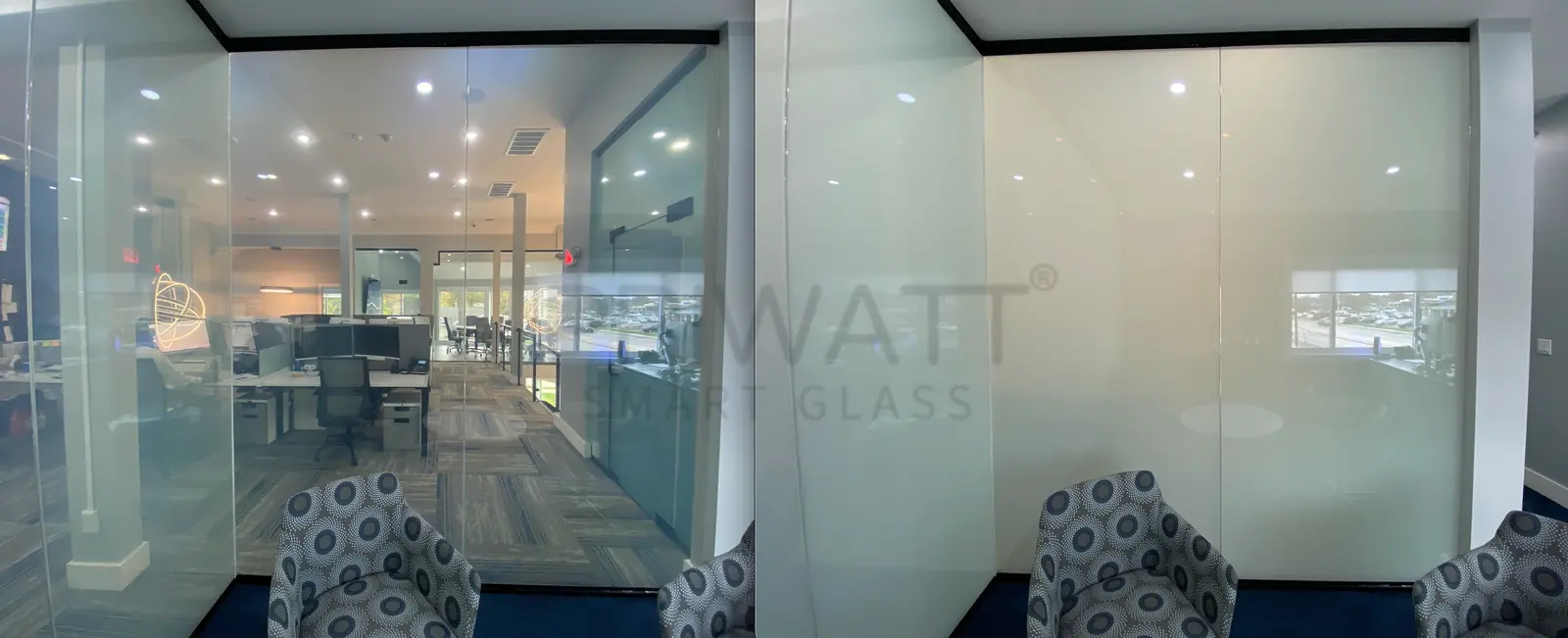
PriWatt film retrofitted into Allstate’s New Jersey office
Three rooms, not the whole floor
Two private offices and one conference room. That is the entire scope, and worth leading with, because it is the part most enquiries get wrong in the other direction.
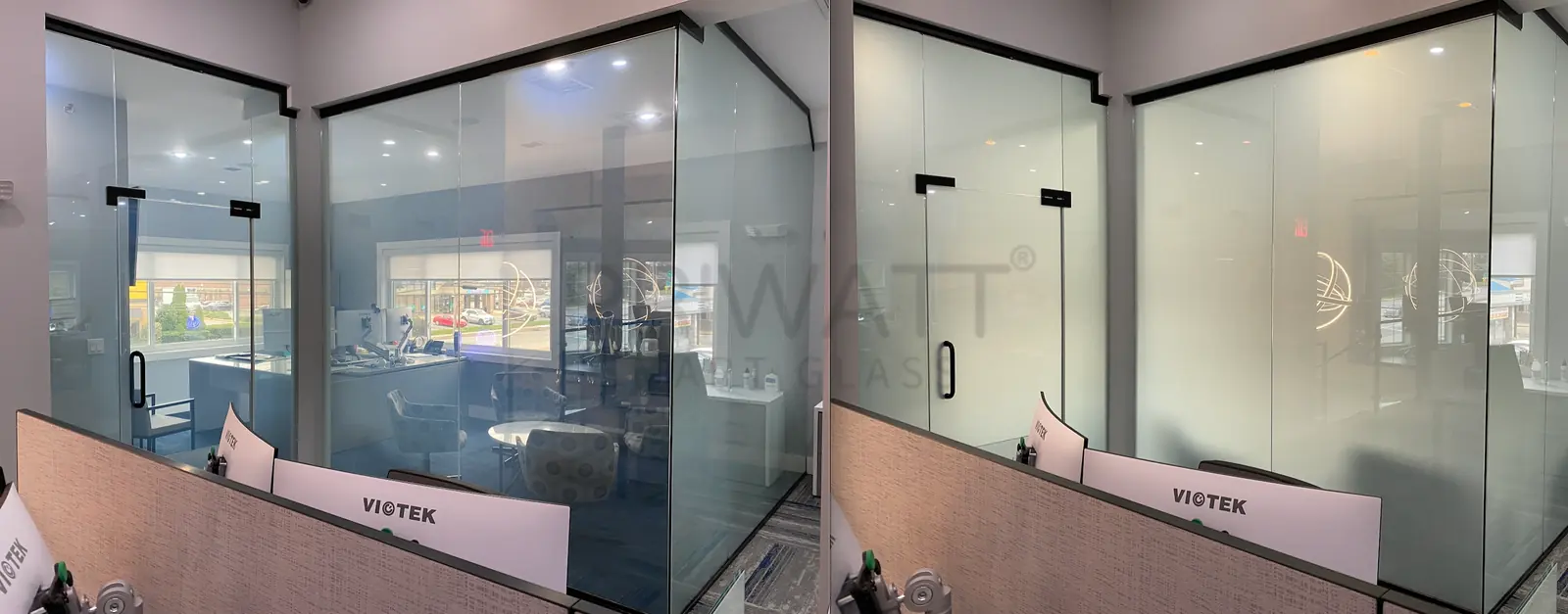
Allstate’s New Jersey office had 200 square feet of PriWatt PDLC film applied to the glass already in those three rooms, over two days, fitted around a working week instead of shutting one down.
The electrical figures, which are the useful ones
| Value | |
|---|---|
| Supply | 48 V AC, from an isolation transformer |
| Draw, clear state | Under 0.5 W per sq ft |
| Draw, private state | None; normal-mode film uses power only while it is transparent |
| This installation | 200 sq ft, so under 100 W with the whole of it switched clear |
| Switching | Under 200 ms |
The fourth line is the arithmetic worth doing before a meeting with a facilities manager, because the number is usually smaller than people expect. A floor’s worth of switchable glazing is a lighting circuit, not a plant item. It is also why the transformer is sized to area and not to panel count: see isolation transformers.
Note which state costs nothing. Normal-mode film draws while clear and nothing while private. Right for a room that spends its day closed, wrong for one that spends its day open. That is the argument for reverse mode in a nutshell.
Why three rooms is the right answer
The commonest way to overspend on switchable glazing is to specify every glazed surface on a floor. Most of them do not want it. Circulation glazing is there to be looked through; a focus room that is closed all day wants a wall; an open-plan area has no privacy requirement to solve.
- Two private offices, glazed onto the floor so the room reads as open, closed for a conversation about a claim, a file or a person
- One conference room: legible between meetings, private the moment client material is on the table
- Everything else on the floor left as plain glazing, because nothing about it changes during the day
The test is simple, and worth applying room by room: does the privacy requirement of this space change during the day? If it never changes, a fixed answer is cheaper and better in both directions.
Peel and stick, and what that phrase hides
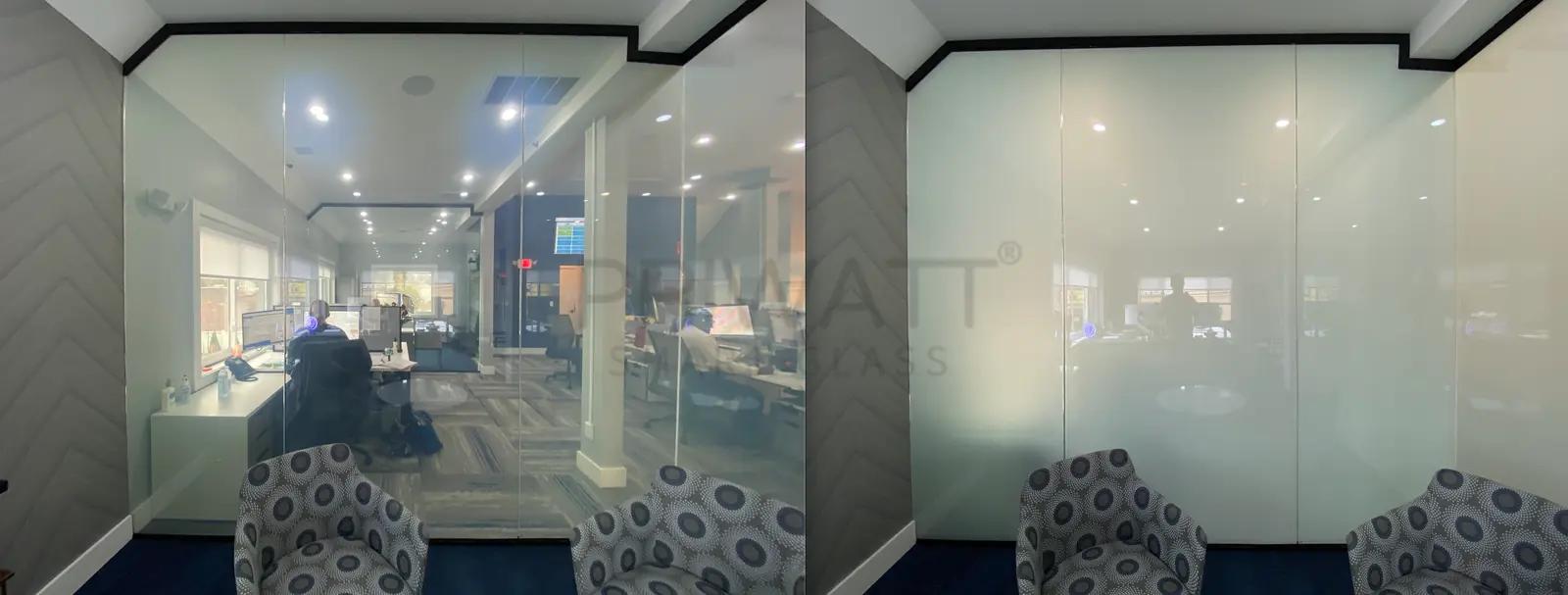
The film is self-adhesive and goes onto glass that is already in the partition, which is genuinely why a job like this takes two days instead of a fortnight. What the phrase leaves out is that the low-voltage side is still an electrical installation: each panel has a busbar and a tail, the tails have to reach a transformer, and the route they take through the partition framing is the part that has to be worked out, not improvised.
That is the honest version, and it is the same on every retrofit: the film is the quick part and the wiring is the project. Glass or film covers which projects want which.
Specified on this project
PriWatt PDLC switchable film
Self-adhesive film applied to glass already in the building. Private unpowered, clear when switched.
Offices and boardrooms
Partitions, meeting rooms and executive offices — the application this belongs to.
Office partitions
How a glazed run is built: where the joints fall, and how one transformer serves a wall.
A project like this one
A handful of rooms on an occupied floor, not a whole building. That is what most of these projects actually are. PriWatt manufactures in Pompano Beach, Florida. Every quote is worked from the project’s own drawings, so send dimensions. A photograph with the sizes written on it does the same job. Earlier than that, book the call.