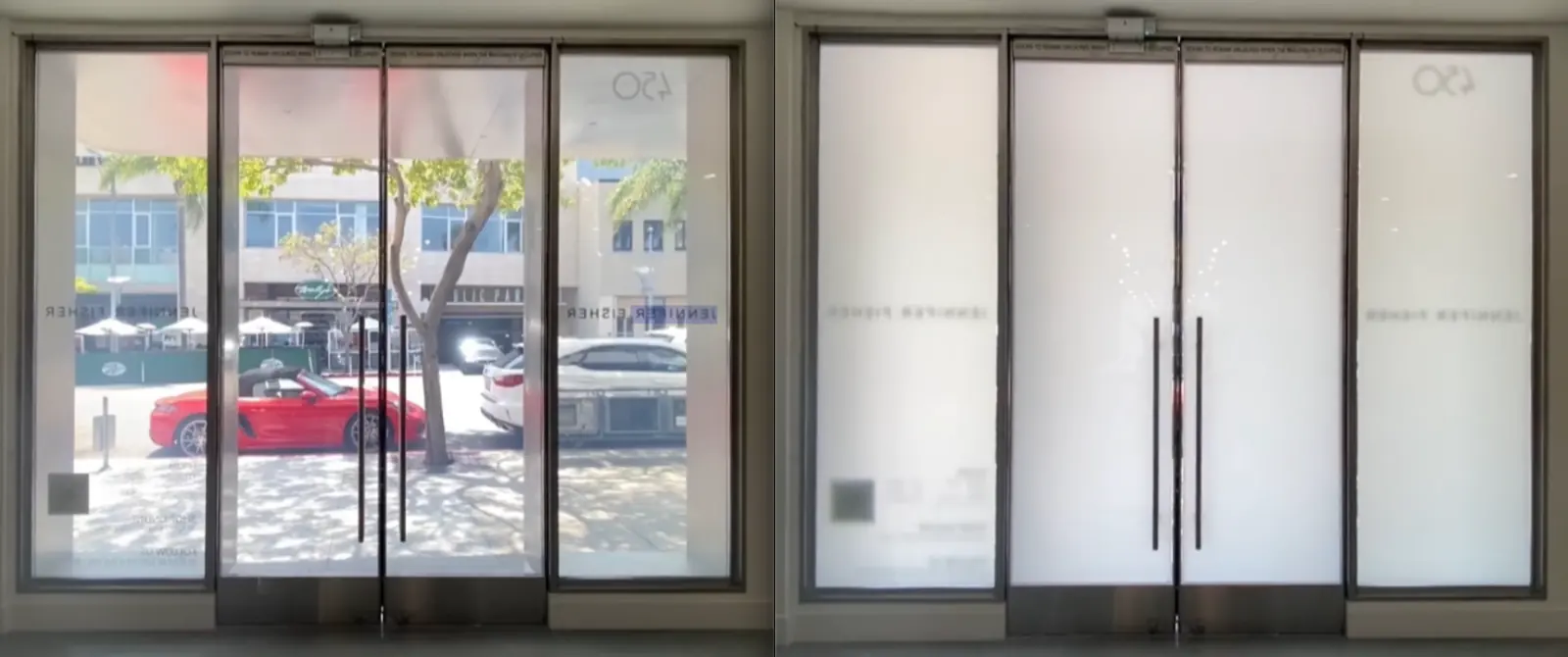
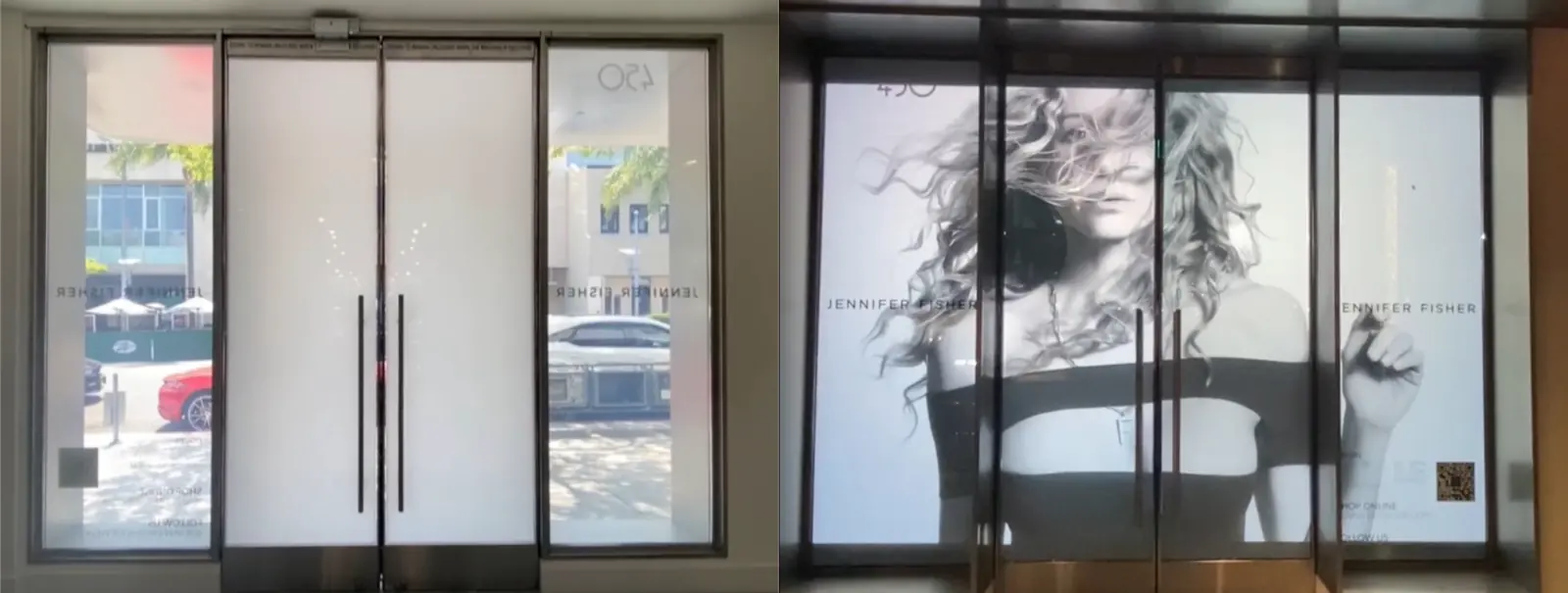
PriWatt film on the shopfront of Jennifer Fisher Jewelry, Beverly Hills
A shopfront that closes without a shutter
A jewellery shopfront has to do opposite things at opposite hours. Open, it is the display, the whole reason for glazing a frontage on a street like this one. Closed, it is a window onto an empty room that people know contains stock.
The usual answer is a roller shutter, which solves the second problem by making the street worse. Jennifer Fisher’s Beverly Hills store took a different one: about 115 square feet of PriWatt switchable film across the front door and its sidelights, fitted in two days in May 2021.
Four panels, three switches — and why not one
| On this project | |
|---|---|
| Switchable area | ≈115 sq ft |
| Panels | 4the entrance door and its sidelights |
| Switched zones | 3, independently |
| Time on site | 2 days |
| Product | PriWatt PDLC self-adhesive film, onto the existing shopfront glazing |
Three circuits over four panels is a decision, not a constraint, and the kind that costs nothing now and cannot be changed later without opening the framing. It lets the door be treated separately from the glazing beside it: a sidelight closed for a private appointment while the entrance stays legible, or the whole frontage taken opaque at closing.
Where the circuits fall on a run is the same question a glazed office wall asks. Office partitions answers it there.
Concealment is a deterrent. Resistance is a rating.
These are two different things and retail security copy runs them together constantly, so this page separates them.
What it does
Switched, the frontage is opaque and the stock is not visible from the pavement. Nothing on display after hours is a real reduction in the reason to try.
What it does not do
It is about 0.4 mm of polymer. It is not security film, it is not tested for containment or attack resistance, and it should not be bought as delay at a door.
Where the rating lives
In the glass, not in the film. If a frontage needs laminated or security glazing it still needs it, and film over the pane changes nothing about that.
The general statement of that principle is on safety glazing and code. It is the single point specifiers most often get wrong about this product, and a jewellery shopfront is not the place to get it wrong.
What a shopfront should check before ordering
- Which state the frontage holds with no power: a retail unit almost always wants opaque out of hours, and that is normal mode
- Whether the entrance door is in a location where code requires safety glazing, which is decided by the pane and not the film
- Where the wiring can leave each panel, since a shopfront frame was not designed to carry a cable
- How the zones are grouped, because that is fixed once the framing is closed
- Whether the glazing is in direct sun for part of the day, and for how long; the film’s rated range is −20 to 60 °C
The first is the one that suits retail unusually well. Normal-mode film is private with no power, so a shopfront that loses supply overnight closes itself instead of exposing the room. That is the opposite of what an office wants, and the reason the mode question is asked as a behaviour and not as a product name.
Specified on this project
PriWatt PDLC switchable film
Self-adhesive film applied to glass already in the building. Private unpowered, clear when switched.
Public spaces
Museums, retail, hospitality and lobbies, where the glass is part of the visit.
Switchable windows
Exterior glazing, where solar gain matters as much as privacy.
A project like this one
A shopfront, a display window or a showroom that has to be open to the street by day and closed to it at night. PriWatt makes the glass and the film in Pompano Beach, Florida, and quotes every project off its own drawings. Send dimensions, or a photograph with the sizes written on it. No drawings yet? Take the call instead.