Switchable “Pearls” built for the set of Stitched
Three structures that change state on cue
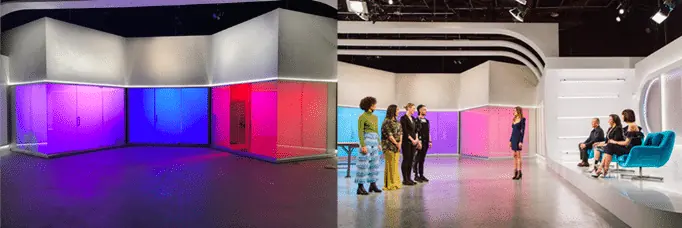
Stitched is a fashion competition series, which means a set that has to do two incompatible things: contain designers working, and become a stage when the work is judged. FORTÉ Entertainment built three structures the production called Pearls to carry both.
Over 500 square feet of PriWatt film went into them, lit from behind by the set lighting system. Installed in a couple of days.
What lighting a switched panel from behind actually does
This is the detail that makes the set work, and the same physics that makes switchable glass a projection surface. In its private state a PDLC panel does not block light. It scatters it, from liquid-crystal droplets sitting at random angles. Measured, that is 94–95% haze.
So a light source behind a switched panel is not hidden. It becomes the panel: the whole surface glows evenly, with no visible source and no hotspot. Switch it clear and the same fitting is a point of light behind glass. One structure, two completely different looks, and the change happens in under a second on a cue.
- Private state: an evenly lit luminous surface, the size of the panel
- Clear state: a transparent structure with the lighting rig visible behind it
- The transition is silent, so it can happen while cameras are rolling
- Nothing moves, so there is no flag, no diffusion frame and nothing for a grip to strike
Why productions keep coming back to this
Five of the case studies on this site are sets and studios, and the reasons are consistent across all of them: a state change is instantaneous, silent, repeatable and controlled from off camera. Nothing else in a set-dressing toolkit is all four.
A newsroom
The first US-based NHK World-Japan studio: the backdrop when the camera is on, private when it is not.
A moving wall
A four-panel sliding door on Netflix’s Blown Away, the leaves running opposite ways, wired in two days.
A set that has to look built
The chief medical officer’s office on Star Trek: Strange New Worlds, switched on camera, not for privacy.
What a production should ask before ordering
- How many times a day will it switch? A set piece cycles far more than a partition, and the published figure of over 800,000 cycles for PDLC film is a lifetime total worth checking against a season
- Which state should it hold with no power, and what does the set look like at that moment?
- Where is the transformer, and can it live somewhere a camera never sees?
- Is anything moving, and if so how does power cross the joint?
- What is the temperature under the lighting rig? The film is rated −20 to 60 °C
The last one catches people on a set more than anywhere else, because a structure wrapped in lighting is a warmer place than a partition in an office. Every published figure is in the technical reference.
Specified on this project
PriWatt PDLC switchable film
Self-adhesive film applied to glass already in the building. Private unpowered, clear when switched.
Film and television
Studios and sets, where visibility is directed rather than managed.
Specialized
Curves, cases, cleanrooms and sets.
A project like this one
A set, a stage, an installation, or any structure that has to be a lit surface one moment and transparent the next. PriWatt makes the glass and the film in Pompano Beach, Florida, and quotes every project off its own drawings. Send dimensions, or a photograph with the sizes written on it. No drawings yet? Take the call instead.