
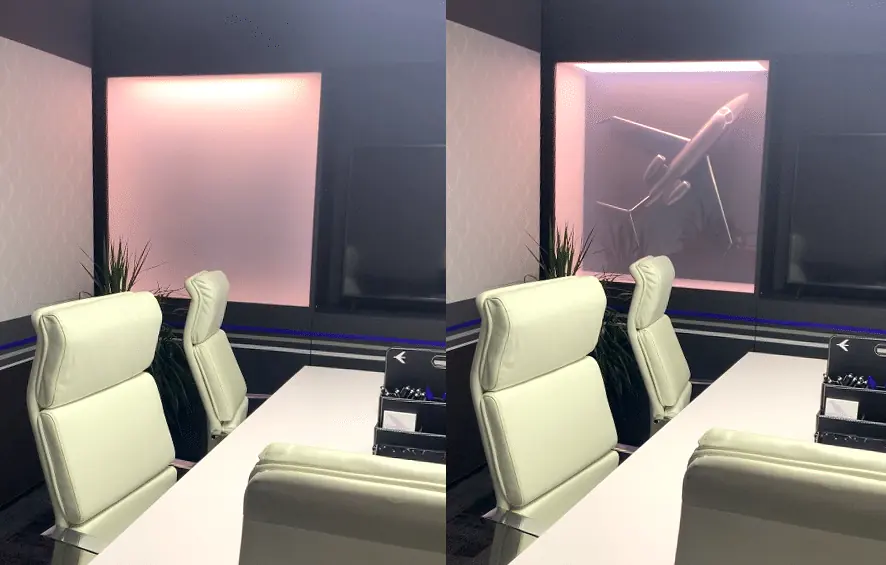
A PriWatt display cabinet built for Embraer and shipped to NBAA Las Vegas
Built in Mississauga, tested, crated, and switched on in Las Vegas
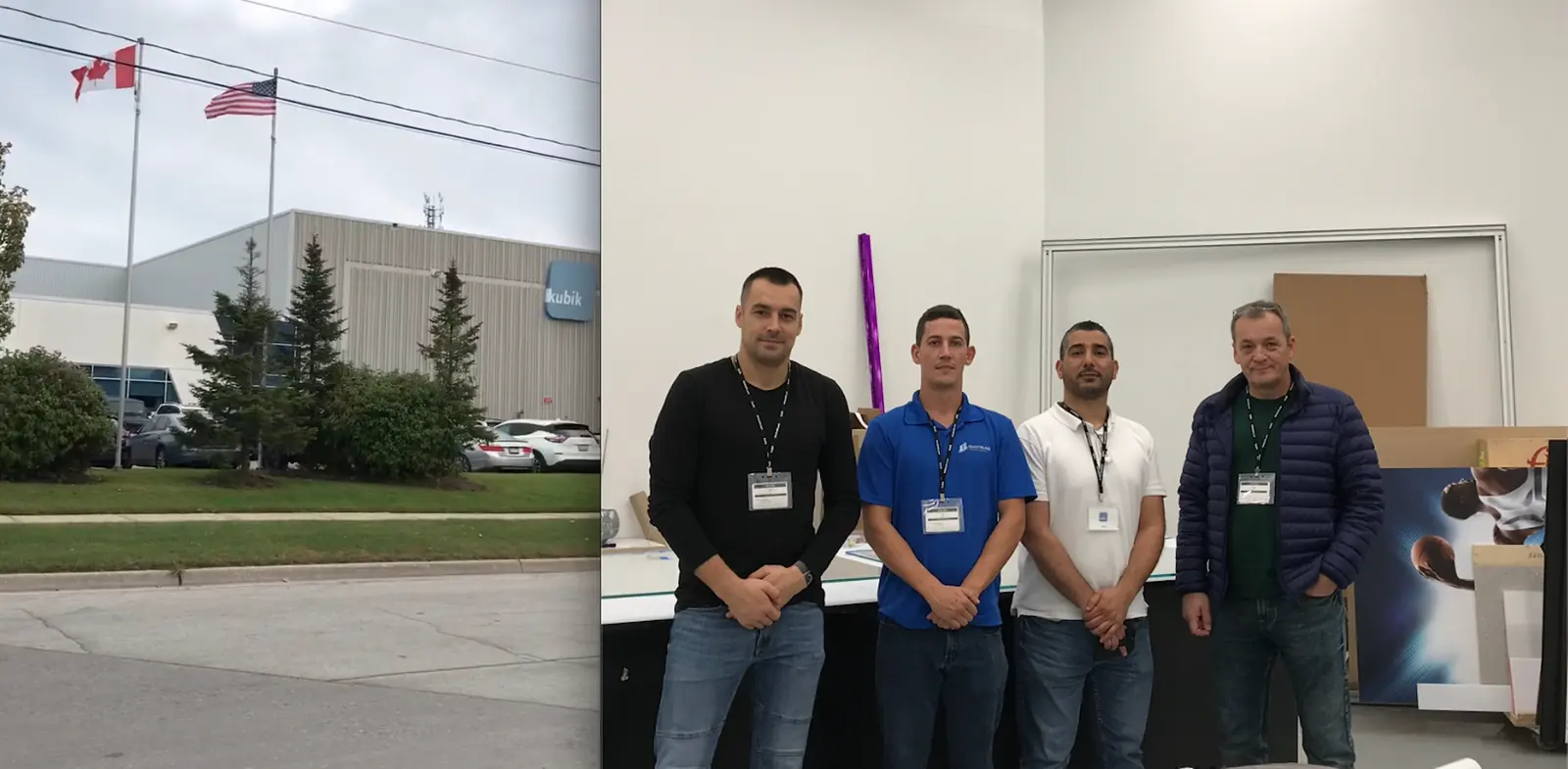
Kubik builds exhibits. For Embraer’s stand at the National Business Aviation Association convention it built a display cabinet with switchable glass in the sides: two panels that go from clear to opaque, so what is in the cabinet is revealed and not merely displayed.
What makes this project worth publishing is not the cabinet. It is that the whole assembly was made and commissioned in Ontario, taken apart, shipped two thousand miles, and put back together by a different team.
The sequence, and the whole point
| Stage | Where |
|---|---|
| Film applied to the two display panels | Kubik’s facility, Mississauga, Ontario |
| Panels installed into the cabinet’s track | Same facility, fitted into the joinery they would ship in |
| Connected to a transformer and switched | Same facility, before anything was packed |
| Each panel crated individually | For a two-thousand-mile road and air journey |
| Reconnected to the transformer on site | Las Vegas, by Kubik’s own crew, briefed beforehand |
| Shown | NBAA convention, 22 October 2019 |
The third row is the one that makes the rest possible. Testing before crating is not a formality on a job like this. It is the only opportunity to find a fault while the people who can fix it are standing next to it. A panel that does not switch on a show floor, the day before an opening, is not a repair; it is a hole in a stand.
What a switchable assembly needs in order to travel
- The electrical side has to disconnect cleanly, at a joint somebody chose, and not by pulling a tail out of a track
- Each panel crates on its own, because a busbar edge is the edge you cannot afford to knock
- The transformer travels separately and is reconnected to the same circuits, which means the circuits have to be labelled
- Whoever reconnects it is not the person who wired it, so the handover is a briefing, not an assumption
- The film’s rated temperature range is −20 to 60 °C, which a crate on a truck can reach at either end
None of that is exotic, and all of it is decided before the panels are made. It is the same discipline any switchable project needs. An exhibit simply compresses it into a week and then repeats it at the next show.
Why an exhibit reaches for switchable glass
The reveal is the mechanism
A cabinet that goes from opaque to clear at a switch turns a static display into a moment. Nothing is lifted, drawn or wheeled away.
It is also a screen
A switched panel is a 94–95% haze diffusing surface, exactly what rear projection needs, so the same cabinet can carry an image and then dissolve it.
Cycle life is the number to check
A show cabinet is switched by staff or visitors all day for several days. PriWatt publishes over 800,000 cycles for PDLC film, worth doing the arithmetic against a season of shows.
PriWatt has been used the same way in a permanent setting: the interactive display case at the Royal Ontario Museum, which visitors switch thousands of times a week, and at a product launch in Ferrari’s New York dealership.
Specified on this project
PriWatt PDLC switchable film
Self-adhesive film applied to glass already in the building. Private unpowered, clear when switched.
Specialized
Curves, cases, cleanrooms and sets.
Public spaces
Museums, retail, hospitality and lobbies, where the glass is part of the visit.
A project like this one
A trade stand, a travelling exhibit, a display case, or any switchable assembly that has to be commissioned in one place and used in another. PriWatt manufactures in Pompano Beach, Florida. Every quote is worked from the project’s own drawings, so send dimensions. A photograph with the sizes written on it does the same job. Earlier than that, book the call.