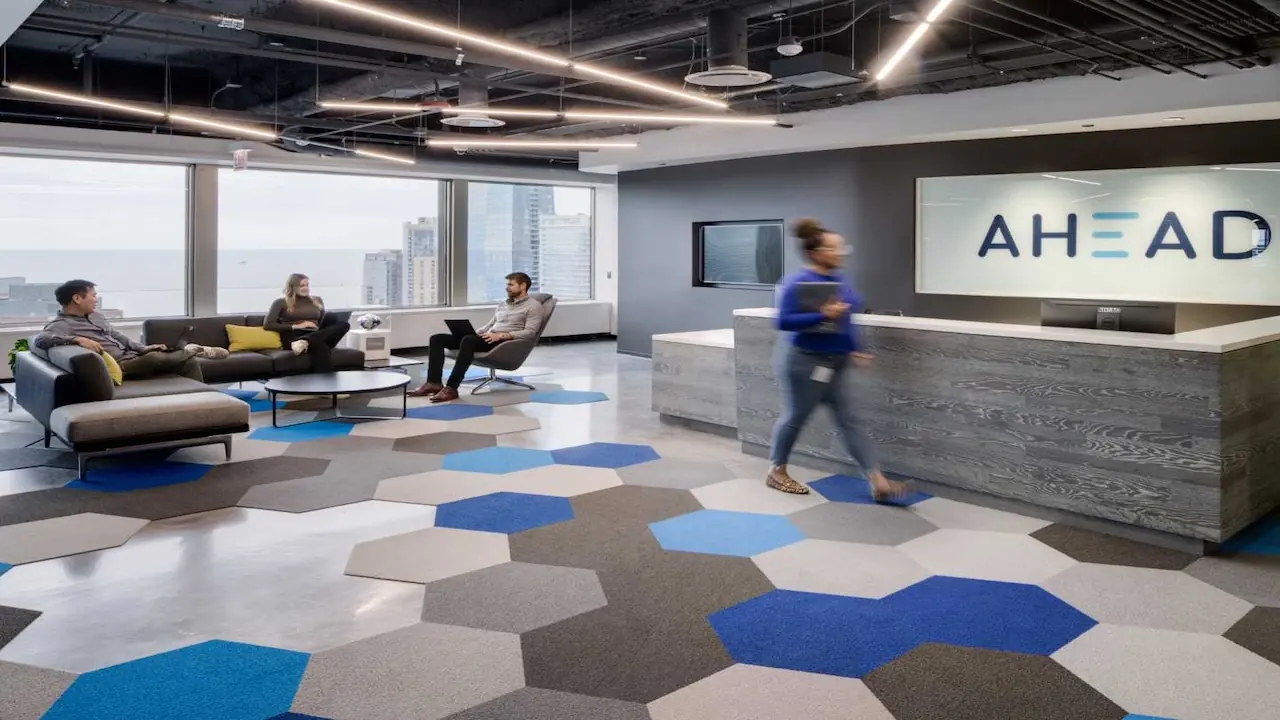
PriWatt film on the meeting-room glazing at technology consultancy AHEAD
A consultancy’s meeting rooms are where the client’s business is
AHEAD is an enterprise technology consultancy. The work is other companies’ infrastructure, their roadmaps and their problems, and most of it is discussed in a meeting room with a screen in it. A glazed one puts a client’s architecture diagram on view to the floor.
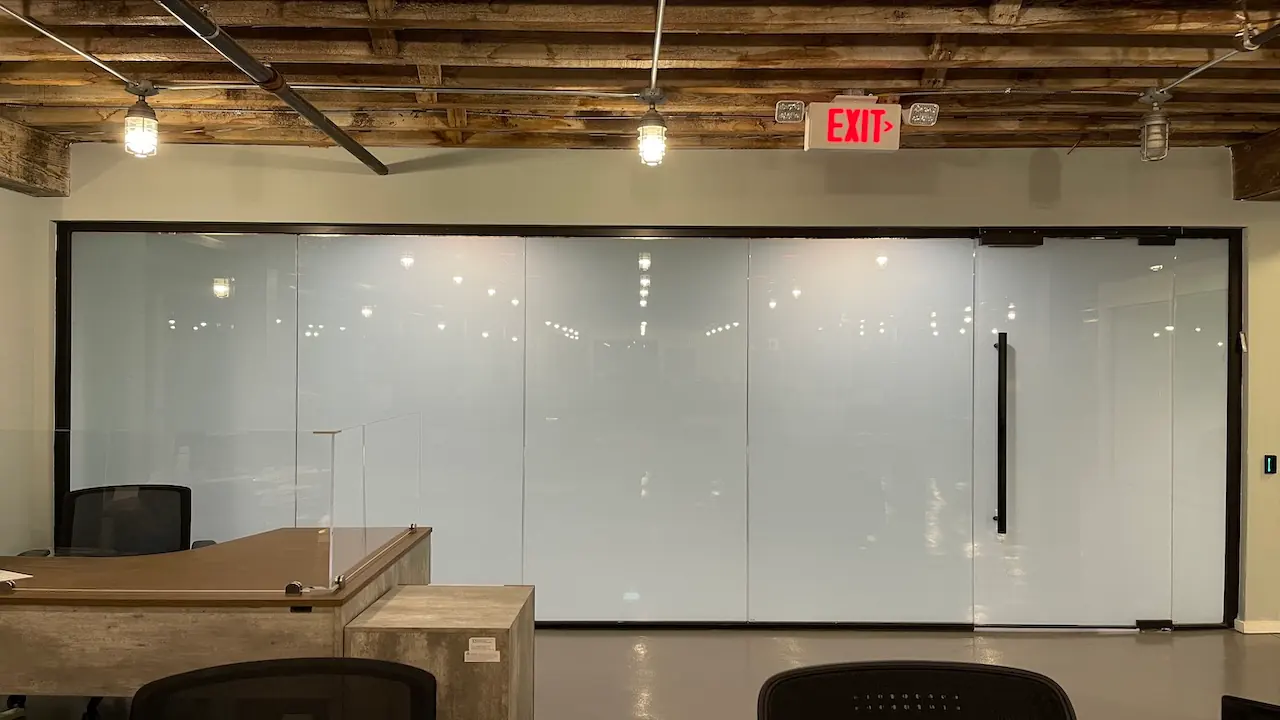
PriWatt film was applied directly to the existing partitions of the conference rooms and executive offices, and wired so the rooms can be switched from a wall plate, a remote, a phone, or the smart-office system already running the floor.
What “voice control” means, precisely
Worth being exact, because it is sold loosely. There is no radio in a PriWatt panel and no firmware. The panel is glass with a busbar, drawing a low-voltage supply, and its state is whatever that supply is doing.
So a voice assistant does not talk to the glass. It talks to the relay in the circuit, the same relay a phone app, a scene controller or a building system talks to. That is genuinely useful, and it explains why it works with platforms nobody wrote a driver for: anything that can switch a low-voltage circuit can switch a PriWatt panel.
What is in the wall
A transformer sized to the area on the circuit, and something that interrupts it. That is the whole system.
What is on the network
The relay, not the glass. So a security review of a switchable installation is a review of the control system.
What this decides
Where relays sit, and what reaches them. It is a wiring decision, made before the partitions are closed.

Why blinds were never in the running
Not appearance, though that is how it is usually put. A blind cannot be driven by anything. It has no state a system can read and no state a system can set, so it can never be part of a room booking, a scene or a policy. It depends entirely on the person nearest to it remembering.
In a consultancy that matters more than it sounds. The meeting where somebody forgot is exactly the meeting where it mattered, and nobody finds out until afterwards.
- A room can close on the booking, not on the occupant
- A floor can close on a condition: after hours, or when a particular client is on site
- The state is knowable, so it can be checked instead of assumed
- Nothing is added to the room, which on a design-led floor is why it was specified at all
Which mode a consultancy floor wants
Almost always the reverse of what gets specified. A meeting room on a collaborative floor is transparent for most of the working day and closed for an hour at a time, so the state it should hold with no power is the clear one and the panel should draw current only while the meeting is on. That is reverse mode.
Normal mode is private unpowered and clear when switched, and it is what went in here: the cheaper product and the right one where a room is closed more often than open. Both are made as film and as laminated glass; which a project wants is on glass or film.
Specified on this project
PriWatt PDLC switchable film
Self-adhesive film applied to glass already in the building. Private unpowered, clear when switched.
Offices and boardrooms
Partitions, meeting rooms and executive offices — the application this belongs to.
Office partitions
How a glazed run is built: where the joints fall, and how one transformer serves a wall.
A project like this one
A consultancy floor, a client-facing meeting suite, or an office whose rooms should close on a booking instead of on somebody remembering. PriWatt manufactures in Pompano Beach, Florida. Every quote is worked from the project’s own drawings, so send dimensions. A photograph with the sizes written on it does the same job. Earlier than that, book the call.