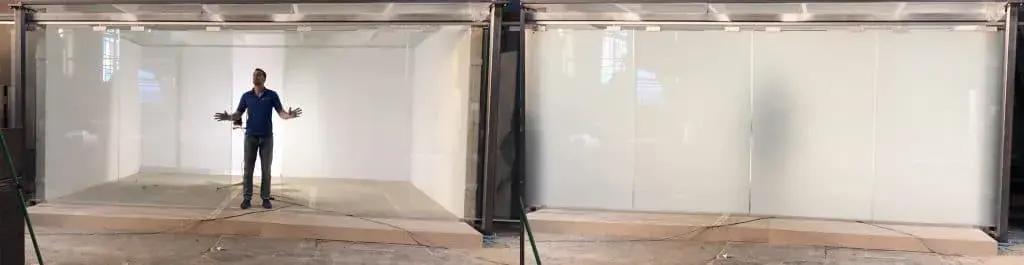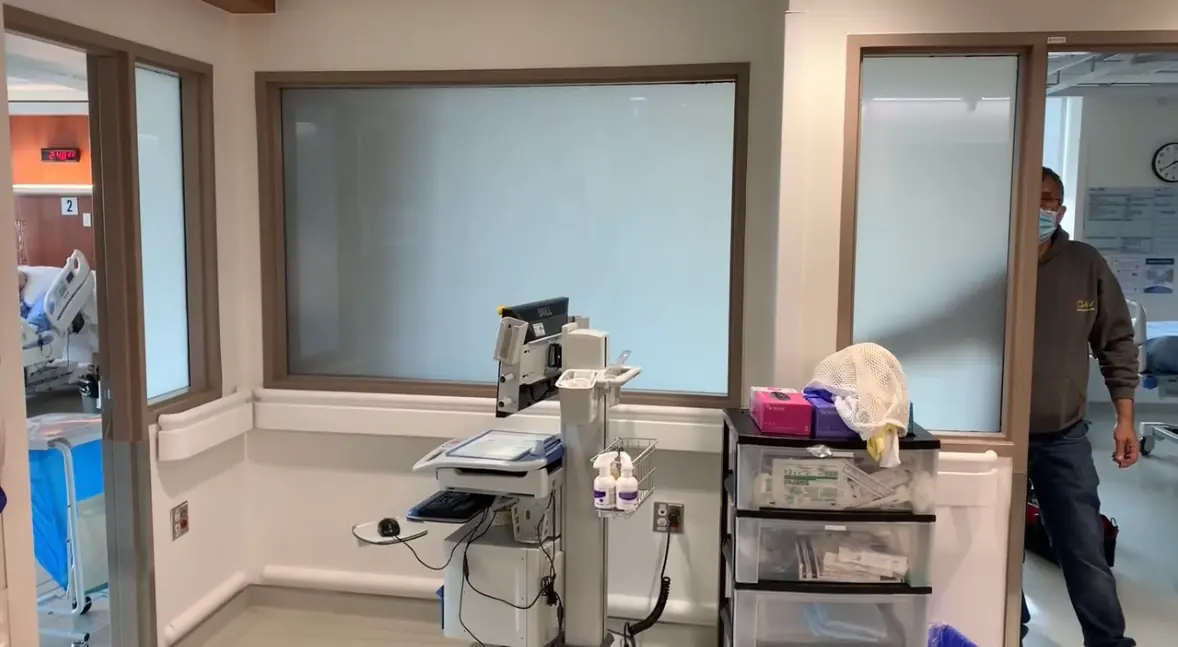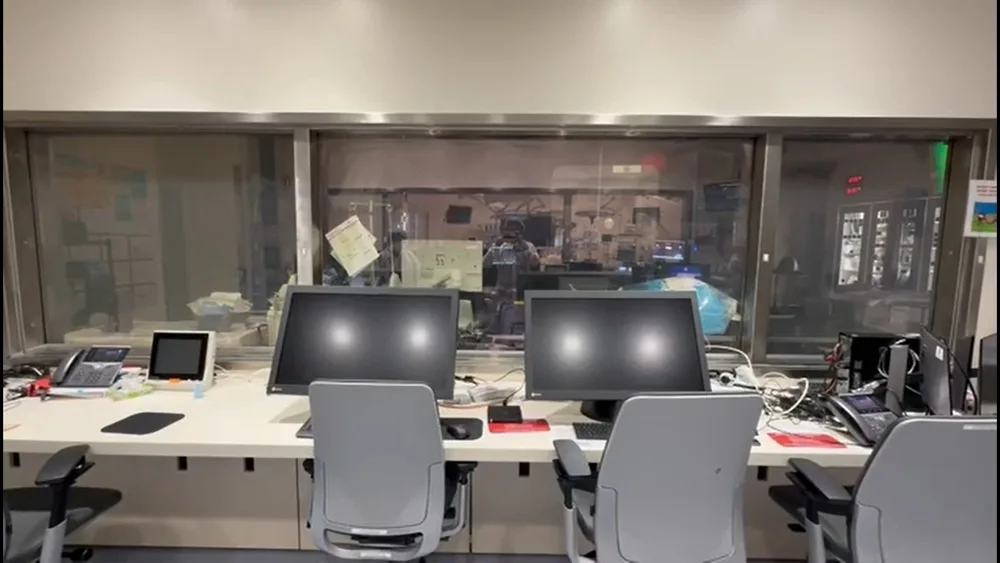

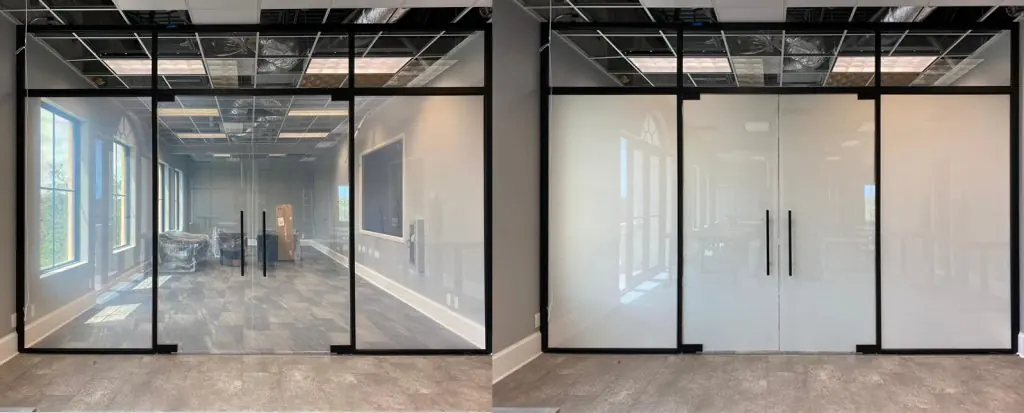
PriWatt film on the pivot doors of a chief executive’s office at Redcon1
A glass door is not a door
Redcon1 moved into a new office in which the chief executive’s room was separated from the general floor by glass doors. The doors closed. Nothing else about them worked: a glazed office with a glazed door is a room you can be seen having a conversation in, and that is the specific thing a chief executive’s office exists not to be.
112 square feet of PriWatt film went on: four panels, two of them fixed and two of them pivot doors. A couple of days.
A pivot door, and its own problem
Most of the moving-panel material on this site is about sliders and hinged leaves. A pivot is neither, and it changes where the power can go.
| Leaf type | Where the conductor crosses |
|---|---|
| Hinged | At the hingea transfer hinge carries the conductor across the joint, the tidiest of the three |
| Sliding | Along the tracka reel or coil pays out as the leaf travels, or the leaf only switches where it parks |
| Pivot | At the pivot point, top or bottom. The leaf rotates about an axis that is usually inset from the edge, so the route is through the patch fitting or the floor spring, not through a frame |
The third row is why a pivot door is worth flagging early. The pivot hardware is usually a patch fitting or a floor closer supplied by somebody else, and whether it can carry a conductor is their answer rather than the glass maker’s. Ask before the door is ordered, not after.
The general case is on doors, and the physical answers — transfer hinges, reel cables, coil wires, armoured cable, custom tracking — are set out on the home cinema project.

The transformer went in the ceiling
A small decision and a good one. The unit sits in the ceiling void where it is out of sight, and — the part that matters — where it can be got at and moved without opening a partition.
Out of the room
Nothing on a wall in an office that was designed without anything on the walls.
Reachable
A transformer is the one component that might need attention over a decade. In a ceiling void that is a tile; inside a stud wall it is a repair.
Movable
Offices get rearranged. A unit that can be relocated with the partitions is a unit that survives the next fit-out.
Where units go and how they are sized — to the area on the circuit, not to the number of panels — is on isolation transformers.
One correction worth making
The version of this case study published elsewhere describes PriWatt film as "a light polarizing matter". It is not. A PDLC panel goes private by scattering light from liquid-crystal droplets sitting at random angles — which is why the private state looks like frost rather than like a filter, and why it works as a rear-projection surface. Polarisation is a different mechanism belonging to a different technology.
The description appears on four of the source pages, so it is a house phrase rather than a slip. It is corrected wherever it appears here, because a specifier who repeats it in a submittal will be corrected by somebody less friendly.
Specified on this project
PriWatt PDLC switchable film
Self-adhesive film applied to glass already in the building. Private unpowered, clear when switched.
Switchable doors
A leaf moves, so power has to cross a joint that moves with it.
Offices and boardrooms
Partitions, meeting rooms and executive offices — the application this belongs to.
A project like this one
A glazed private office, a pivot door, or any leaf where the hardware has to carry the conductor. PriWatt manufactures in Pompano Beach, Florida. Every quote is worked from the project’s own drawings, so send dimensions. A photograph with the sizes written on it does the same job. Earlier than that, book the call.