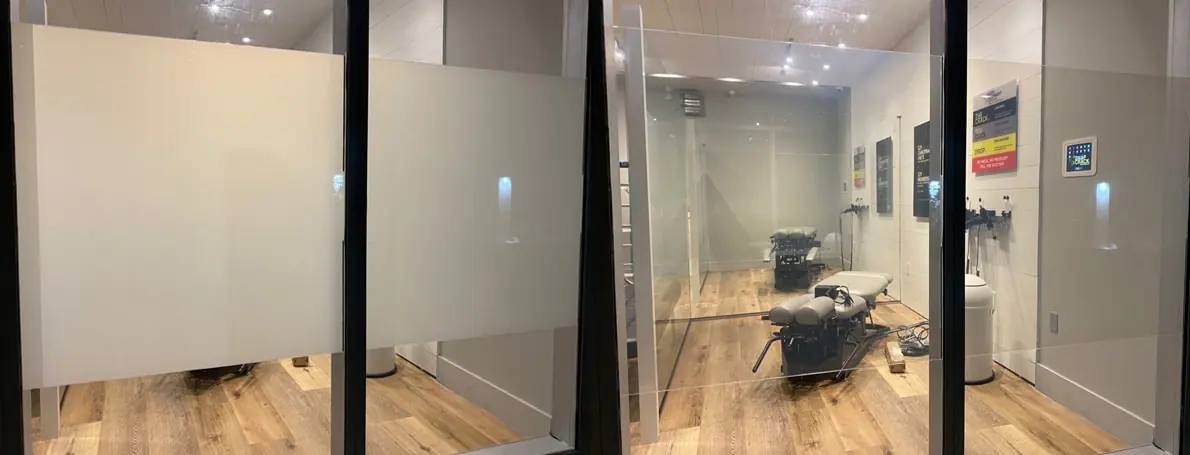
PriWatt film on a seven-foot band at the SnapCrack clinic in Brickell
Privacy at the height a patient is lying at
A chiropractic clinic is a treatment space that wants to look like a shop. The front is glazed because walk-in traffic is the business, and the treatment happens a few feet behind that glass with somebody partly undressed on a table.
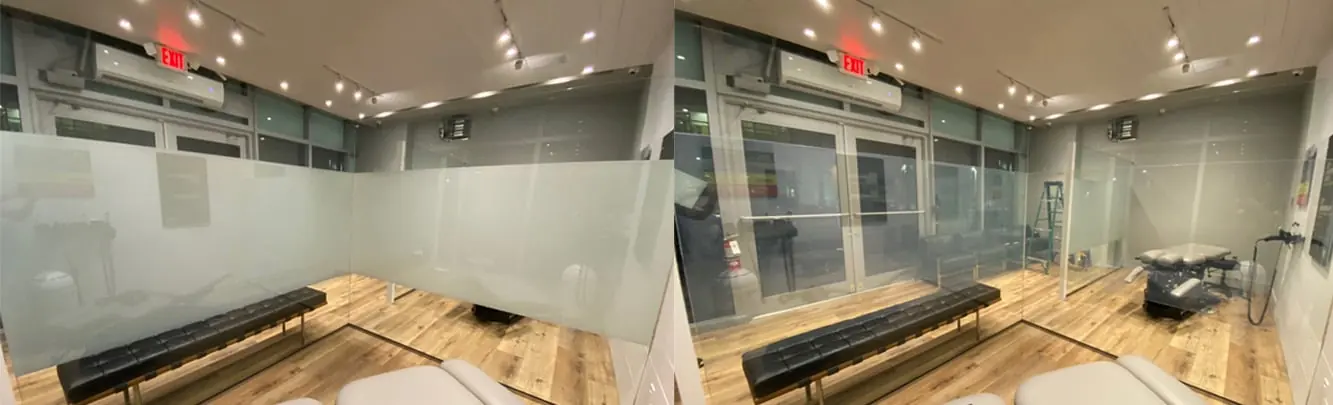
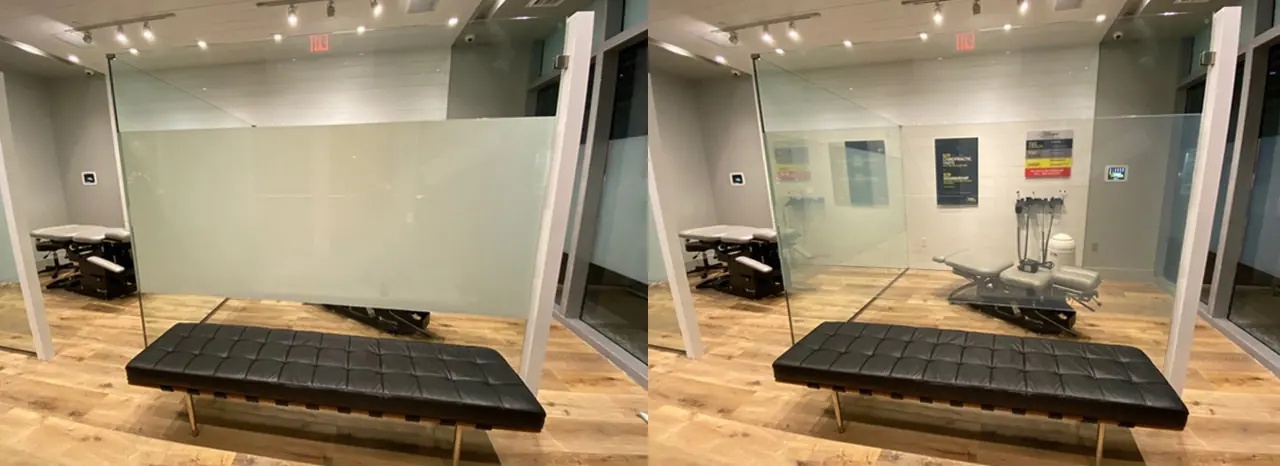
PriWatt film was applied to a seven-foot section of the panels instead of the whole of them: the band that covers standing and lying eye level, leaving the glazing above it to carry daylight into the room.
Why a band, and why seven feet
Because visual privacy is a question about sight lines, not about area. Everything a passer-by can see of a treatment happens below about seven feet; above that the glass is showing them a ceiling.
It is the same technique used at Modern HR in Los Angeles, where the reason was budget. Here the reason is design: the clinic wanted to stay bright and to read as open from the street, and a fully switched frontage would have looked shut whenever a patient was in.
- The band covers the treatment, the table and anyone standing beside it
- Daylight continues over the top, the reason the frontage is glass
- From outside the clinic still reads as open, not as closed for the afternoon
- And the same caution applies as anywhere: a band is a more exacting install, not a lesser one; it has two free edges and a line the eye reads across every panel
The electrical figures, the published ones
| Value | |
|---|---|
| Supply | 48–55 V AC from an isolation transformer |
| Draw, clear state | Under 0.5 W per sq ft |
| Draw, private state | None; normal-mode film draws only while transparent |
| Switching | Under 200 ms |
These match what PriWatt publishes, and that is why they are on this page when several other figures from the same source are not. Everything measured is in the technical reference.
Note which state costs nothing. A clinic with the band switched private all afternoon draws no power for it at all: the current is used to make the glass clear, not to make it opaque. Whether that is the right way round is the mode question, and for a treatment room the answer is usually yes.
Four things this page does not claim
It does not strengthen the glass. The version published elsewhere says the 0.4 mm layer reduces the likelihood of a break-in. It does not. This is not security film, it is tested for no such thing, and a clinic should not count it as one. The full statement is on the El Paso school page and on safety glazing and code.
It does not save energy here. Interior clinical glazing is not part of the thermal envelope and there is no solar load on it to manage.
There is no UV or infrared percentage. PriWatt publishes none, and the source pages give four different pairs of numbers for the same material.
It is not antibacterial. What is true: there is no textile in the room, and the surface is cleaned with the glazing.
Specified on this project
PriWatt PDLC switchable film
Self-adhesive film applied to glass already in the building. Private unpowered, clear when switched.
Healthcare and clinics
Observation walls, consulting rooms and imaging suites.
Switchable windows
Exterior glazing, where solar gain matters as much as privacy.
A project like this one
A clinic with a glazed frontage, a treatment room on a street, or any space that has to look open while somebody is being treated in it. PriWatt manufactures in Pompano Beach, Florida. Every quote is worked from the project’s own drawings, so send dimensions. A photograph with the sizes written on it does the same job. Earlier than that, book the call.